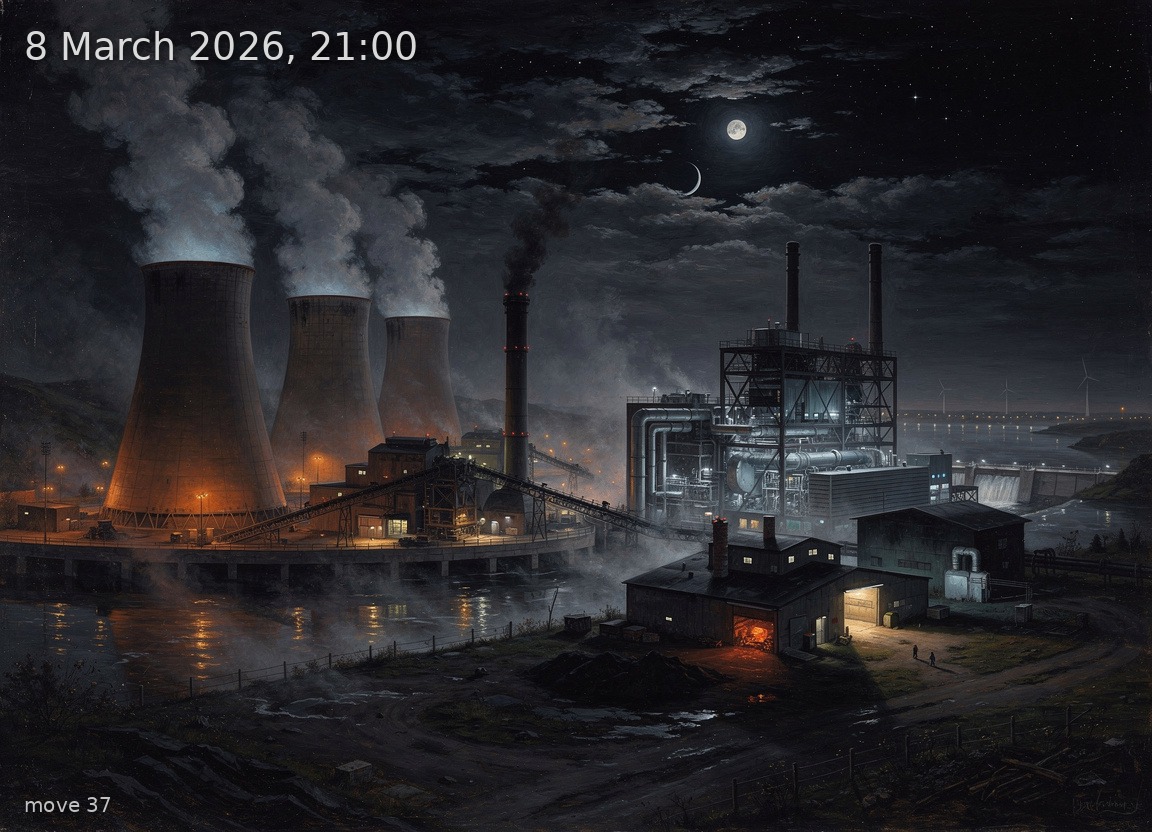
Brown coal, onshore wind, gas, and hard coal power Germany's evening peak as zero solar drives prices above 127 EUR/MWh.
Back
Generation mix
Wind onshore 32%
Wind offshore 3%
Solar 0%
Biomass 9%
Hydro 3%
Natural gas 14%
Hard coal 11%
Brown coal 26%
48%
Renewable share
16.3 GW
Wind (on + offshore)
0.0 GW
Solar
46.0 GW
Total generation
-2.5 GW
Net import
127.4 €/MWh
Day-ahead price
9.2°C / 4 km/h
Temp / Wind speed
Open-Meteo, Kassel (51.3°N 9.5°E)
29% / 0.0 W/m²
Cloud cover / Radiation
372
gCO₂/kWh
Image prompt
Brown coal 12.1 GW dominates the left third of the scene as a massive lignite power station complex with four hyperbolic cooling towers emitting thick white-grey steam plumes rising into the black night sky, lit from below by orange sodium floodlights reflecting off wet concrete. Onshore wind 14.8 GW spans the right half as dozens of tall three-blade turbines on lattice and tubular steel towers stretching across rolling dark hills, their red aviation warning lights blinking in staggered rhythms, blades barely turning in the light 3.5 km/h breeze. Natural gas 6.6 GW appears centre-right as a compact CCGT facility with twin exhaust stacks and a slender rectangular cooling unit, blue-white industrial lighting illuminating its steel framework. Hard coal 5.2 GW sits centre-left as a coal-fired plant with a single large chimney trailing thin smoke, conveyor belts visible under yellow lights. Biomass 4.3 GW is rendered as a mid-ground wood-chip-fired CHP plant with a modest stack and a glowing furnace visible through an open bay door. Hydro 1.4 GW appears as a small dam structure in the far background, water shimmering faintly under floodlights. Offshore wind 1.5 GW is suggested by distant tiny red lights on the far horizon line. The sky is completely dark—deep black to navy, no twilight, no sky glow—it is 21:00 in March. A partial clearing at 29% cloud cover reveals a scattering of cold stars and a faint crescent moon between drifting cloud banks. The atmosphere feels heavy and oppressive, befitting the high electricity price: haze and industrial steam create a brooding, claustrophobic canopy over the landscape. Early spring vegetation—bare deciduous trees with just the first buds, damp brown-green grass at 9.2°C—frames the foreground. A small town's lit windows glow warmly in the middle distance. Highly detailed oil painting in the tradition of 19th-century German Romantic landscape painters such as Caspar David Friedrich and Carl Blechen, with rich impasto brushwork, deep chiaroscuro contrasts between the artificial industrial light and the enveloping darkness, atmospheric depth created through layered mist and steam, and meticulous engineering accuracy in every turbine nacelle, cooling tower, and exhaust stack. No text, no labels.