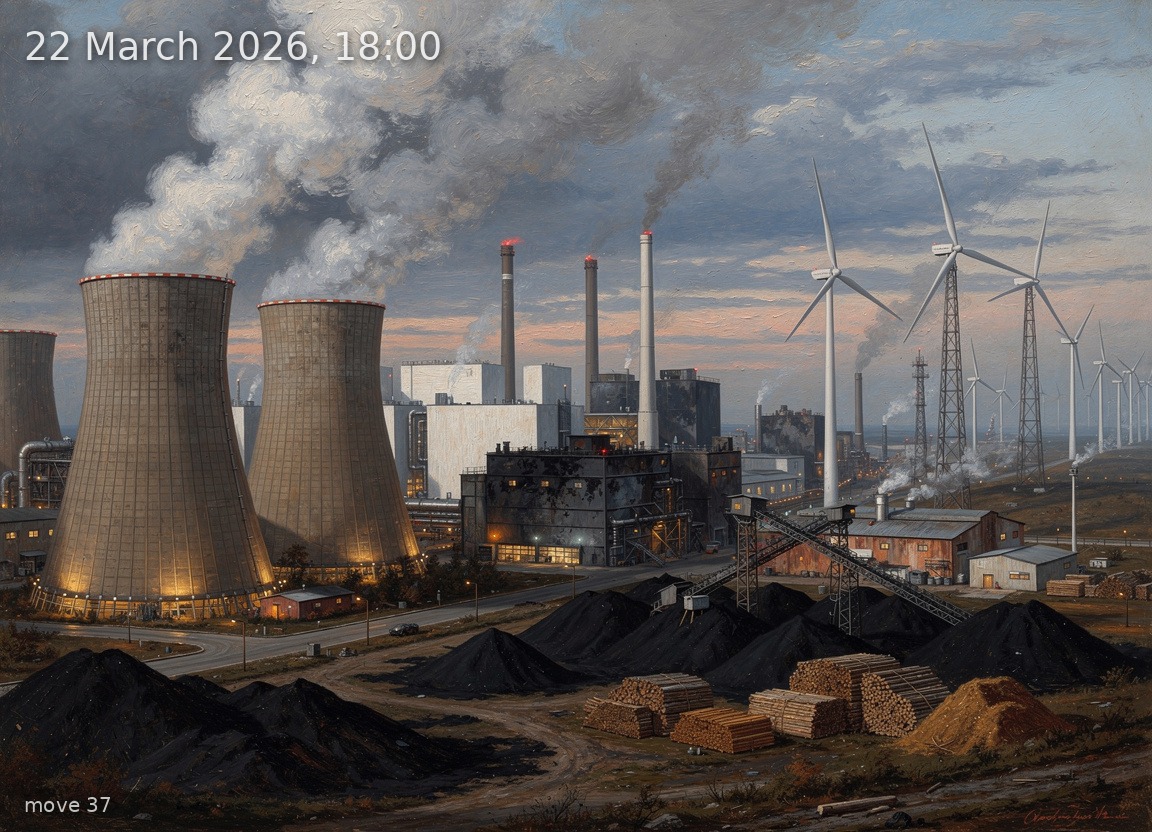
Brown coal, gas, and hard coal dominate evening generation as solar fades and 8.3 GW of net imports fill the gap.
Back
Generation mix
Wind onshore 19%
Wind offshore 0%
Solar 1%
Biomass 12%
Hydro 3%
Natural gas 17%
Hard coal 14%
Brown coal 33%
36%
Renewable share
7.0 GW
Wind (on + offshore)
0.5 GW
Solar
36.9 GW
Total generation
-8.3 GW
Net import
174.2 €/MWh
Day-ahead price
12.6°C / 8 km/h
Temp / Wind speed
Open-Meteo, Kassel (51.3°N 9.5°E)
0% / 68.2 W/m²
Cloud cover / Radiation
456
gCO₂/kWh
Image prompt
Brown coal 12.1 GW dominates the left third of the scene as a dense cluster of massive hyperbolic cooling towers with thick white-grey steam plumes rising into the sky; natural gas 6.3 GW occupies the centre-left as a row of modern CCGT power plants with tall slender exhaust stacks venting thin heat shimmer; hard coal 5.1 GW appears centre-right as blocky dark industrial boiler houses with conveyor belts and stockpiles of black coal; onshore wind 6.9 GW spans the right quarter as a line of tall three-blade turbines on lattice and tubular towers, blades turning slowly in light wind; biomass 4.6 GW sits in the middle distance as several wood-chip-fired plants with modest chimneys and stacked timber yards; hydro 1.2 GW appears as a small concrete dam with spillway in a river valley at far right; solar 0.5 GW is barely visible as a tiny cluster of aluminium-framed crystalline silicon panels catching the last fading rays at ground level near the turbines. The sky is a dusk scene at 18:00 in late March: a rapidly fading orange-red glow clings to the lower horizon in the west, the upper sky deepening from steel blue to near-indigo, the first evening stars faintly emerging. The atmosphere is heavy and oppressive, conveying the strain of 174 EUR/MWh prices—low haze hangs across the industrial landscape, the steam plumes from brown coal towers merge with darkening clouds, creating a brooding, weighty ceiling. Temperature is mild at 12.6°C; early spring vegetation shows fresh pale-green buds on scattered birch and willow trees in the foreground, with brown-green meadow grass. Cloud cover is zero—the sky is clear but the industrial haze creates its own murky veil. Light wind barely stirs the turbine blades. Overhead high-voltage transmission lines on steel lattice pylons cross the scene, symbolizing the import flows. Rendered as a highly detailed oil painting in the tradition of 19th-century German Romantic landscape painters—rich, saturated colour with visible impasto brushwork, dramatic atmospheric depth reminiscent of Caspar David Friedrich meeting industrial sublime, meticulous engineering accuracy on every turbine nacelle, cooling tower contour, and exhaust stack. No text, no labels.