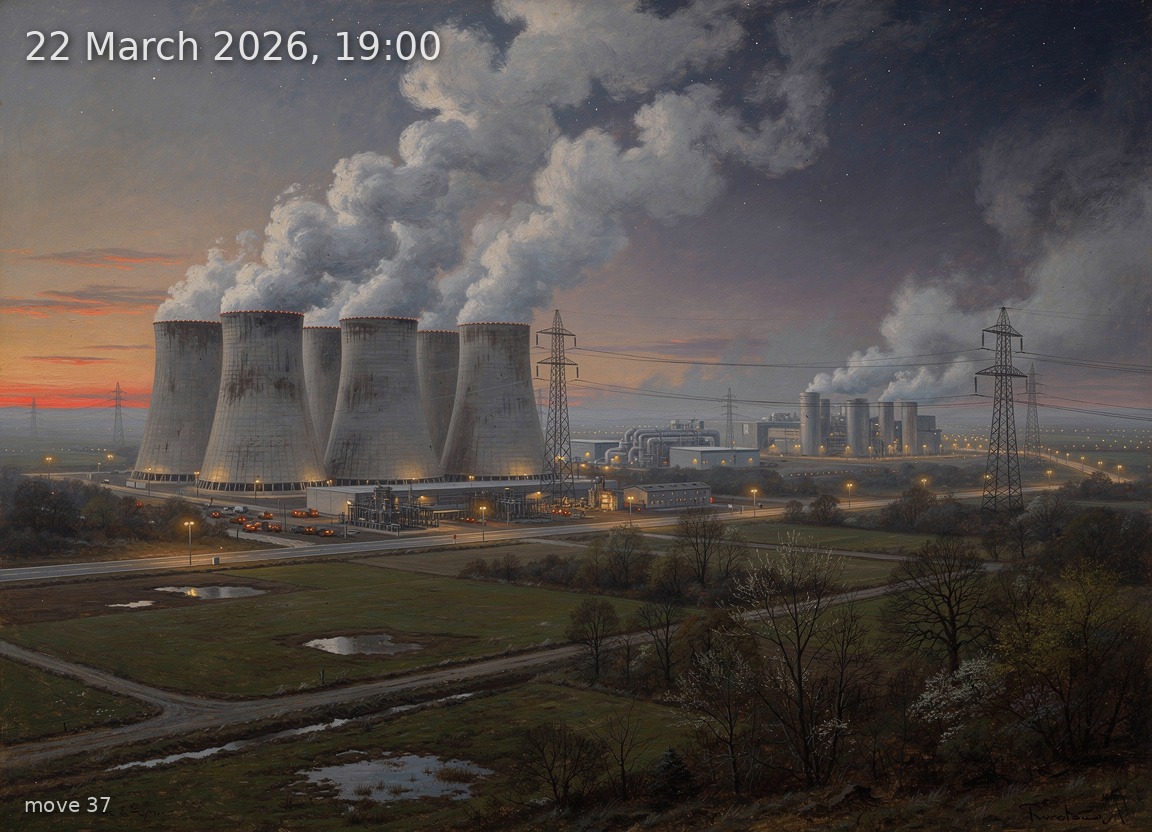
Brown coal, hard coal, and gas dominate as solar drops to zero and 12.5 GW of net imports fill the evening gap.
Back
Generation mix
Wind onshore 22%
Wind offshore 1%
Biomass 12%
Hydro 4%
Natural gas 17%
Hard coal 13%
Brown coal 32%
38%
Renewable share
8.9 GW
Wind (on + offshore)
0.0 GW
Solar
39.0 GW
Total generation
-12.5 GW
Net import
173.4 €/MWh
Day-ahead price
11.1°C / 6 km/h
Temp / Wind speed
Open-Meteo, Kassel (51.3°N 9.5°E)
0% / 3.0 W/m²
Cloud cover / Radiation
443
gCO₂/kWh
Image prompt
Brown coal 12.5 GW dominates the left third of the scene as a massive cluster of hyperbolic cooling towers with thick white-grey steam plumes rising into the dusk sky; natural gas 6.5 GW fills the centre-left as a row of compact CCGT plants with tall single exhaust stacks venting thin heat shimmer; hard coal 5.2 GW appears centre-right as a blocky coal-fired station with conveyor belts and a broad smokestack; onshore wind 8.7 GW spans the right third as a line of three-blade turbines on lattice towers along a ridge, their rotors barely turning in the light breeze; biomass 4.6 GW appears as a modest wood-chip-fed CHP facility with a small plume near the wind turbines; hydro 1.4 GW is represented by a small dam and powerhouse visible in a valley in the far right background; offshore wind 0.2 GW is a faint silhouette of two turbines on the far horizon. The sky is a late-dusk scene at 19:00 in March — the last thin band of orange-red light clings to the western horizon, with the sky above rapidly deepening to indigo and near-black overhead; first stars emerging. The atmosphere feels heavy and oppressive, hazy with industrial vapour reflecting the amber glow of sodium streetlights that have switched on along roads connecting the facilities. The landscape is flat central German terrain with early spring — bare deciduous trees just beginning to bud, dull green-brown fields, patches of mud. Temperature is mild at 11°C, no frost. The air is still, smoke and steam rise almost vertically. High-voltage transmission lines on steel lattice pylons cross the entire scene, symbolizing the heavy import flows. Highly detailed oil painting in the tradition of 19th-century German Romantic landscape painters — rich, brooding colour palette of amber, slate, indigo, and charcoal, visible impasto brushwork, atmospheric depth and chiaroscuro. Each energy technology rendered with meticulous engineering accuracy: turbine nacelles and three-blade rotors, aluminium-framed structures, lignite hyperbolic cooling towers with realistic concrete texture and condensation plumes, gas CCGT exhaust stacks with heat distortion. The scene conveys the monumental industrial weight of an evening peak powered overwhelmingly by fossil fuels. No text, no labels.