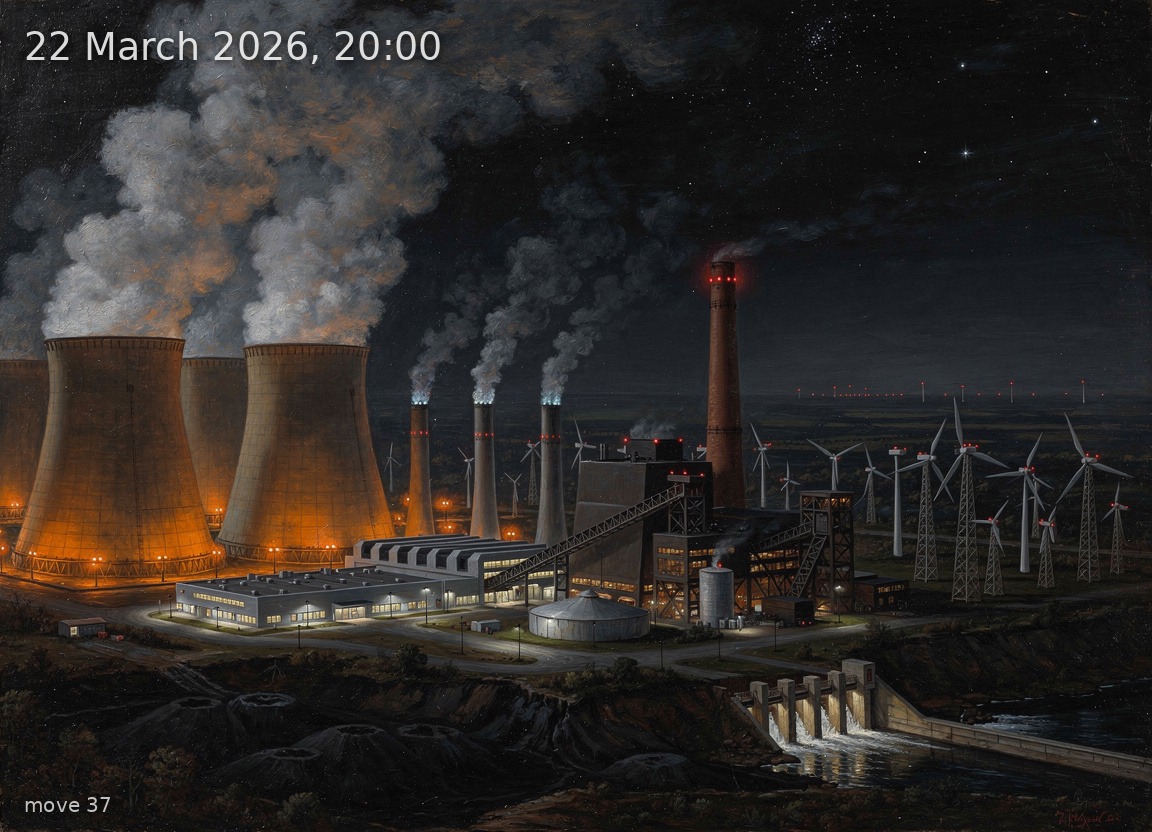
Brown coal (12.7 GW) and hard coal (5.2 GW) dominate a windless, post-sunset German grid at 164.7 EUR/MWh.
Back
Generation mix
Wind offshore 2%
Hard coal 29%
Brown coal 70%
2%
Renewable share
0.3 GW
Wind (on + offshore)
0.0 GW
Solar
18.1 GW
Total generation
+18.1 GW
Net export
164.7 €/MWh
Day-ahead price
9.1°C / 4 km/h
Temp / Wind speed
Open-Meteo, Kassel (51.3°N 9.5°E)
0% / 0.0 W/m²
Cloud cover / Radiation
787
gCO₂/kWh
Records
#1
Coal Hour
#1
Fossil Hour
Image prompt
Brown coal 12.7 GW dominates the scene as a vast complex of hyperbolic cooling towers stretching across the left two-thirds of the composition, their massive concrete shells venting thick white steam plumes into the night sky, lit from below by amber sodium-vapor industrial lighting; hard coal 5.2 GW occupies the right third as a cluster of rectangular coal-fired boiler houses with tall tapered chimneys trailing thinner smoke, illuminated by harsh white floodlights on their gantries and conveyor belts carrying dark fuel. The time is 20:00 in March — the sky is completely black, no twilight remains, a deep navy-to-black firmament with faint cold stars visible between the rising steam columns. No wind turbines are visible, no solar panels — the air is perfectly still, and the steam plumes rise vertically without deflection, emphasizing the windless calm. The atmosphere is heavy and oppressive, reflecting the high electricity price: a faint ochre industrial haze hangs low over the facilities, sodium lights casting long amber reflections on wet pavement and cooling ponds in the foreground. Early spring vegetation is sparse — bare deciduous trees with just the first pale buds stand as dark silhouettes at the margins. The landscape is flat central German lowland. Rendered as a highly detailed oil painting in the tradition of 19th-century German Romantic landscape masters — rich, dark palette of umber, amber, slate-blue, and ivory; visible confident brushwork in the steam and sky; meticulous engineering accuracy in the cooling tower geometries, boiler house structures, coal conveyors, and chimney stacks; atmospheric depth achieved through layers of haze and light. No text, no labels.