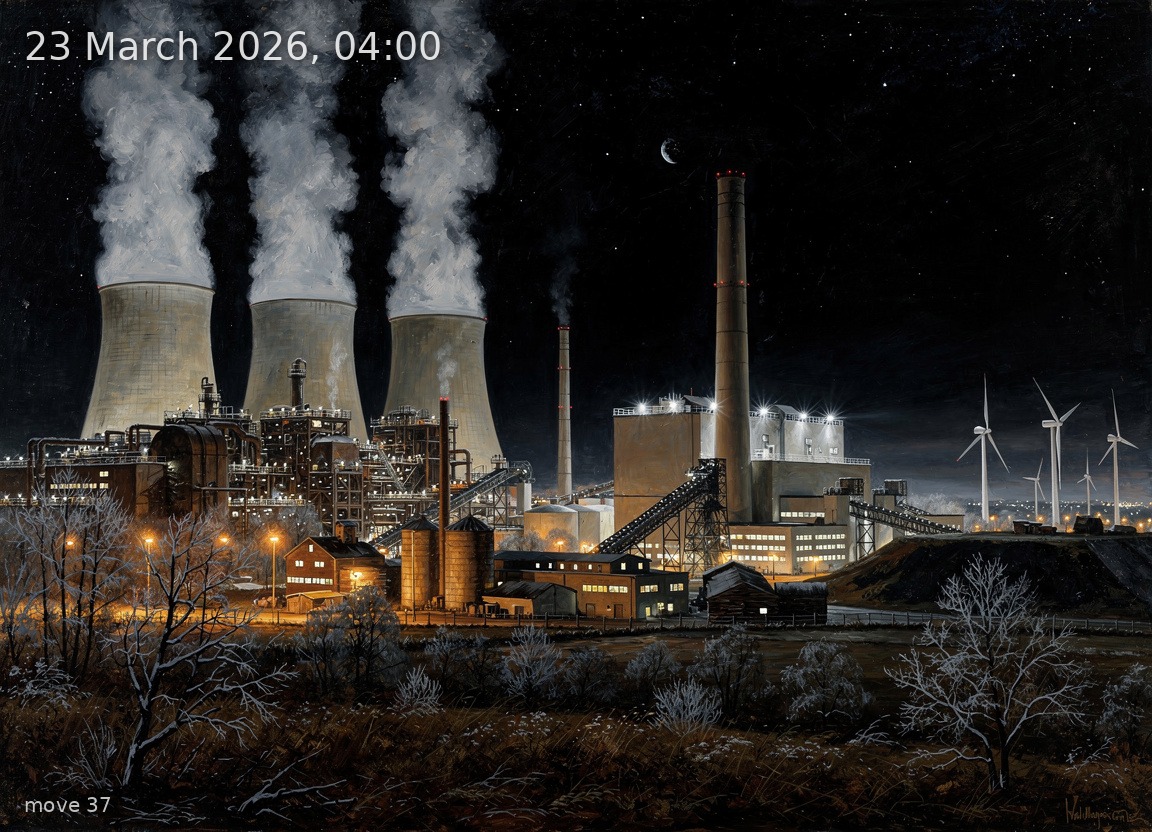
Brown coal dominates at 12.8 GW as near-zero wind and no solar force heavy thermal dispatch on a cold, calm night.
Back
Generation mix
Wind onshore 5%
Wind offshore 0%
Solar 0%
Biomass 13%
Hydro 3%
Natural gas 22%
Hard coal 16%
Brown coal 40%
21%
Renewable share
1.6 GW
Wind (on + offshore)
0.0 GW
Solar
31.5 GW
Total generation
+31.5 GW
Net export
138.3 €/MWh
Day-ahead price
0.6°C / 2 km/h
Temp / Wind speed
Open-Meteo, Kassel (51.3°N 9.5°E)
0% / 0.0 W/m²
Cloud cover / Radiation
561
gCO₂/kWh
Records
#2
Coal Hour
Image prompt
Brown coal 12.8 GW dominates the left third of the scene as a massive lignite power station complex with four towering hyperbolic cooling towers billowing thick white steam plumes into the black night sky; natural gas 7.0 GW occupies the centre-left as two compact CCGT plants with tall single exhaust stacks emitting thin hot vapour, lit from below by orange sodium lamps; hard coal 5.1 GW appears centre-right as a large coal-fired station with a single enormous smokestack and conveyor belts faintly visible under floodlights; biomass 4.1 GW is rendered as a cluster of smaller industrial facilities with wood-chip silos and modest chimneys glowing warmly in the middle distance; wind onshore 1.6 GW appears as a handful of three-blade turbines on a distant ridge to the far right, their rotors nearly motionless in the dead-calm air, red aviation warning lights blinking; hydro 1.0 GW is suggested by a small dam and reservoir in the far background valley, with a faint security light at its base; wind offshore 0.1 GW is a single barely-visible turbine silhouette on the far horizon. The time is 04:00 — complete darkness, deep black sky with scattered cold stars visible through clear skies (0% cloud cover), no twilight, no sky glow. The air is near-freezing at 0.6°C: frost coats bare-branched late-winter trees and dormant brown grass in the foreground. The atmosphere is heavy and oppressive despite clear skies, reflecting the high electricity price — a faint industrial haze hangs at low altitude, lit from beneath by amber and harsh white industrial lighting. The landscape is flat central German lowland. Steam from the cooling towers rises vertically in the still air, massive white columns against the black sky. Style: highly detailed oil painting in the tradition of 19th-century German Romantic landscape painters — rich, deep colour palette dominated by blacks, deep navy blues, amber industrial glow and ghostly white steam; visible impasto brushwork; atmospheric depth with layers receding into darkness; meticulous engineering detail on every turbine nacelle, cooling tower, exhaust stack, and conveyor system; the scene evokes both the sublime grandeur and the somber weight of industrial power at night. No text, no labels.