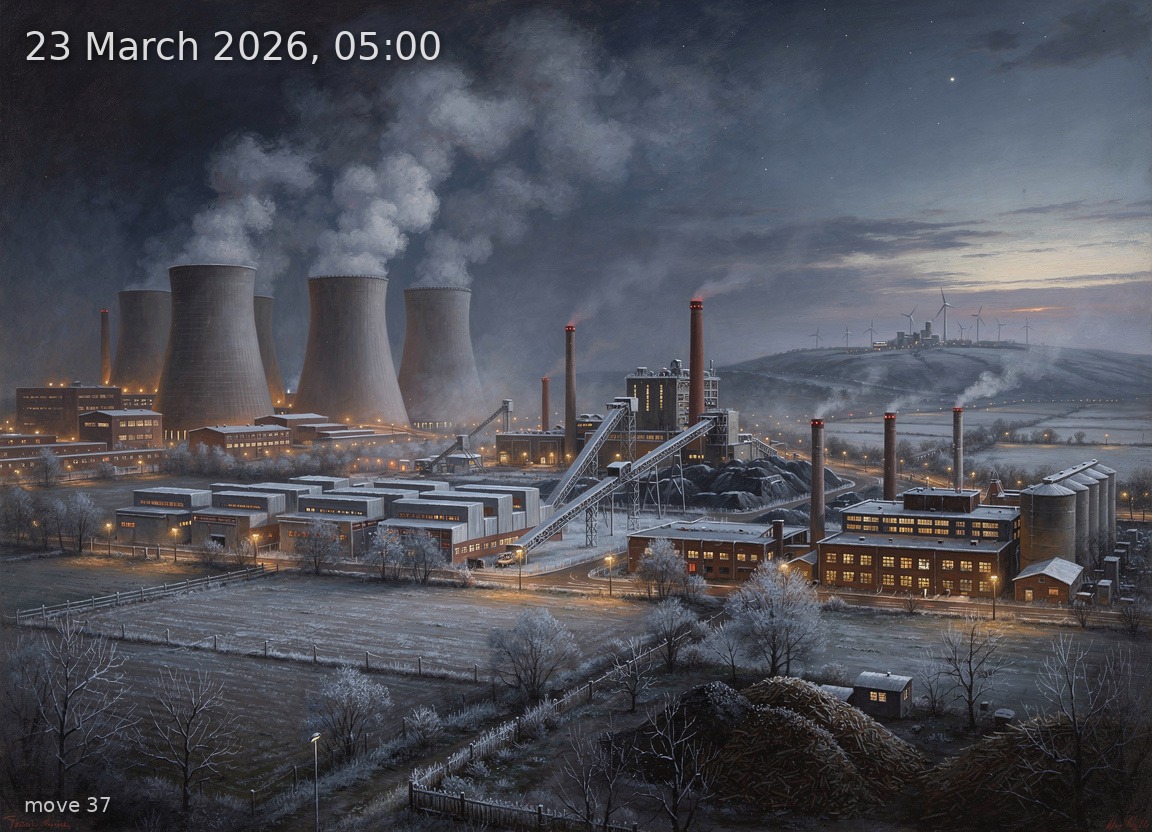
Brown coal, gas, and hard coal dominate at 5 AM as cold, calm, dark conditions leave renewables at 22%.
Back
Generation mix
Wind onshore 5%
Wind offshore 1%
Solar 0%
Biomass 13%
Hydro 3%
Natural gas 22%
Hard coal 16%
Brown coal 40%
22%
Renewable share
1.9 GW
Wind (on + offshore)
0.0 GW
Solar
31.8 GW
Total generation
+31.8 GW
Net export
155.7 €/MWh
Day-ahead price
-0.9°C / 3 km/h
Temp / Wind speed
Open-Meteo, Kassel (51.3°N 9.5°E)
56% / 0.0 W/m²
Cloud cover / Radiation
557
gCO₂/kWh
Records
#3
Coal Hour
Image prompt
Brown coal 12.8 GW dominates the left third of the scene as a vast complex of hyperbolic cooling towers with thick white steam plumes rising into the dark sky; natural gas 7.0 GW fills the centre-left as rows of compact CCGT plants with slender exhaust stacks emitting heat shimmer and faint orange-lit exhaust; hard coal 5.1 GW appears centre-right as a cluster of large industrial boiler houses with conveyor belts and stockpiles, chimney stacks glowing at their tips; biomass 4.1 GW occupies the right-centre as a group of wood-chip-fed CHP plants with modest stacks and warm amber-lit windows; wind onshore 1.7 GW appears as a small cluster of three-blade turbines on a distant ridge, rotors barely turning; hydro 1.0 GW is a small dam structure at the far right edge with faint floodlights on spillway; wind offshore 0.2 GW is a barely visible pair of turbines on a far horizon line. Time is 05:00 pre-dawn in late March: the sky is deep blue-grey with the faintest pale hint of light on the eastern horizon, no direct sunlight, stars still faintly visible overhead. The landscape is flat central German terrain with frost-covered bare fields and leafless trees, temperature below freezing with visible frost on metal structures and rime on railings. The atmosphere is heavy and oppressive — low haze and industrial steam create a dense, weighty ceiling that presses down on the scene, reflecting the sodium-orange glow of facility lights. Sodium streetlamps line an access road in the foreground. No solar panels anywhere. Highly detailed oil painting in the tradition of 19th-century German Romantic landscape painters — Caspar David Friedrich's brooding atmosphere merged with meticulous industrial realism — rich dark blues, deep oranges from artificial light, visible impasto brushwork, atmospheric depth and haze, correct engineering details on all turbine nacelles, cooling tower geometry, and CCGT stacks. No text, no labels.