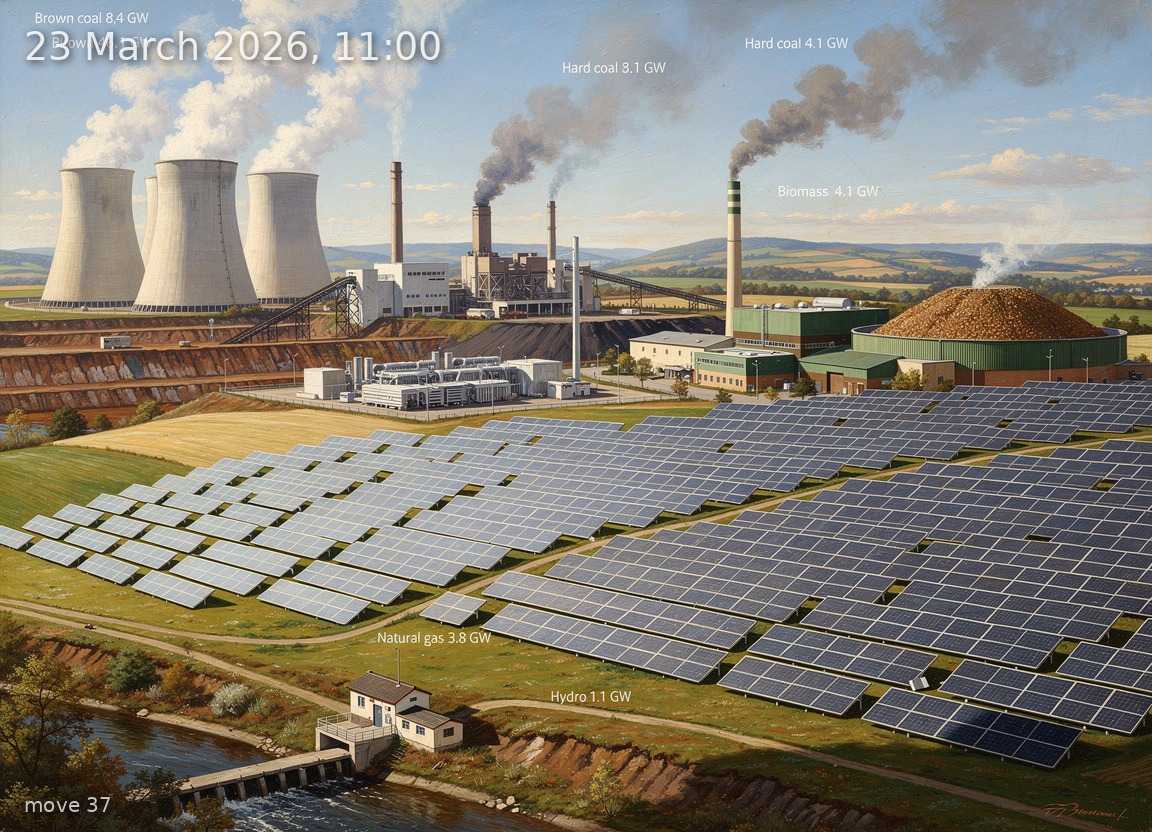
Solar at 46 GW leads a 76% renewable mix, backed by 16 GW of fossil thermal under near-calm, clear skies.
Back
Generation mix
Wind onshore 1%
Wind offshore 0%
Solar 67%
Biomass 6%
Hydro 2%
Natural gas 5%
Hard coal 6%
Brown coal 12%
76%
Renewable share
1.0 GW
Wind (on + offshore)
46.1 GW
Solar
68.6 GW
Total generation
+68.6 GW
Net export
48.1 €/MWh
Day-ahead price
10.4°C / 2 km/h
Temp / Wind speed
Open-Meteo, Kassel (51.3°N 9.5°E)
30% / 401.0 W/m²
Cloud cover / Radiation
172
gCO₂/kWh
Image prompt
Solar 46.1 GW dominates the scene as a vast expanse of crystalline silicon photovoltaic panels stretching across rolling central German farmland, covering roughly two-thirds of the composition, their aluminium frames glinting under bright late-morning spring sunlight. Brown coal 8.4 GW appears at the left as a cluster of massive hyperbolic cooling towers with thick white-grey steam plumes rising into the sky, adjacent to conveyor belts and open-pit mine terraces. Hard coal 4.1 GW sits behind the lignite plant as a smaller coal-fired station with rectangular stacks and darker smoke. Natural gas 3.8 GW is rendered as a compact modern CCGT facility with a single tall exhaust stack and a thin heat shimmer, positioned centre-left. Biomass 4.1 GW appears as a mid-sized industrial plant with a wood-chip storage dome and a modest smokestack near the right-centre. Hydro 1.1 GW shows as a small run-of-river weir and powerhouse along a gentle river cutting through the foreground. Wind onshore 0.9 GW is represented by just two or three distant three-blade turbines on lattice towers, their rotors nearly still in the calm air, tiny against the horizon. The sky is approximately 30% covered with soft cumulus clouds drifting across a bright blue expanse, strong direct sunlight casting crisp shadows; temperature around 10°C gives the landscape an early-spring palette—bare deciduous trees just beginning to bud, pale green grass, patches of brown earth. The atmosphere is clear and mild, neither oppressive nor heavy, reflecting a moderate electricity price. Style: highly detailed oil painting in the tradition of 19th-century German Romantic landscape painters such as Caspar David Friedrich and Carl Blechen—rich saturated colour, visible confident brushwork, deep atmospheric perspective, golden light modelling every surface—but with meticulous engineering accuracy on every turbine nacelle, PV cell grid pattern, cooling tower curvature, and exhaust stack detail. No text, no labels.