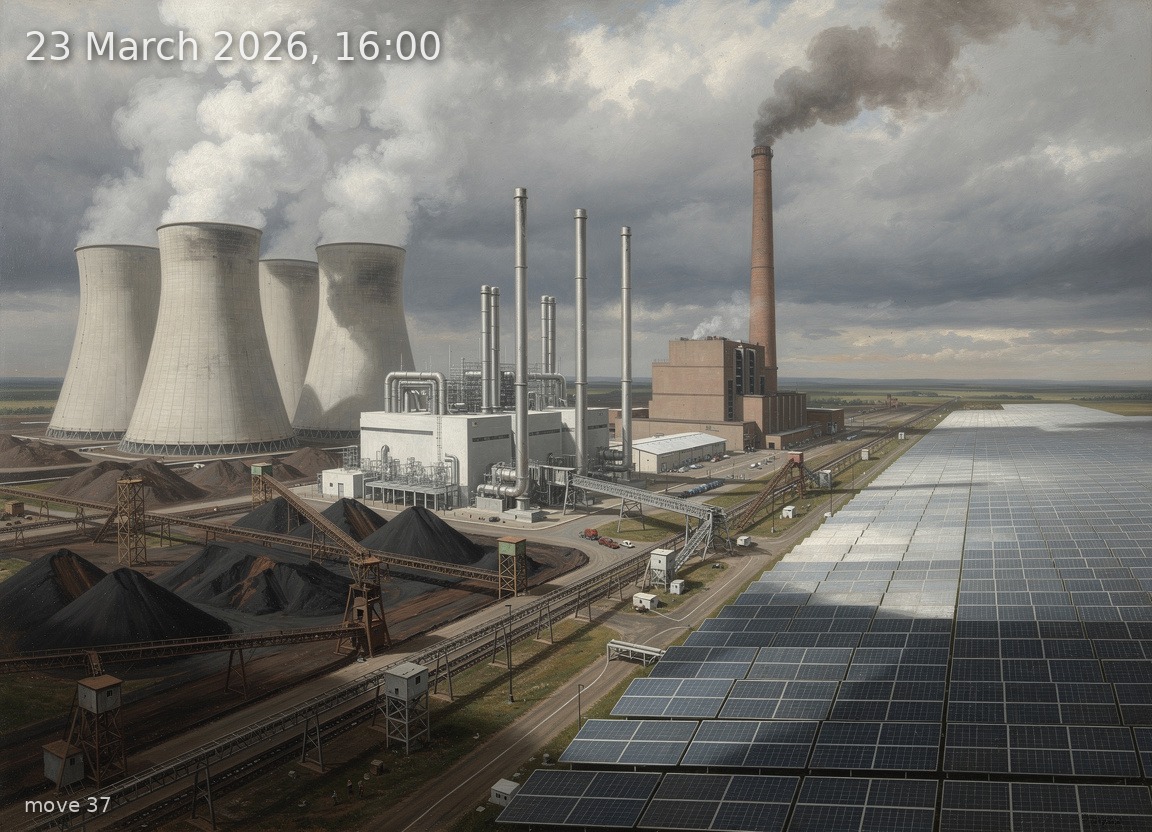
Brown coal and gas dominate as wind collapses to 1 GW, driving 9.6 GW net imports and a 138.5 EUR/MWh price.
Back
Generation mix
Wind onshore 2%
Wind offshore 0%
Solar 31%
Biomass 9%
Hydro 3%
Natural gas 18%
Hard coal 11%
Brown coal 27%
44%
Renewable share
1.0 GW
Wind (on + offshore)
14.4 GW
Solar
47.2 GW
Total generation
-9.6 GW
Net import
138.5 €/MWh
Day-ahead price
15.2°C / 5 km/h
Temp / Wind speed
Open-Meteo, Kassel (51.3°N 9.5°E)
88% / 342.5 W/m²
Cloud cover / Radiation
394
gCO₂/kWh
Image prompt
Brown coal 13.0 GW dominates the left third of the scene as a vast complex of hyperbolic cooling towers — at least six massive concrete towers with voluminous white-grey steam plumes merging into the overcast sky, surrounded by conveyor belts carrying dark lignite. Natural gas 8.3 GW occupies the centre-left as three modern CCGT plants with tall slender exhaust stacks emitting thin heat shimmer. Hard coal 5.2 GW appears centre-right as a traditional coal-fired station with rectangular box boiler houses and a single tall brick chimney trailing darker smoke. Solar 14.4 GW fills the right third as an enormous field of aluminium-framed crystalline silicon photovoltaic panels stretching to the horizon, their glass surfaces reflecting muted grey-white light from the overcast sky. Biomass 4.2 GW is rendered as a mid-sized industrial facility with a rounded wood-chip storage dome and a modest stack, tucked between the coal and solar zones. Hydro 1.2 GW appears as a concrete run-of-river dam with water spilling over a weir in the far background. Wind onshore 0.8 GW is represented by just two or three distant three-blade turbines on a ridge, their rotors nearly still in the calm air. Wind offshore 0.2 GW is a single barely visible turbine on the far horizon line. The time is 16:00 in late March: full daylight but heavily diffused through 88% cloud cover — a thick, oppressive, low blanket of stratocumulus in grey and off-white tones, with patches where warm direct radiation of moderate strength breaks through, casting pale golden shafts onto the solar field. The atmosphere feels heavy and pressurized, reflecting the high electricity price — the sky bears down on the landscape with leaden weight. Temperature is a mild 15°C; early spring vegetation shows fresh pale-green buds on scattered birch and beech trees, new grass underfoot. The air is almost completely still, no motion in branches or flags. Painted in the style of a highly detailed 19th-century German Romantic landscape oil painting — rich, layered colour with visible confident brushwork, atmospheric depth achieved through sfumato haze between the industrial complexes, dramatic chiaroscuro where light breaks through cloud. Engineering details are meticulous: turbine nacelles with correct proportions, PV panel cell grids visible, cooling tower parabolic curves precise, CCGT triple-pressure steam paths implied by stacked exhaust ducts. The composition evokes Caspar David Friedrich's sense of sublime scale but applied to an industrial energy landscape. No text, no labels, no people in the foreground.