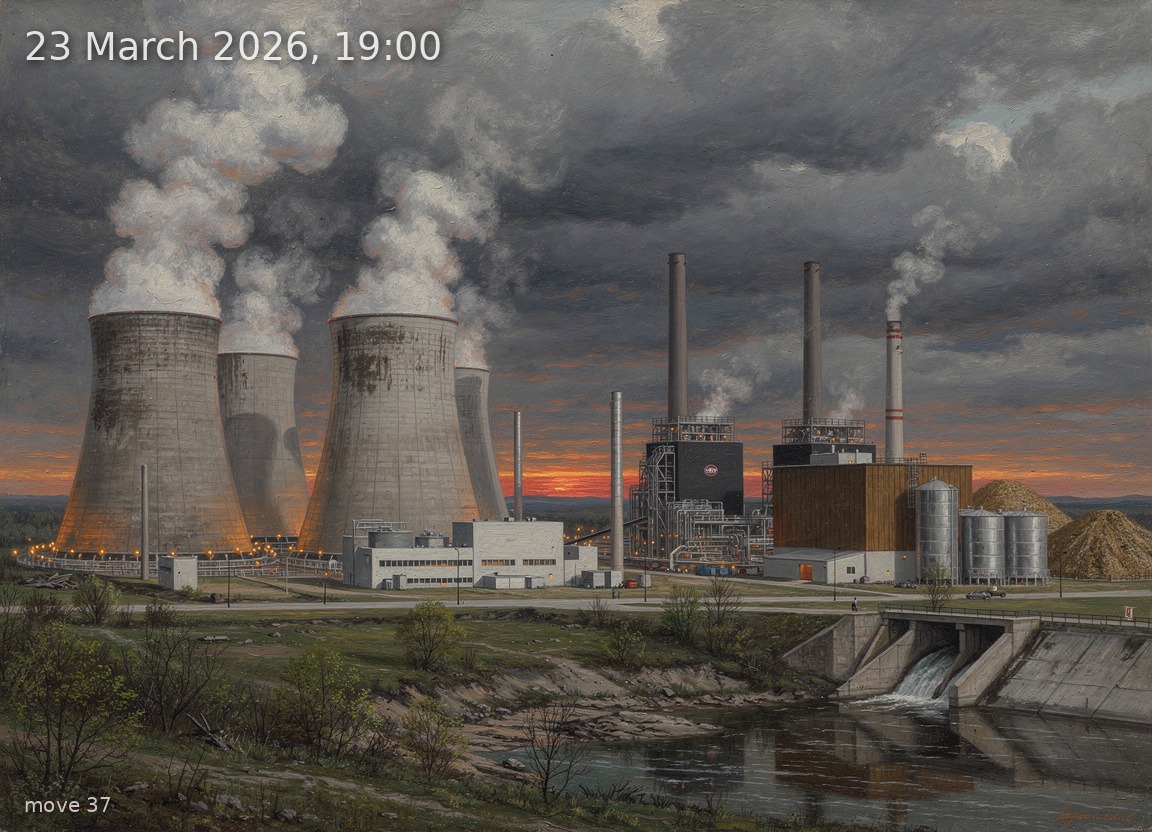
Brown coal, gas, and hard coal dominate as near-zero wind and no solar force heavy imports at 22.9 GW.
Back
Generation mix
Wind onshore 2%
Wind offshore 1%
Biomass 12%
Hydro 4%
Natural gas 32%
Hard coal 14%
Brown coal 35%
19%
Renewable share
1.2 GW
Wind (on + offshore)
0.0 GW
Solar
38.2 GW
Total generation
-23.0 GW
Net import
241.6 €/MWh
Day-ahead price
8.0°C / 2 km/h
Temp / Wind speed
Open-Meteo, Kassel (51.3°N 9.5°E)
100% / 1.0 W/m²
Cloud cover / Radiation
550
gCO₂/kWh
Records
#2
Fossil Hour
Image prompt
Brown coal 13.3 GW dominates the left third of the scene as a dense cluster of massive hyperbolic cooling towers trailing thick white steam plumes into the overcast sky; natural gas 12.4 GW fills the centre-left as a row of compact CCGT power plants with tall single exhaust stacks venting shimmering heat; hard coal 5.4 GW appears centre-right as a pair of smaller coal-fired stations with rectangular boiler houses and twin chimneys; biomass 4.6 GW is rendered as a timber-clad industrial facility with a modest smokestack and wood-chip storage silos in the right-centre; hydro 1.3 GW appears as a concrete dam with spillways in the far right middle-ground; wind onshore 0.9 GW is represented by two or three barely turning three-blade turbines on lattice towers in the distant background, their rotors nearly still. The time is 19:00 in late March — dusk is ending, with only a faint residual orange-red glow clinging to the lowest sliver of the western horizon, the rest of the sky a dark, heavy, fully overcast ceiling of grey-charcoal clouds pressing downward oppressively, conveying the extreme 241.6 EUR/MWh price. No solar panels anywhere — the sun is gone. The landscape is flat northern German terrain with sparse early-spring vegetation just beginning to green, temperature around 8°C, the air absolutely still with no motion in grass or flags. Sodium-orange industrial lighting illuminates the power plants from below, reflecting off the steam plumes. High-voltage transmission lines recede into the gloom toward the borders, symbolizing the massive import flows. Painted in the style of a highly detailed 19th-century German Romantic oil painting — rich, moody palette of ochre, slate grey, burnt sienna, and deep indigo — with visible impasto brushwork, atmospheric depth and haze between the industrial structures, meticulous engineering detail on every turbine nacelle, cooling tower flute, and exhaust stack, evoking Caspar David Friedrich's sublime dread transposed onto a modern industrial energy landscape. No text, no labels.