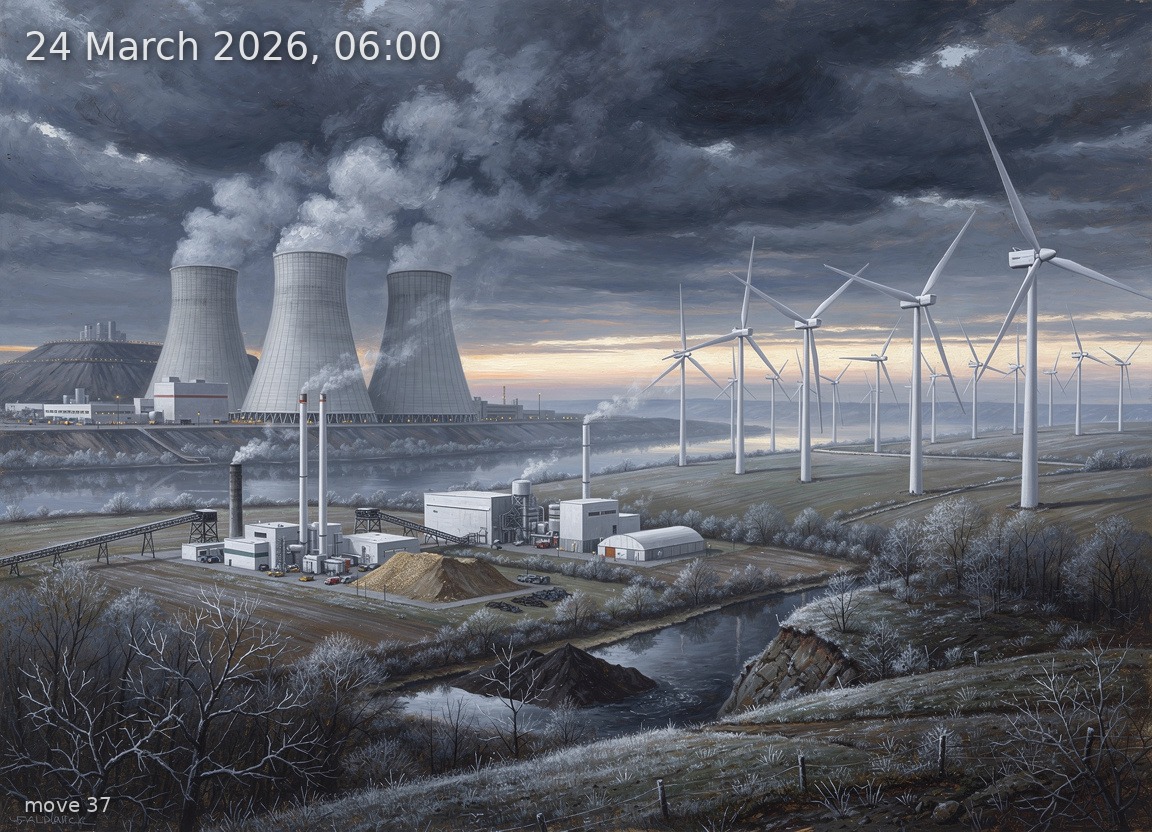
Strong onshore wind and heavy lignite baseload power a cold, overcast pre-dawn grid at elevated prices.
Back
Generation mix
Wind onshore 38%
Wind offshore 11%
Solar 2%
Biomass 7%
Hydro 2%
Natural gas 13%
Hard coal 7%
Brown coal 20%
60%
Renewable share
28.3 GW
Wind (on + offshore)
1.0 GW
Solar
57.5 GW
Total generation
+57.5 GW
Net export
110.8 €/MWh
Day-ahead price
2.0°C / 4 km/h
Temp / Wind speed
Open-Meteo, Kassel (51.3°N 9.5°E)
98% / 0.0 W/m²
Cloud cover / Radiation
282
gCO₂/kWh
Image prompt
Wind onshore 22.1 GW dominates the right half of the canvas as dozens of towering three-blade turbines with white tubular towers and detailed nacelles stretching across rolling farmland in staggered rows, their rotors barely turning in the light 3.9 km/h breeze; brown coal 11.8 GW occupies the left quarter as a massive lignite power station with four hyperbolic cooling towers emitting thick white steam plumes rising into the heavy sky, conveyors of raw lignite visible at the plant base; natural gas 7.4 GW appears left-centre as a pair of compact CCGT plants with slender single exhaust stacks and smaller vapour trails; wind offshore 6.2 GW is suggested on the far-right horizon as a line of turbines fading into a distant grey sea glimpsed between hills; hard coal 3.9 GW stands as a coal-fired station with a tall square chimney and coal bunkers near the lignite complex; biomass 4.2 GW appears as a mid-ground wood-chip combustion facility with a modest stack and steam wisp; hydro 1.0 GW is a small dam with spillway in a valley at centre-right; solar 1.0 GW is represented only by a small cluster of dark, dew-covered aluminium-framed crystalline silicon panels on a rooftop, completely unlit, receiving no sunlight. Time of day is 06:00 pre-dawn in late March: the sky is deep blue-grey with the faintest pale band of cold light on the eastern horizon, no direct sun visible, 98% cloud cover forming a heavy unbroken overcast pressing low over the landscape, creating an oppressive atmosphere reflecting high electricity prices. Temperature is 2 °C — frost rims the bare branches of leafless early-spring trees, grass is silvered with ice crystals, and breath-like mist clings to the river valley. Sodium-orange streetlights glow in a small village in the mid-ground. Style: highly detailed oil painting in the tradition of Caspar David Friedrich and Carl Blechen — rich, sombre colour palette of slate grey, Prussian blue, and umber, visible impasto brushwork in the clouds and steam, atmospheric aerial perspective giving depth, meticulous engineering accuracy in every turbine nacelle, cooling tower fluting, and gas-plant pipework. The scene is a masterwork industrial Romantic landscape. No text, no labels.