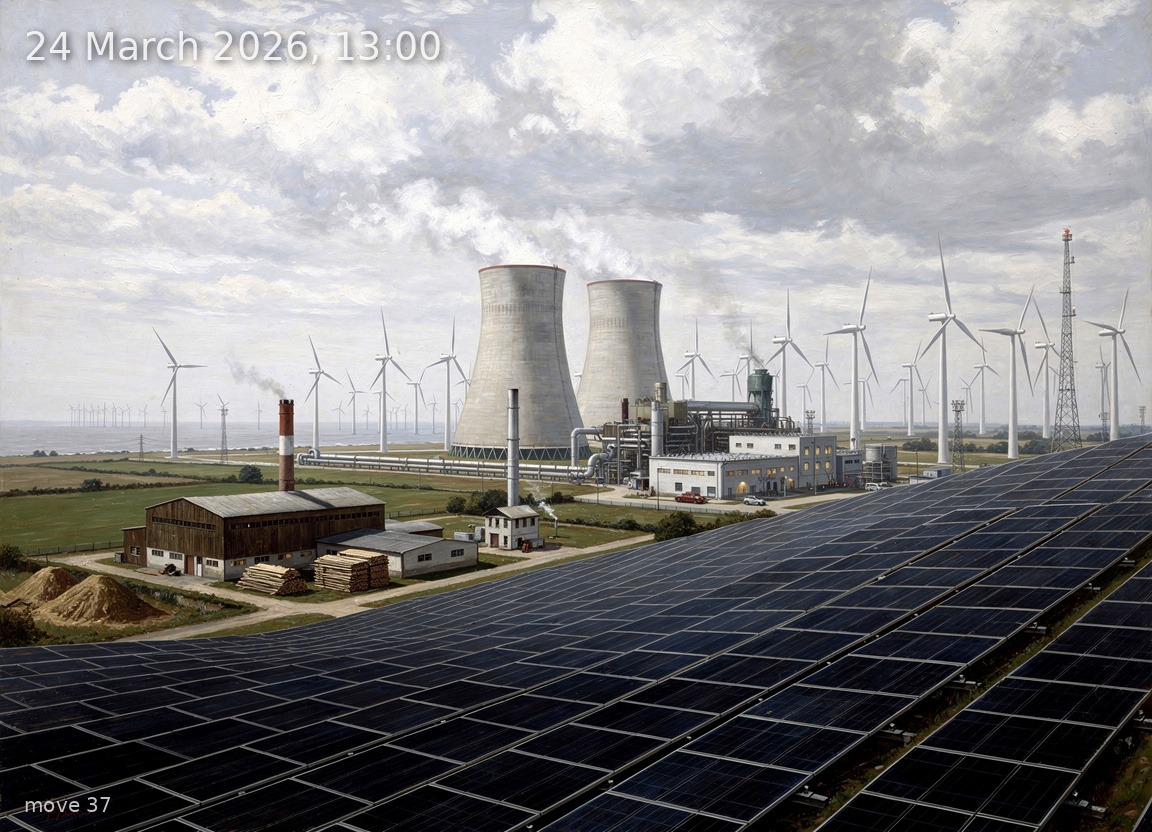
Solar (34.4 GW) and onshore wind (27.1 GW) drive a 14.7 GW net export at near-zero prices.
Back
Generation mix
Wind onshore 35%
Wind offshore 6%
Solar 44%
Biomass 5%
Hydro 2%
Natural gas 3%
Hard coal 1%
Brown coal 4%
91%
Renewable share
32.0 GW
Wind (on + offshore)
34.4 GW
Solar
78.4 GW
Total generation
+14.6 GW
Net export
-0.0 €/MWh
Day-ahead price
13.6°C / 13 km/h
Temp / Wind speed
Open-Meteo, Kassel (51.3°N 9.5°E)
100% / 200.2 W/m²
Cloud cover / Radiation
59
gCO₂/kWh
Image prompt
Solar 34.4 GW dominates the right half and centre of the scene as vast fields of aluminium-framed crystalline silicon photovoltaic panels stretching across gentle rolling farmland under a bright but fully overcast white-grey sky at midday, diffuse daylight illuminating everything evenly with no direct shadows. Wind onshore 27.1 GW fills the left third and extends across the horizon as dense ranks of modern three-blade turbines on tall lattice-and-tubular towers, rotors turning at moderate speed in a steady breeze. Wind offshore 4.9 GW appears in the far left background as a cluster of turbines standing in a sliver of grey North Sea visible on the horizon. Brown coal 3.2 GW is rendered in the centre-left middle ground as two hyperbolic cooling towers with modest white steam plumes drifting sideways in the wind, attached to a low industrial complex. Natural gas 2.3 GW sits beside them as a compact combined-cycle gas turbine plant with a single tall exhaust stack emitting a thin heat shimmer. Biomass 4.0 GW appears as a wood-clad industrial facility with a short smokestack and stacked timber beside it in the left middle ground. Hard coal 1.2 GW is a small conventional plant with a single square cooling tower barely visible behind the biomass facility. Hydro 1.2 GW is suggested by a small river with a low weir and run-of-river turbine house in the foreground. The landscape is early spring: pale green buds on deciduous trees, patches of rapeseed beginning to yellow, temperature mild at 13°C. The sky is a uniform blanket of stratus cloud, luminous white-grey, no blue visible, yet bright enough that the solar panels gleam. The atmosphere is calm and expansive, reflecting near-zero electricity prices — no oppressive weight, just a vast serene industrial pastoral. Style: highly detailed oil painting in the tradition of 19th-century German Romantic landscape masters — Caspar David Friedrich's atmospheric depth merged with Adolph Menzel's industrial precision — rich layered colour, visible impasto brushwork, meticulous engineering detail on every turbine nacelle, every panel frame, every cooling tower's parabolic curve, dramatic sense of scale. No text, no labels.