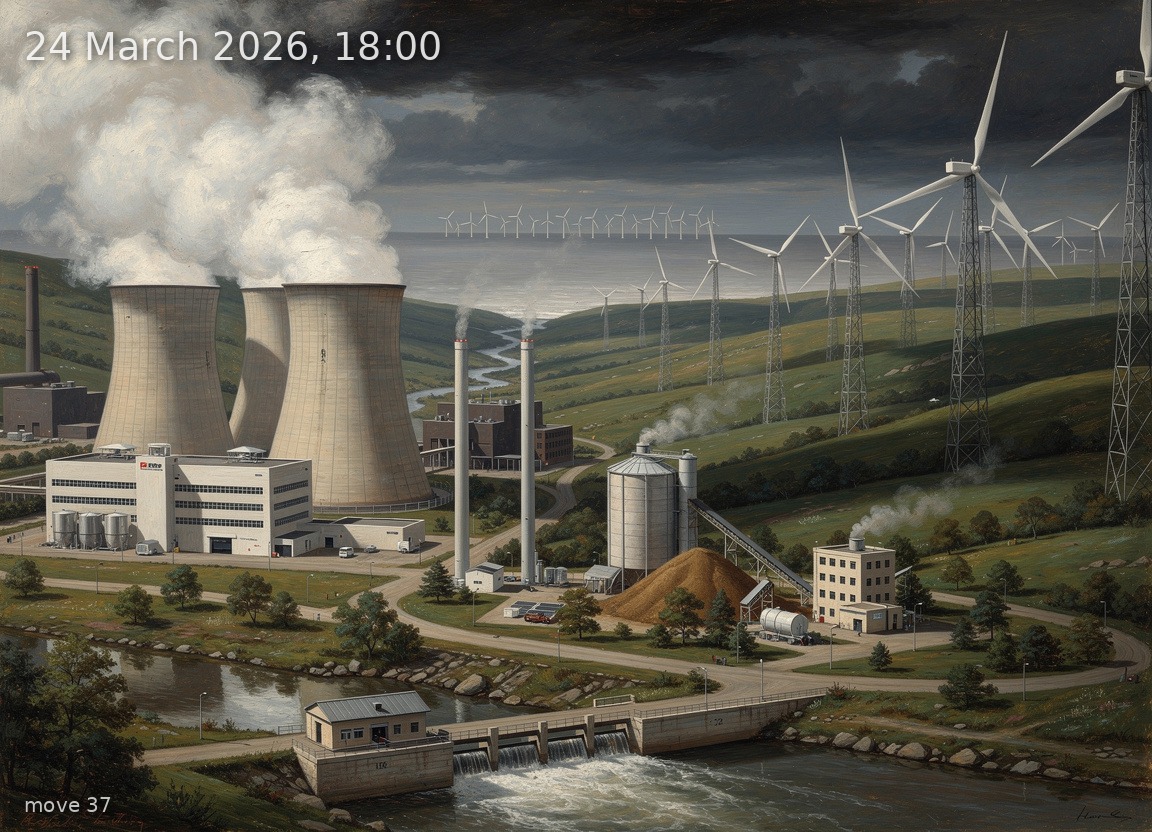
Strong wind (33.7 GW) leads generation but 7.3 GW net imports needed to meet 61.1 GW evening demand.
Back
Generation mix
Wind onshore 50%
Wind offshore 13%
Solar 2%
Biomass 9%
Hydro 2%
Natural gas 10%
Hard coal 5%
Brown coal 11%
75%
Renewable share
33.6 GW
Wind (on + offshore)
1.0 GW
Solar
53.8 GW
Total generation
-7.3 GW
Net import
135.8 €/MWh
Day-ahead price
14.7°C / 13 km/h
Temp / Wind speed
Open-Meteo, Kassel (51.3°N 9.5°E)
97% / 11.5 W/m²
Cloud cover / Radiation
171
gCO₂/kWh
Image prompt
Wind onshore 26.9 GW dominates the right two-thirds of the scene as dozens of massive three-blade turbines on lattice and tubular towers stretching across rolling green hills, rotors spinning in moderate wind. Wind offshore 6.8 GW appears as a cluster of turbines on the distant horizon over a grey sea glimpsed through a valley. Brown coal 5.7 GW occupies the left foreground as a lignite power station with three hyperbolic concrete cooling towers emitting thick white steam plumes. Natural gas 5.4 GW sits beside it as two compact CCGT blocks with slender exhaust stacks venting thin heat shimmer. Hard coal 2.5 GW is a smaller single-stack coal plant partially obscured behind the lignite station. Biomass 4.6 GW appears as a mid-sized industrial facility with a wood-chip silo and modest chimney with pale smoke, set in the middle ground. Hydro 1.1 GW is a small run-of-river weir with a concrete powerhouse along a river in the lower foreground. Solar 1.0 GW is barely represented: a small rooftop array on a farmhouse, panels dark and reflecting only grey sky, receiving no sunlight. Time is 18:00 late March dusk in central Germany: the sky is 97% overcast with heavy grey stratus clouds, a narrow band of fading orange-red glow clings to the lower western horizon, the upper sky darkening to slate blue-grey. The atmosphere is oppressive and heavy, reflecting a high electricity price — the clouds press low, the air feels dense. Temperature is mild at 14.7°C; early spring vegetation shows fresh pale-green buds on deciduous trees and bright green grass. Style: highly detailed oil painting in the tradition of 19th-century German Romantic landscape painters such as Caspar David Friedrich and Carl Blechen — rich layered colour, visible confident brushwork, deep atmospheric perspective, dramatic chiaroscuro between the glowing industrial facilities and the darkening sky. Every technology rendered with meticulous engineering accuracy: turbine nacelles, three-blade rotors, aluminium PV frames, hyperbolic cooling tower geometry, CCGT exhaust stacks. The scene reads as a grand industrial landscape masterwork. No text, no labels, no people prominent.