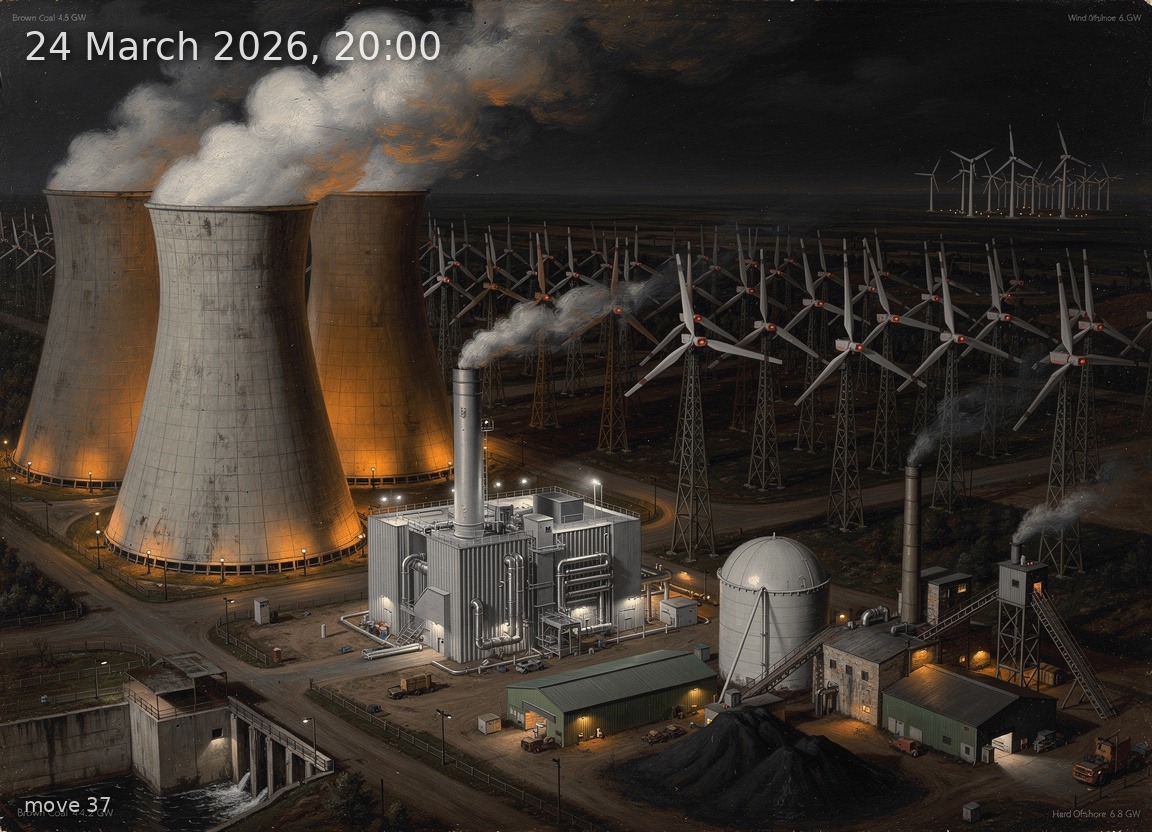
Strong onshore wind at 37.2 GW leads an 81% renewable mix; thermal plants cover residual evening demand at elevated prices.
Back
Generation mix
Wind onshore 61%
Wind offshore 11%
Solar 0%
Biomass 7%
Hydro 2%
Natural gas 7%
Hard coal 5%
Brown coal 7%
81%
Renewable share
44.0 GW
Wind (on + offshore)
0.0 GW
Solar
61.1 GW
Total generation
-0.3 GW
Net import
101.1 €/MWh
Day-ahead price
9.6°C / 17 km/h
Temp / Wind speed
Open-Meteo, Kassel (51.3°N 9.5°E)
100% / 0.0 W/m²
Cloud cover / Radiation
128
gCO₂/kWh
Image prompt
Wind onshore 37.2 GW dominates the right two-thirds of the scene as vast ranks of three-blade turbines on lattice towers stretching deep into the composition, rotors visibly spinning in strong wind; wind offshore 6.8 GW appears as a distant cluster of larger turbines on the far-right horizon over a dark plain; brown coal 4.2 GW occupies the left foreground as two massive hyperbolic cooling towers with billowing white steam plumes lit from below by sodium-orange industrial lights; natural gas 4.5 GW sits center-left as a compact CCGT plant with a single tall exhaust stack emitting a thin heat shimmer, its corrugated metal walls glowing under floodlights; hard coal 2.9 GW appears as a smaller coal plant with a single squat stack and conveyor infrastructure beside a dark coal pile, slightly behind the gas plant; biomass 4.4 GW is rendered as a wood-chip-fed power station with a distinctive dome silo and short stack, positioned between the coal complex and the wind turbines; hydro 1.1 GW is suggested by a small dam structure with illuminated spillway at the far left edge. The sky is completely dark — deep navy-black, no twilight, no glow on the horizon — it is 20:00 in late March. Full 100% cloud cover means no stars, no moon, just an oppressive heavy overcast pressing down, conveying the elevated 101 EUR/MWh price as atmospheric weight. All illumination comes from artificial sources: sodium-vapor streetlights casting amber pools, white industrial floodlights on plant structures, red aviation warning lights blinking on turbine nacelles receding into darkness. Temperature is 9.6°C — early spring, bare deciduous trees with just the faintest hint of budding, dormant brown grass, patches of mud. Wind at 16.6 km/h animates the scene: steam plumes shear sideways from cooling towers, bare branches bend, puddles ripple. Painted in the style of a highly detailed 19th-century German Romantic oil painting — rich impasto brushwork, deep chiaroscuro contrasts between warm industrial light and cold darkness, atmospheric depth as turbine rows vanish into murky distance, meticulous engineering accuracy on every nacelle, cooling tower, and stack. No text, no labels.