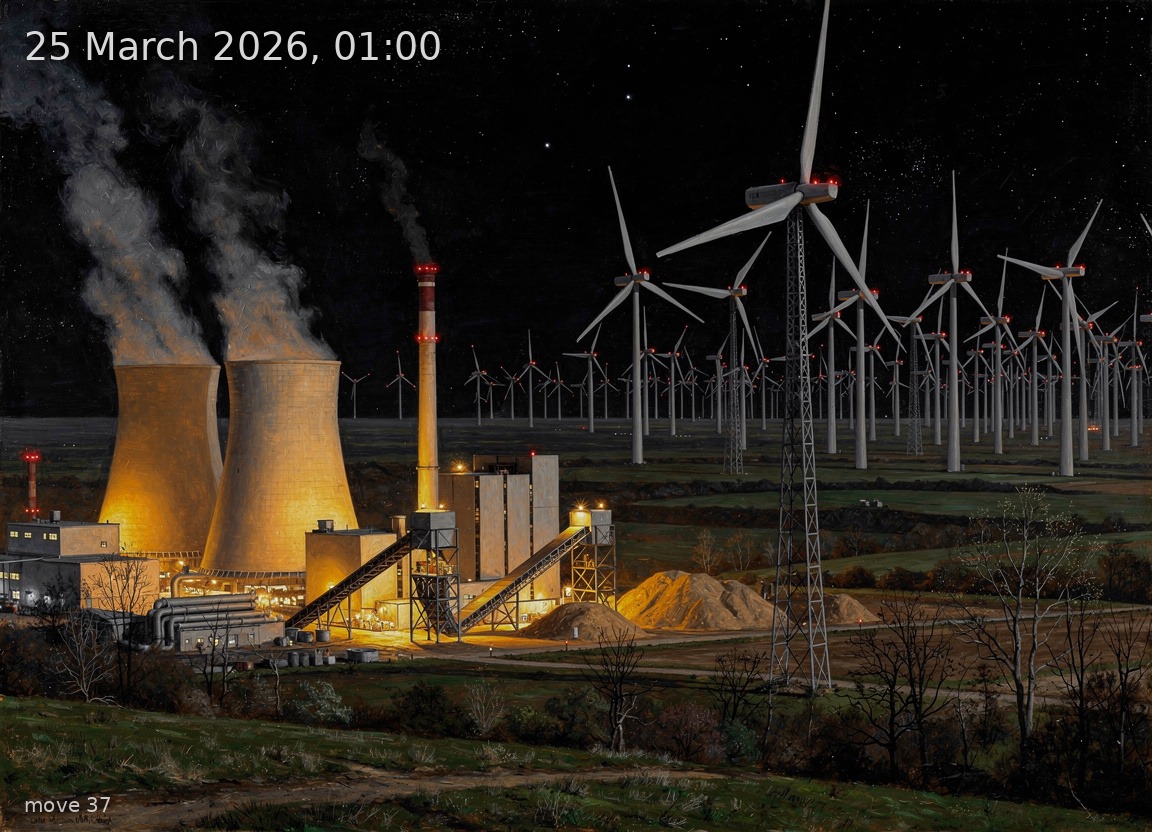
Massive onshore wind output of 47.8 GW drives 14.3 GW net exports and near-zero overnight prices.
Back
Generation mix
Wind onshore 71%
Wind offshore 8%
Solar 0%
Biomass 6%
Hydro 2%
Natural gas 4%
Hard coal 4%
Brown coal 5%
87%
Renewable share
53.4 GW
Wind (on + offshore)
0.0 GW
Solar
67.2 GW
Total generation
+14.3 GW
Net export
0.4 €/MWh
Day-ahead price
10.6°C / 12 km/h
Temp / Wind speed
Open-Meteo, Kassel (51.3°N 9.5°E)
0% / 0.0 W/m²
Cloud cover / Radiation
90
gCO₂/kWh
Image prompt
Wind onshore 47.8 GW dominates the entire right two-thirds of the canvas as an enormous sprawling wind farm stretching to the horizon — dozens upon dozens of tall three-blade turbines on lattice and tubular towers, rotors spinning energetically, their red aviation warning lights blinking against the black sky. Wind offshore 5.5 GW appears in the far background right as a cluster of offshore turbines silhouetted against a faint strip of dark sea, each crowned with a blinking beacon. Biomass 4.1 GW occupies the centre-left as a mid-sized industrial facility with a tall smokestack emitting a thin warm-lit plume, woodchip storage bunkers visible under sodium-yellow floodlights. Brown coal 3.3 GW sits at the far left as two hyperbolic cooling towers releasing pale steam columns illuminated from below by facility lights. Natural gas 3.0 GW appears as a compact CCGT plant with a single tall exhaust stack and a modest heat shimmer, situated between the brown coal plant and the biomass facility. Hard coal 2.4 GW is rendered as a smaller coal-fired station with a rectangular boiler house and a single tapered chimney, set just behind the gas plant. Hydro 1.0 GW appears as a small dam structure in the lower left foreground, water glistening under reflected facility light. The scene is set at 1:00 AM in late March central Germany: the sky is completely black with scattered bright stars visible through perfectly clear skies (0% cloud cover), no moon glow, no twilight — only artificial illumination from sodium streetlamps along access roads, floodlit industrial yards, and the red tip-lights of the turbines. The landscape is flat to gently rolling northern German plains, early spring with bare-branched trees just beginning to bud, patches of short green grass visible under lamplight, a mild 10°C night with no frost. The atmosphere is calm and open, reflecting the rock-bottom price — no oppressive haze, just clean cool night air. Painted in the style of a highly detailed 19th-century German Romantic oil painting — rich deep blues and blacks in the sky, warm amber and orange tones from the industrial lighting, visible impasto brushwork, atmospheric depth receding into darkness, meticulous engineering detail on every turbine nacelle, every cooling tower curve, every exhaust stack. The composition evokes Caspar David Friedrich's sense of sublime scale, but applied to a modern industrial energy landscape. No text, no labels.