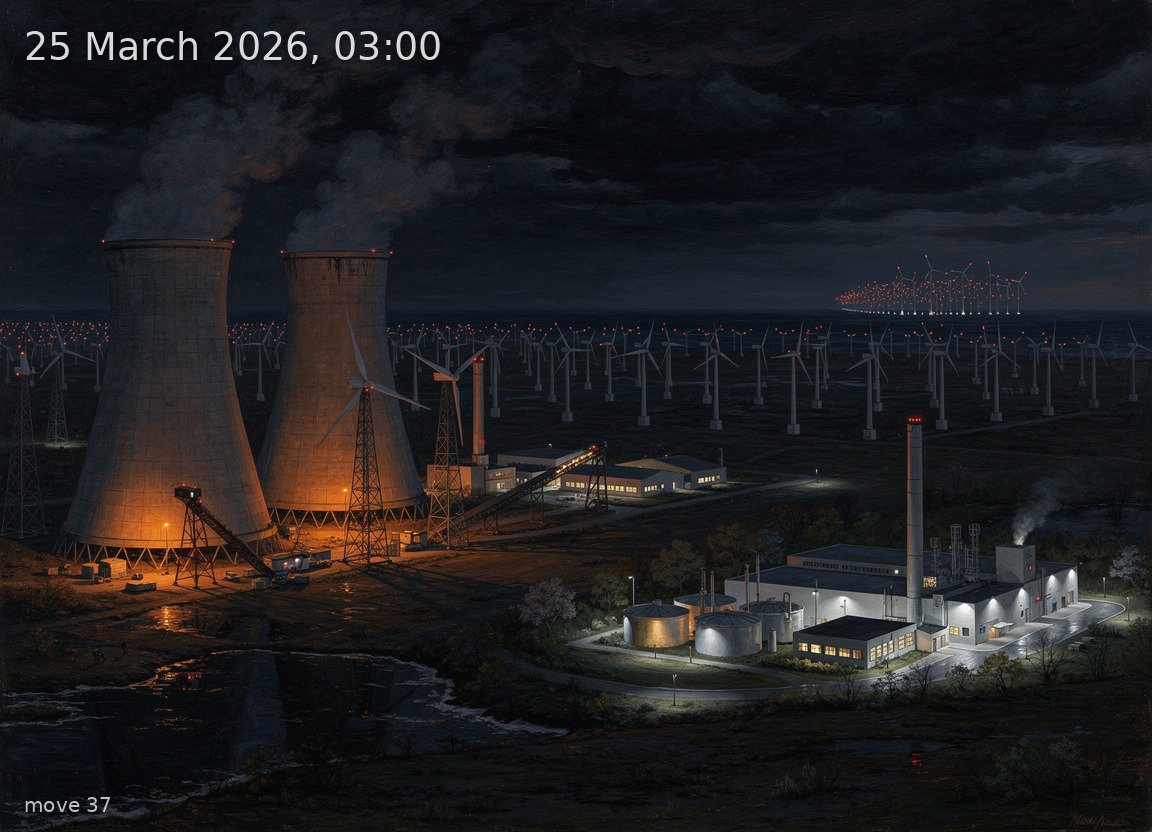
Massive onshore wind output of 49.3 GW drives 20 GW net exports and near-zero prices at 3 AM.
Back
Generation mix
Wind onshore 72%
Wind offshore 8%
Solar 0%
Biomass 6%
Hydro 1%
Natural gas 4%
Hard coal 3%
Brown coal 5%
88%
Renewable share
54.9 GW
Wind (on + offshore)
0.0 GW
Solar
68.0 GW
Total generation
+20.1 GW
Net export
-0.0 €/MWh
Day-ahead price
9.3°C / 14 km/h
Temp / Wind speed
Open-Meteo, Kassel (51.3°N 9.5°E)
100% / 0.0 W/m²
Cloud cover / Radiation
83
gCO₂/kWh
Image prompt
Wind onshore 49.3 GW dominates three-quarters of the composition as hundreds of three-blade turbines with lattice towers stretching across a vast dark plain from foreground to deep background, rotors visibly turning in strong wind; wind offshore 5.6 GW appears as a distant cluster of taller turbines on the far-right horizon over a dark sea; brown coal 3.2 GW occupies the left foreground as two massive hyperbolic cooling towers emitting faintly lit steam plumes, with sodium-orange industrial lights at their base; hard coal 2.3 GW sits behind them as a single smaller stack with a glowing conveyor belt; natural gas 2.6 GW appears as a compact CCGT plant with a single tall exhaust stack and modest vapour, lit by white security lights; biomass 4.1 GW is rendered as a mid-ground cluster of blocky biogas facilities with small chimneys and warm yellow-lit windows; hydro 1.0 GW is a barely visible dam structure in the far left background with a thin gleam of water. The sky is completely black to deep navy — no twilight, no moon, no sky glow — it is 3 AM in late March. Overcast clouds at 100% are barely discernible as a dark textured ceiling above. The only illumination comes from sodium streetlights casting orange pools on wet roads, the amber and white industrial lighting of power plants, and faint red aviation warning lights blinking atop the endless rows of turbine nacelles. Spring vegetation is hinted at by fresh low grass barely visible near lit pathways. The atmosphere is calm and open despite the darkness, reflecting the zero electricity price — no oppressive haze. Highly detailed oil painting in the tradition of 19th-century German Romantic landscape painters — rich dark palette of Prussian blue, lamp black, and warm sodium-orange — visible confident brushwork, extraordinary atmospheric depth, meticulous engineering detail on every turbine nacelle, cooling tower ridge, and CCGT stack. The scene evokes Caspar David Friedrich reimagining the industrial Energiewende at night. No text, no labels.