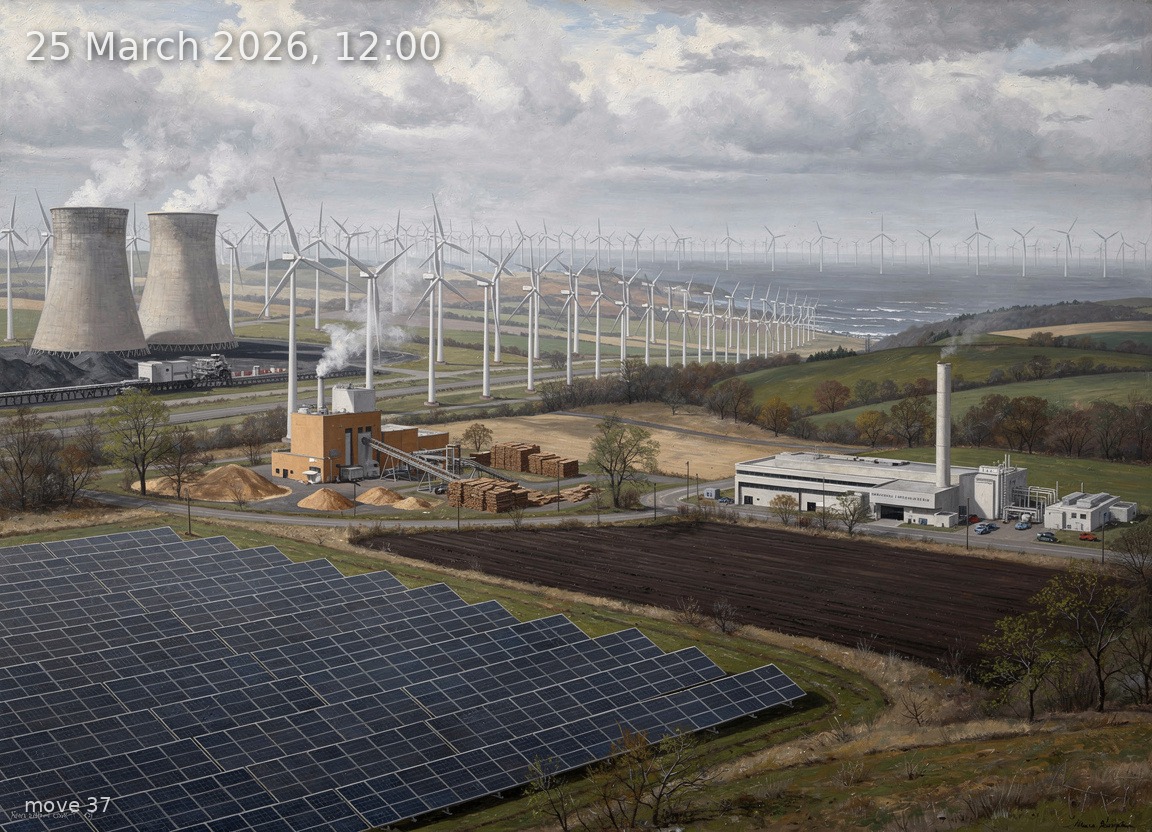
Strong onshore wind (42.8 GW) and diffuse solar (20.2 GW) push renewables to 90%, yielding 13.2 GW net exports at zero price.
Back
Generation mix
Wind onshore 51%
Wind offshore 8%
Solar 24%
Biomass 5%
Hydro 1%
Natural gas 3%
Hard coal 3%
Brown coal 4%
90%
Renewable share
49.8 GW
Wind (on + offshore)
20.2 GW
Solar
83.6 GW
Total generation
+13.2 GW
Net export
-0.0 €/MWh
Day-ahead price
9.1°C / 18 km/h
Temp / Wind speed
Open-Meteo, Kassel (51.3°N 9.5°E)
100% / 85.0 W/m²
Cloud cover / Radiation
70
gCO₂/kWh
Image prompt
Wind onshore 42.8 GW dominates the scene as an enormous field of hundreds of three-blade turbines with white lattice towers stretching from the centre to the far right horizon, rotors visibly spinning in brisk wind, occupying over half the canvas. Wind offshore 7.0 GW appears as a distant line of larger turbines on a grey North Sea horizon visible through a gap in the hills at far right. Solar 20.2 GW fills the lower-left foreground as expansive rows of aluminium-framed crystalline silicon PV panels on flat farmland, their surfaces reflecting only the pale diffuse light of a fully overcast sky—no direct sun. Biomass 4.2 GW is rendered as a mid-ground wood-chip power station with a modest smokestack and stored timber piles. Brown coal 3.3 GW appears at the left edge as two hyperbolic concrete cooling towers with thin, wispy steam plumes, a conveyor belt carrying lignite visible at their base. Natural gas 2.7 GW sits just right of the coal as a compact combined-cycle gas turbine plant with a single tall exhaust stack and minimal exhaust haze. Hard coal 2.4 GW is a smaller traditional power station with a square chimney next to a dark coal stockpile, barely smoking. Hydro 1.0 GW is suggested by a small reservoir dam nestled in a valley in the distant left background. The sky is entirely overcast with a uniform blanket of grey-white stratus clouds, full midday daylight but no visible sun disc, the light flat and diffuse—consistent with 100% cloud cover at noon. Early spring landscape: bare deciduous trees with the faintest green buds, pale-brown dormant grass, patches of dark ploughed earth. Temperature around 9°C conveyed by cool-toned palette and damp atmosphere. The price at zero is reflected in an open, calm, expansive sky—no oppressive weight. Style: highly detailed oil painting in the tradition of 19th-century German Romantic landscape painters—Caspar David Friedrich meets industrial realism—rich layered colour, visible confident brushwork, atmospheric depth with subtle aerial perspective fading distant turbines into haze. Meticulous engineering detail on every turbine nacelle, every PV cell grid pattern, every cooling tower's parabolic curve. No text, no labels.