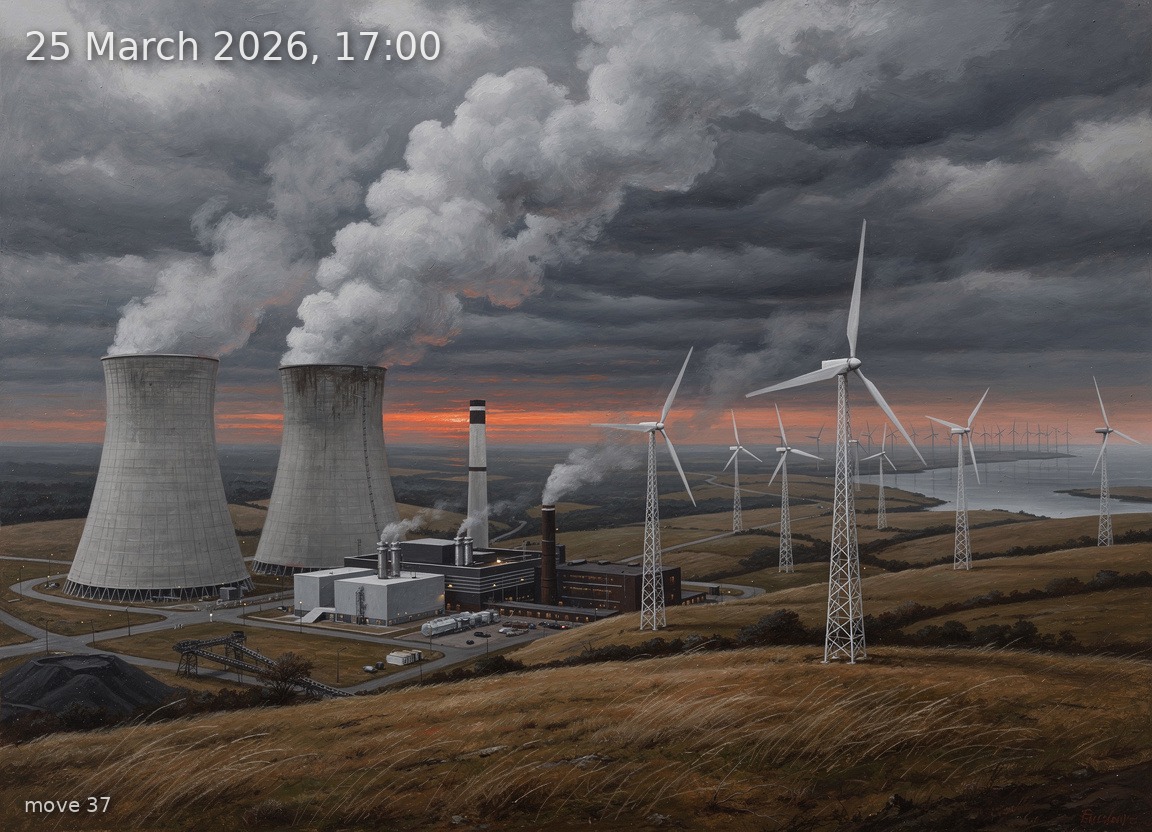
Strong wind dominates at 29.7 GW but cold, overcast evening demand of 62.5 GW requires coal, gas, and 4.8 GW net imports.
Back
Generation mix
Wind onshore 41%
Wind offshore 11%
Solar 6%
Biomass 8%
Hydro 2%
Natural gas 12%
Hard coal 8%
Brown coal 13%
67%
Renewable share
29.6 GW
Wind (on + offshore)
3.5 GW
Solar
57.7 GW
Total generation
-4.7 GW
Net import
98.8 €/MWh
Day-ahead price
4.9°C / 19 km/h
Temp / Wind speed
Open-Meteo, Kassel (51.3°N 9.5°E)
100% / 25.0 W/m²
Cloud cover / Radiation
224
gCO₂/kWh
Image prompt
Wind onshore 23.5 GW dominates the right two-fifths of the scene as dozens of tall three-blade turbines with white lattice towers stretching across rolling hills, rotors spinning visibly in strong wind; wind offshore 6.2 GW appears as a distant line of larger turbines on the far-right horizon over a grey sea inlet. Brown coal 7.3 GW occupies the left foreground as a massive lignite power station with three hyperbolic cooling towers emitting thick white-grey steam plumes drifting rightward in the wind. Natural gas 7.2 GW sits centre-left as a compact combined-cycle gas turbine plant with twin exhaust stacks and a single slender vapour trail. Hard coal 4.5 GW appears behind the gas plant as a dark rectangular station with a tall chimney and coal conveyor belt. Biomass 4.4 GW is rendered centre-right as a mid-sized wood-chip-fed plant with a squat smokestack and timber storage yard. Solar 3.5 GW is a modest field of aluminium-framed crystalline silicon panels in the centre-foreground, their surfaces dull and lightless under the heavy overcast — no sun reflections, no glare. Hydro 1.2 GW appears as a small concrete run-of-river dam with spillway on a stream in the lower left. The sky is entirely overcast with thick, low, oppressive grey clouds — no blue visible anywhere — creating a heavy, high-price atmosphere. Time is 17:00 dusk in late March: a thin band of fading orange-red glow sits along the lowest horizon behind the cooling towers, while the upper sky darkens rapidly toward slate grey and deep indigo. Bare deciduous trees with the faintest hint of early spring buds dot the landscape. Temperature near 5°C suggested by frost patches on grass and workers in heavy coats. The wind visibly bends dry meadow grass and whips flags on the industrial buildings. Overhead high-voltage transmission lines run across the scene, symbolising interconnector flows. Style: highly detailed oil painting in the tradition of 19th-century German Romantic landscape painters — Caspar David Friedrich's atmospheric depth merged with meticulous industrial-age accuracy — rich, moody colour palette of greys, umbers, and muted orange, visible confident brushwork, dramatic chiaroscuro lighting from the dying horizon glow against dark industrial silhouettes. No text, no labels.