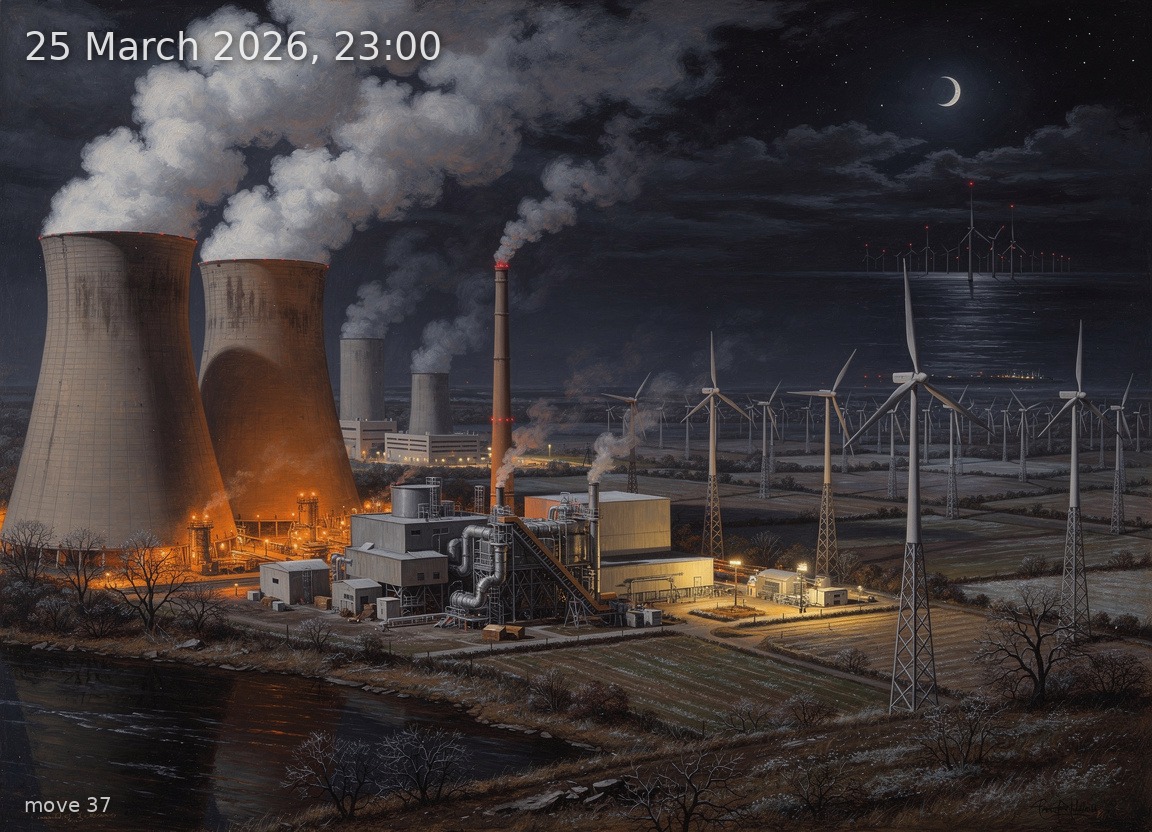
Strong overnight wind covers most demand; coal and gas provide baseload support with 2.4 GW net imports.
Back
Generation mix
Wind onshore 57%
Wind offshore 13%
Biomass 9%
Hydro 2%
Natural gas 6%
Hard coal 5%
Brown coal 8%
81%
Renewable share
32.3 GW
Wind (on + offshore)
0.0 GW
Solar
46.3 GW
Total generation
-2.4 GW
Net import
88.8 €/MWh
Day-ahead price
2.8°C / 15 km/h
Temp / Wind speed
Open-Meteo, Kassel (51.3°N 9.5°E)
24.0% / 0.0 W/m²
Cloud cover / Radiation
135
gCO₂/kWh
Image prompt
Wind onshore 26.2 GW dominates the entire right two-thirds of the scene as vast ranks of three-blade turbines on lattice towers stretching deep into the distance across rolling farmland, rotors spinning briskly in moderate wind. Wind offshore 6.2 GW appears as a cluster of taller turbines visible on the far-right horizon above a dark estuary. Brown coal 3.9 GW occupies the left foreground as two massive hyperbolic cooling towers emitting thick white steam plumes lit from below by sodium-orange industrial lighting. Biomass 4.1 GW appears as a medium-sized industrial plant with a distinctive wood-chip conveyor and a single squat smokestack with faint exhaust, positioned left of centre. Natural gas 2.8 GW is rendered as a compact CCGT facility with a single tall exhaust stack and visible heat shimmer, nestled between the coal plant and the biomass facility. Hard coal 2.3 GW is a smaller conventional power station with a pair of rectangular cooling towers releasing thin steam, tucked behind the brown coal plant. Hydro 1.0 GW appears as a small concrete dam and turbine house at the far left edge beside a dark river. The sky is completely dark—deep navy to black, no twilight, no horizon glow—it is 23:00 in late March. A partial clearing reveals scattered stars and a thin crescent moon through 24% cloud cover. The temperature is near freezing: bare-branched trees, patches of frost on brown grass, breath-visible cold. The atmosphere feels heavy and oppressive despite the clear patches, conveying the high electricity price—a brooding weight in the air, thick clouds pressing down at the edges. Sodium streetlights cast amber pools along a road winding through the scene. All rendered as a highly detailed oil painting in the tradition of 19th-century German Romantic landscape painters—rich, dark palette of indigo, amber, slate-grey, and ivory; visible impasto brushwork; dramatic chiaroscuro between the glowing industrial facilities and the vast dark countryside; atmospheric depth receding into hazy distance. Meticulous engineering detail on every turbine nacelle, cooling tower, and exhaust stack. No text, no labels.