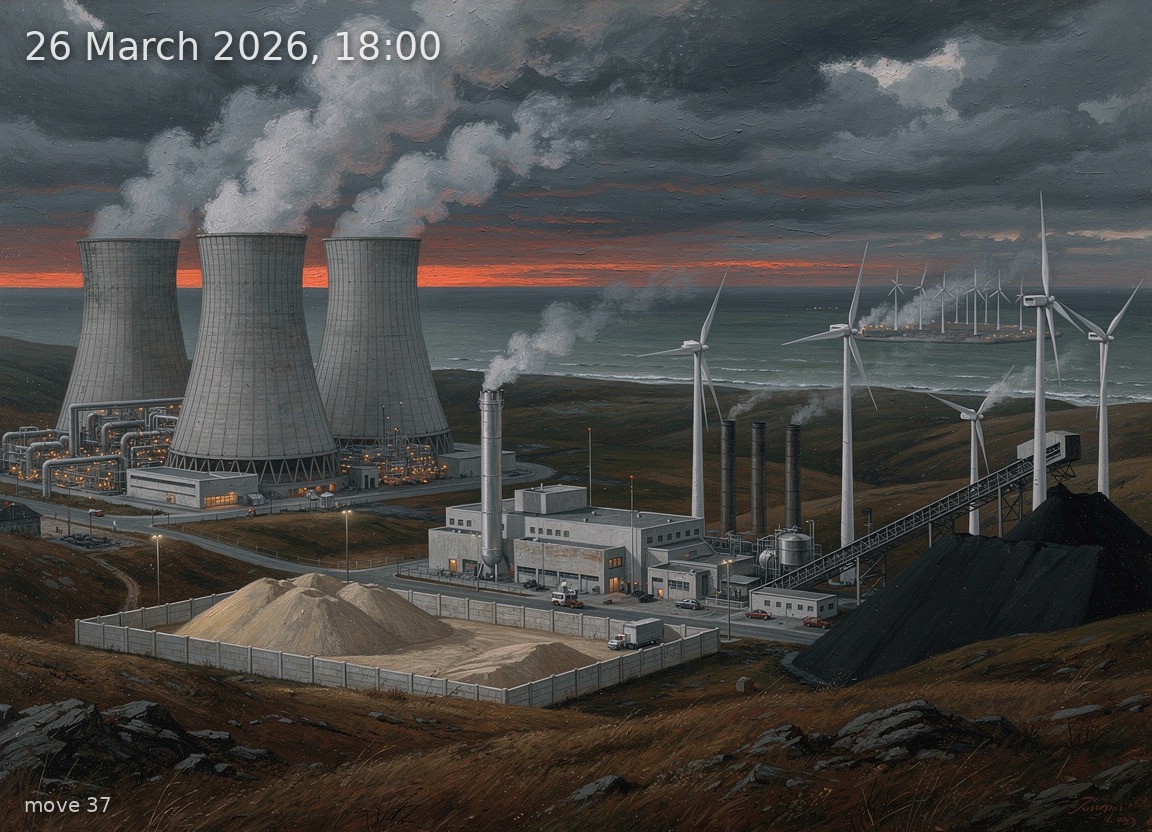
Wind leads at 26.5 GW but a 19.8 GW import gap and evening demand push prices to 155 EUR/MWh.
Back
Generation mix
Wind onshore 49%
Wind offshore 14%
Solar 2%
Biomass 10%
Hydro 2%
Natural gas 3%
Hard coal 8%
Brown coal 11%
78%
Renewable share
26.5 GW
Wind (on + offshore)
0.7 GW
Solar
41.7 GW
Total generation
-19.8 GW
Net import
155.4 €/MWh
Day-ahead price
4.0°C / 17 km/h
Temp / Wind speed
Open-Meteo, Kassel (51.3°N 9.5°E)
83.0% / 35.2 W/m²
Cloud cover / Radiation
168
gCO₂/kWh
Image prompt
Wind onshore 20.5 GW dominates the right two-thirds of the scene as dozens of tall three-blade turbines with white tubular towers and nacelles stretching across rolling hills, blades in active rotation; wind offshore 6.0 GW appears in the distant background right as a cluster of turbines rising from a grey-green sea on the horizon; brown coal 4.8 GW occupies the left foreground as a massive lignite power station with three hyperbolic cooling towers trailing thick white-grey steam plumes; hard coal 3.2 GW sits just right of the lignite plant as a smaller station with rectangular chimneys and a conveyor belt leading to a dark coal pile; biomass 4.3 GW appears as a mid-sized industrial facility with a tall cylindrical stack and adjacent wood-chip storage area in the centre-left middle ground; natural gas 1.4 GW is a compact CCGT plant with a single slim exhaust stack and visible heat-recovery unit beside the biomass facility; hydro 0.9 GW is a small dam and powerhouse visible in a valley notch at left; solar 0.7 GW is barely suggested by a tiny row of aluminium-framed crystalline PV panels on a barn roof, panels dark and inactive under heavy cloud. Time is 18:00 in late March — dusk lighting with a narrow band of deep orange-red glow lingering on the lower western horizon, the sky above rapidly darkening to slate blue and charcoal grey, 83% cloud cover rendering the overcast heavy and oppressive. Temperature is 4°C: bare deciduous trees, dry brown grass, patches of residual snow in furrows. The atmosphere feels weighted and costly — the thick cloud ceiling presses down, sodium streetlights along a road are just flickering on, casting amber pools. The wind is visible in the motion of turbine blades, bending grass, and drifting steam plumes. Style: highly detailed oil painting in the tradition of 19th-century German Romantic landscape painters such as Caspar David Friedrich and Carl Blechen — rich, sombre colour palette of umber, slate, rust, and cold teal; visible impasto brushwork in the clouds and steam; atmospheric aerial perspective with industrial haze; meticulous engineering detail on every turbine nacelle, cooling tower ribbing, and coal conveyor. The scene conveys the sublime tension between nature's fading light and industry's persistent glow. No text, no labels.