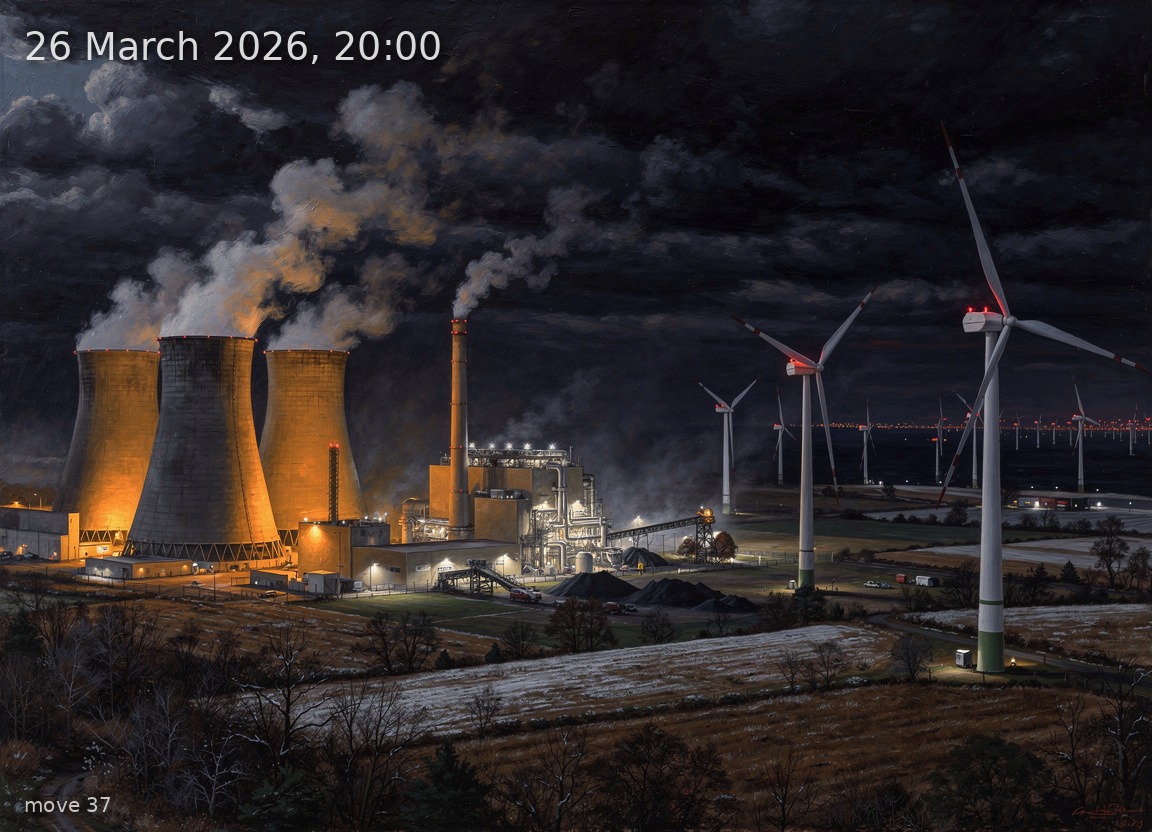
Wind leads at 24 GW but 19.5 GW net imports are needed as cold evening demand reaches 58.8 GW with no solar.
Back
Generation mix
Wind onshore 46%
Wind offshore 15%
Biomass 11%
Hydro 3%
Natural gas 4%
Hard coal 7%
Brown coal 14%
75%
Renewable share
24.2 GW
Wind (on + offshore)
0.0 GW
Solar
39.3 GW
Total generation
-19.5 GW
Net import
153.7 €/MWh
Day-ahead price
1.9°C / 11 km/h
Temp / Wind speed
Open-Meteo, Kassel (51.3°N 9.5°E)
91.0% / 0.0 W/m²
Cloud cover / Radiation
188
gCO₂/kWh
Image prompt
Wind onshore 18.2 GW dominates the right two-thirds of the scene as dozens of three-blade turbines with white tubular towers and nacelles stretching across rolling fields into the distance; wind offshore 5.9 GW appears as a distant line of larger turbines on the far-right horizon over a dark sea; brown coal 5.6 GW occupies the left foreground as a cluster of massive hyperbolic cooling towers emitting thick white steam plumes lit from below by amber industrial lights; biomass 4.3 GW appears as a mid-sized industrial plant with a rectangular boiler building and a single smokestack with a modest plume, positioned left of centre; hard coal 2.7 GW is rendered as a smaller coal-fired station with conveyor belts and a pair of shorter stacks, just behind the biomass facility; natural gas 1.6 GW appears as a compact CCGT unit with a single tall exhaust stack and modest heat shimmer, tucked between the coal plants; hydro 1.0 GW is a small concrete dam with spillway visible at the far left edge beside a dark river. TIME AND LIGHTING: 20:00 in late March, fully dark—black sky with heavy 91% cloud cover blocking all stars, no twilight remnant, no sky glow whatsoever; all illumination comes from sodium-orange streetlights lining a road in the foreground, amber and white industrial floodlights on the power stations, and faint red aviation warning lights blinking atop the wind turbines. The atmosphere is heavy and oppressive reflecting the high 153.7 EUR/MWh price—low clouds press down, steam merges into the overcast, and a cold damp haze clings to the ground. Vegetation is late-winter bare—leafless trees, dormant brown grass, patches of frost on the fields suggesting the near-freezing 1.9°C temperature. Moderate wind at 10.7 km/h gives the turbine blades visible rotation blur and pushes the steam plumes sideways. Style: highly detailed oil painting in the tradition of 19th-century German Romantic landscape art—rich, dark palette of deep navy, amber, burnt sienna, and charcoal; visible impasto brushwork; dramatic chiaroscuro between the glowing industrial facilities and the surrounding darkness; meticulous engineering accuracy on every turbine nacelle, cooling tower profile, and exhaust stack; atmospheric depth achieved through layered haze and diminishing light. No text, no labels.