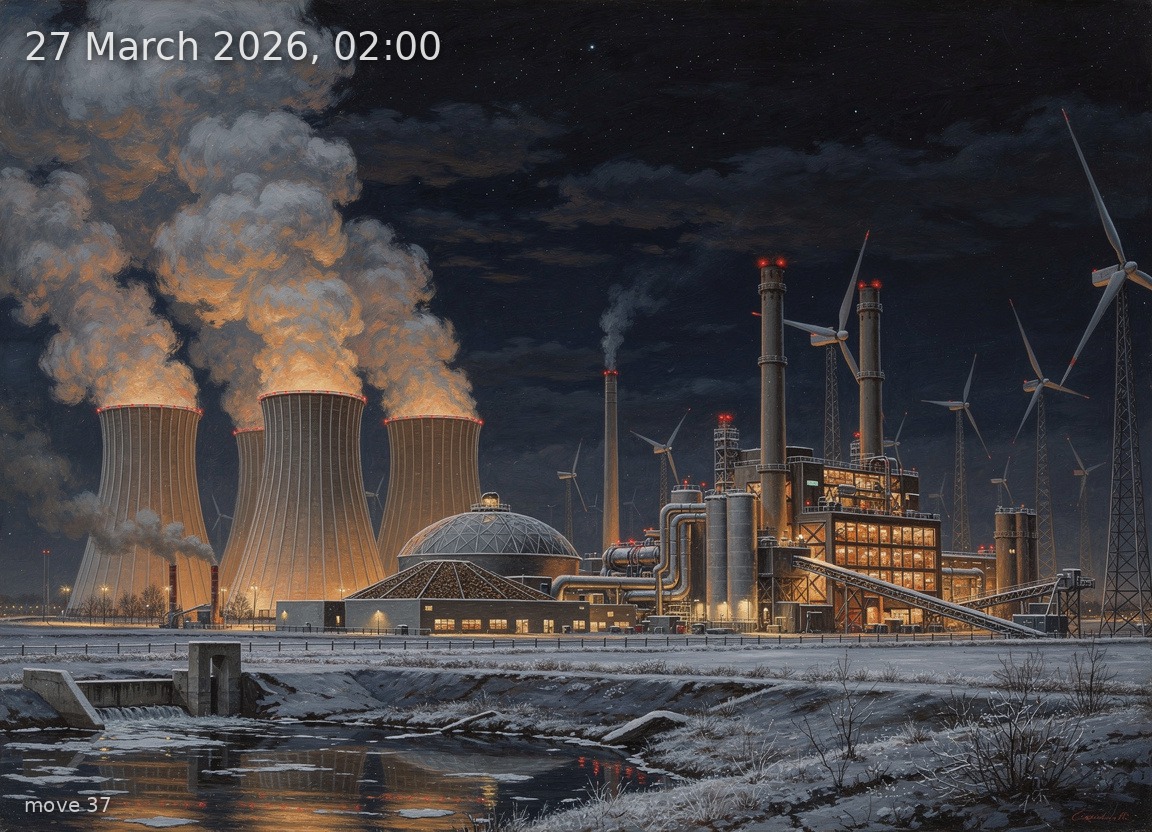
Strong onshore wind and heavy coal baseload dominate nighttime generation amid elevated prices and sub-zero temperatures.
Back
Generation mix
Wind onshore 32%
Wind offshore 2%
Solar 26%
Biomass 6%
Hydro 1%
Natural gas 7%
Hard coal 10%
Brown coal 16%
67%
Renewable share
25.2 GW
Wind (on + offshore)
19.9 GW
Solar
75.5 GW
Total generation
+75.5 GW
Net export
117.3 €/MWh
Day-ahead price
-0.6°C / 4 km/h
Temp / Wind speed
Open-Meteo, Kassel (51.3°N 9.5°E)
40.0% / 0.0 W/m²
Cloud cover / Radiation
242
gCO₂/kWh
Image prompt
Wind onshore 23.8 GW dominates the right half of the scene as dozens of tall three-blade turbines with lattice towers stretching across a flat North German plain into deep darkness, red aviation warning lights blinking on nacelles; brown coal 11.8 GW occupies the left quarter as a cluster of massive hyperbolic cooling towers emitting thick white steam plumes lit from below by sodium-orange industrial lights; hard coal 7.8 GW sits just right of centre as a blocky power station with twin chimneys and conveyor belt structures, glowing warmly from interior furnace light; natural gas 5.7 GW appears as a compact CCGT plant with a single tall exhaust stack and a slim vapour trail, positioned between the coal complex and the wind farm; biomass 4.3 GW is rendered as a smaller industrial facility with a wood-chip storage dome and a modest smokestack with faint grey exhaust, tucked in the mid-ground; hydro 1.0 GW is suggested by a small concrete dam structure with spillway visible at the far left edge beside a frozen riverbank. The sky is completely black to deep navy — it is 2 AM, no twilight, no sky glow, only artificial lighting from the power plants and turbine warning beacons. Temperature is below freezing: frost glistens on bare branches of dormant March vegetation in the foreground, patches of old snow on plowed fields. Cloud cover at 40% is suggested by darker patches obscuring some stars overhead. The atmosphere feels heavy and oppressive, reflecting the high electricity price — a brooding, weighty industrial stillness. Style: highly detailed oil painting in the tradition of 19th-century German Romantic landscape painters such as Caspar David Friedrich, with rich chiaroscuro, visible impasto brushwork, atmospheric depth and dramatic tonal contrasts between the warm orange industrial glow and the cold dark countryside. Meticulous engineering detail on all turbine nacelles, cooling tower fluting, conveyor structures, and exhaust stacks. No text, no labels.