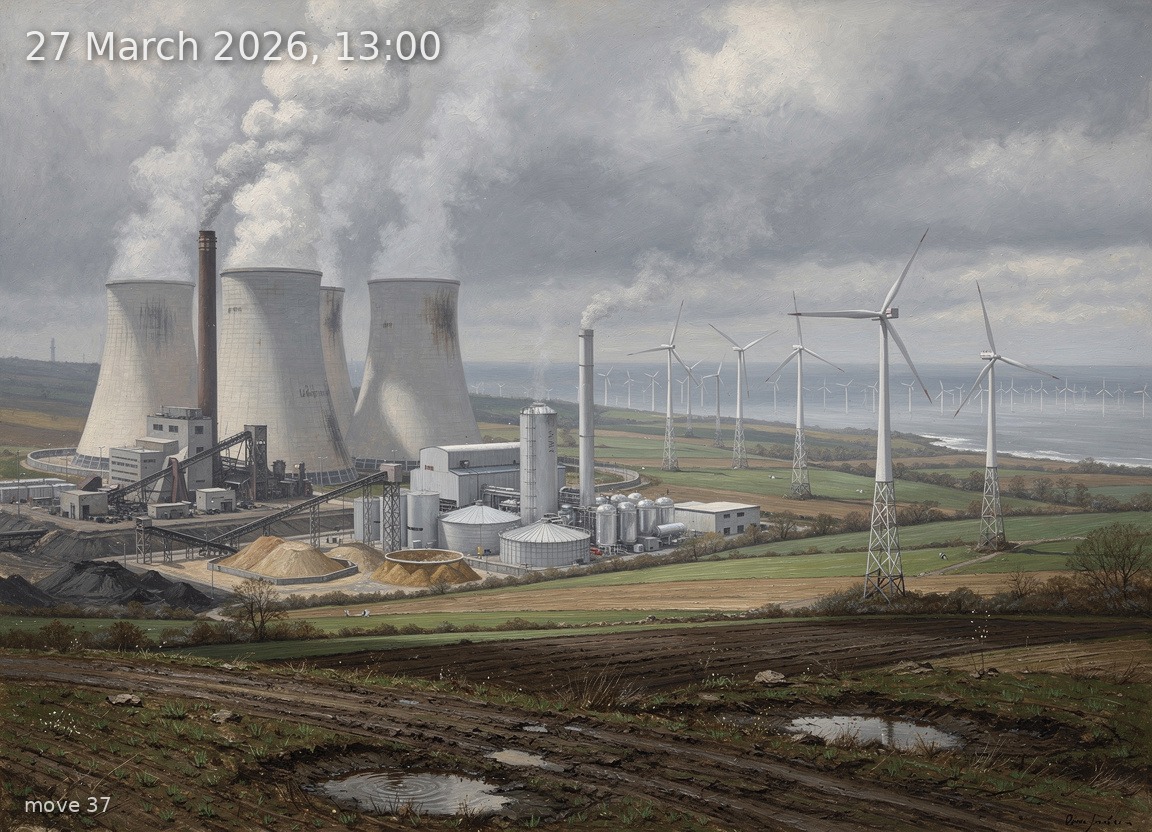
Wind onshore (13.3 GW) leads generation on an overcast spring midday, with brown coal (6.9 GW) providing firm thermal backup.
Back
Generation mix
Wind onshore 40%
Wind offshore 10%
Biomass 12%
Hydro 3%
Natural gas 5%
Hard coal 8%
Brown coal 21%
66%
Renewable share
16.8 GW
Wind (on + offshore)
0.0 GW
Solar
33.2 GW
Total generation
+33.2 GW
Net export
59.6 €/MWh
Day-ahead price
5.6°C / 7 km/h
Temp / Wind speed
Open-Meteo, Kassel (51.3°N 9.5°E)
72.0% / 128.2 W/m²
Cloud cover / Radiation
257
gCO₂/kWh
Image prompt
Wind onshore 13.3 GW dominates the right half and background as dozens of three-blade turbines on tall lattice-and-tubular towers stretching across rolling early-spring farmland with sparse green shoots; brown coal 6.9 GW occupies the left quarter as a cluster of massive hyperbolic cooling towers emitting thick white-grey steam plumes into overcast sky; wind offshore 3.5 GW appears in the far right distance as a line of turbines on the hazy horizon above a grey North Sea inlet; biomass 4.1 GW is represented in the centre-left as a mid-sized industrial plant with a tall stack and woodchip storage silos; hard coal 2.8 GW sits beside the brown coal complex as a smaller power station with conveyor belts and a single rectangular chimney trailing darker smoke; natural gas 1.7 GW appears as a compact CCGT unit with a single sleek exhaust stack and minimal visible emissions tucked between the coal and biomass plants; hydro 1.0 GW is rendered as a modest concrete dam with spillway in a valley in the far left background. Time of day: full midday daylight but heavily diffused through 72% cloud cover—a flat, even, pewter-grey sky with no direct sun and no visible solar panels anywhere. Temperature 5.6°C: bare deciduous trees with tiny budding tips, patches of old brown grass, cool-toned light. Wind 6.9 km/h: slight motion in turbine blades, gentle ripple in puddles on muddy field paths. Price-driven atmosphere: moderately heavy, slightly oppressive grey ceiling pressing down on the landscape. Style: highly detailed oil painting in the tradition of 19th-century German Romantic landscape painters—Caspar David Friedrich meets industrial realism—rich muted earth tones, visible impasto brushwork, atmospheric depth with haze softening distant turbines, meticulous engineering detail on every nacelle, cooling tower, and smokestack. No text, no labels, no human figures prominent.