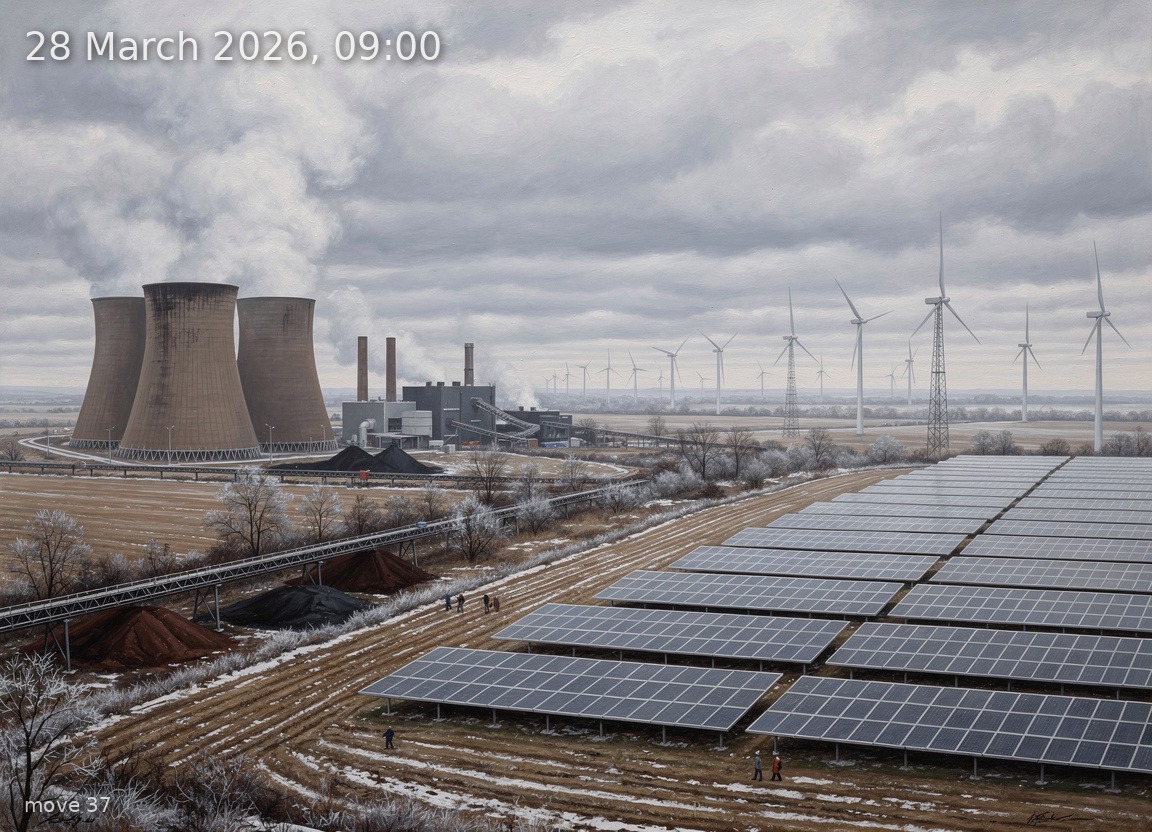
Solar leads at 20.9 GW under full overcast; coal and wind round out supply on a cold, cloudy March morning.
Back
Generation mix
Wind onshore 18%
Wind offshore 6%
Solar 37%
Biomass 7%
Hydro 2%
Natural gas 4%
Hard coal 9%
Brown coal 17%
70%
Renewable share
13.7 GW
Wind (on + offshore)
20.9 GW
Solar
56.5 GW
Total generation
+0.7 GW
Net export
44.9 €/MWh
Day-ahead price
0.9°C / 18 km/h
Temp / Wind speed
Open-Meteo, Kassel (51.3°N 9.5°E)
100.0% / 0.2 W/m²
Cloud cover / Radiation
223
gCO₂/kWh
Image prompt
Solar 20.9 GW dominates the right half of the scene as vast fields of aluminium-framed crystalline silicon PV panels stretching across flat farmland, their surfaces reflecting only the dull grey of the overcast sky — no direct sunlight, no glare. Brown coal 9.4 GW occupies the left foreground as a cluster of massive hyperbolic cooling towers emitting thick white steam plumes drifting rightward in the breeze, with conveyor belts of dark lignite visible at their base. Hard coal 4.9 GW appears behind them as a smaller coal plant with rectangular chimneys and a dark coal stockyard. Wind onshore 10.3 GW fills the centre-right middle ground as dozens of tall three-blade turbines on lattice and tubular towers, rotors visibly spinning in moderate wind. Wind offshore 3.5 GW is glimpsed far in the background as a line of turbines emerging from a misty horizon. Biomass 4.2 GW appears as a modest wood-clad biogas facility with a green domed fermenter and a small exhaust stack, nestled between the coal plant and the wind turbines. Natural gas 2.5 GW is rendered as a compact CCGT plant with a single sleek exhaust stack and minimal steam, placed behind the biomass facility. Hydro 0.9 GW is suggested by a small weir and powerhouse on a stream in the far left valley. The sky is 100% overcast — a uniform ceiling of heavy, layered grey-white stratus clouds, no blue visible anywhere, diffuse morning daylight with flat illumination typical of 09:00 in late March. The atmosphere is cold: frost rims bare hedgerows and dormant brown fields; patches of residual snow sit in shadowed furrows. Leafless deciduous trees with dark wet bark stand among the infrastructure. The air feels heavy and still despite moderate wind. Temperature near freezing: breath-visible cold. Painted as a highly detailed oil painting in the tradition of 19th-century German Romantic landscape painters — Caspar David Friedrich meets industrial realism — with rich layered colour in muted greys, browns, and slate blues, visible confident brushwork, atmospheric aerial perspective fading distant turbines into mist, meticulous engineering accuracy on every nacelle, cooling tower contour, and PV module frame. No text, no labels.