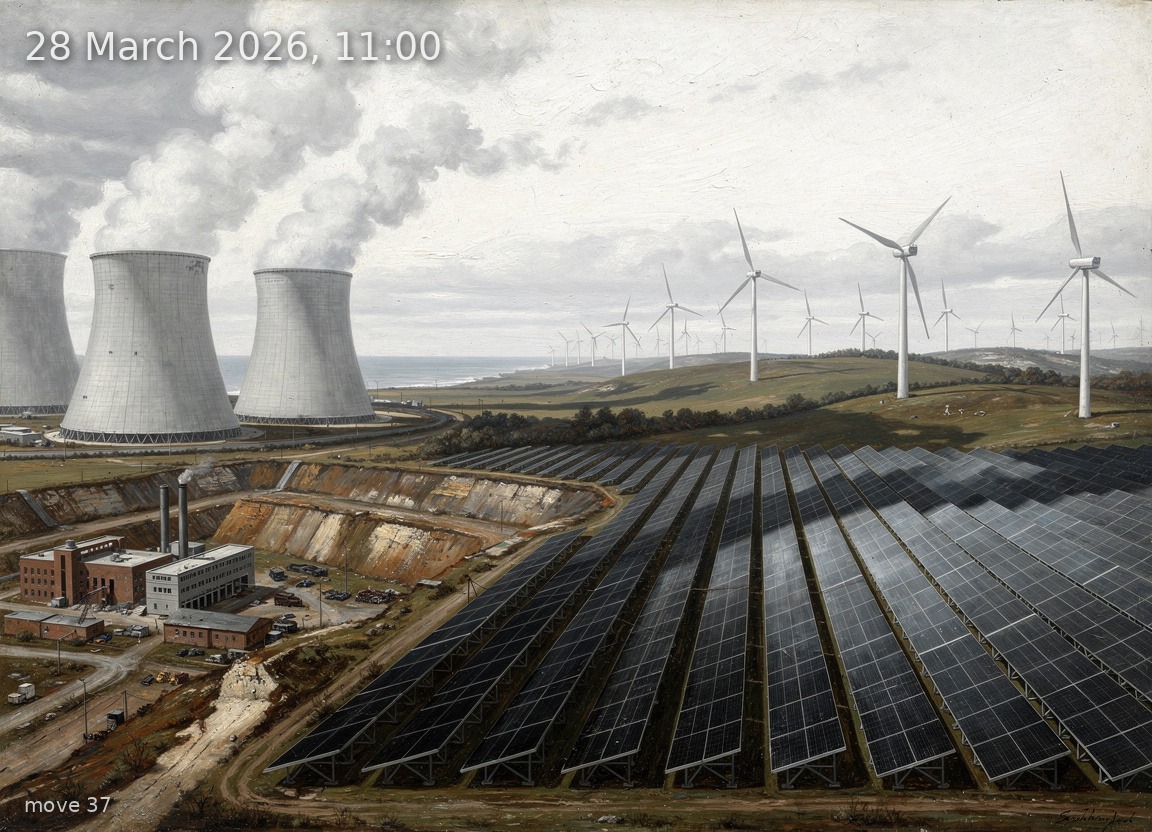
Solar dominates at 25.3 GW under overcast skies; brown coal persists at 8.6 GW as renewables reach 75% share with very low prices.
Back
Generation mix
Wind onshore 16%
Wind offshore 6%
Solar 45%
Biomass 7%
Hydro 2%
Natural gas 3%
Hard coal 7%
Brown coal 15%
75%
Renewable share
12.3 GW
Wind (on + offshore)
25.3 GW
Solar
56.8 GW
Total generation
-0.1 GW
Net import
7.6 €/MWh
Day-ahead price
2.3°C / 18 km/h
Temp / Wind speed
Open-Meteo, Kassel (51.3°N 9.5°E)
100.0% / 10.0 W/m²
Cloud cover / Radiation
188
gCO₂/kWh
Image prompt
Solar 25.3 GW dominates the right half and centre of the scene as vast fields of aluminium-framed crystalline silicon PV panels stretching across flat farmland under a completely overcast, bright-white sky with no visible sun—diffuse grey-white light illuminating everything evenly at midday. Wind onshore 9.1 GW appears as dozens of tall three-blade turbines with white tubular towers scattered across gentle rolling hills in the centre-right, blades turning moderately in 17.5 km/h winds. Wind offshore 3.2 GW is visible in the far background as a cluster of offshore turbines on a grey horizon line above a barely visible North Sea strip. Brown coal 8.6 GW occupies the left quarter as massive hyperbolic cooling towers emitting thick white-grey steam plumes that merge with the overcast ceiling, alongside a lignite open-pit mine edge with terraced brown earth. Hard coal 3.7 GW sits as a smaller coal-fired power station with rectangular stacks and thinner smoke columns adjacent to the lignite complex. Biomass 4.1 GW appears as several modest industrial biogas facilities with green cylindrical digesters and small chimneys with faint heat shimmer, placed in the mid-left among bare early-spring fields. Natural gas 1.7 GW is rendered as a single compact CCGT plant with a slender exhaust stack and minimal exhaust, near the biomass facilities. Hydro 0.9 GW is a small run-of-river weir with churning water in the foreground left corner. The landscape is late March with bare deciduous trees just beginning to bud, brown-green dormant grass, patches of old snow in shaded areas, temperature near freezing. The sky is uniformly thick cloud cover with no blue patches and no direct shadows on the ground—full diffuse daylight at 11:00. The atmosphere is calm and tranquil, reflecting a very low electricity price. Painted in the style of a highly detailed 19th-century German Romantic oil painting—rich impasto brushwork, atmospheric depth with muted earth tones and greys, meticulous engineering detail on every turbine nacelle, every PV panel frame, every cooling tower's parabolic curve, every brick of the coal plant. No text, no labels.