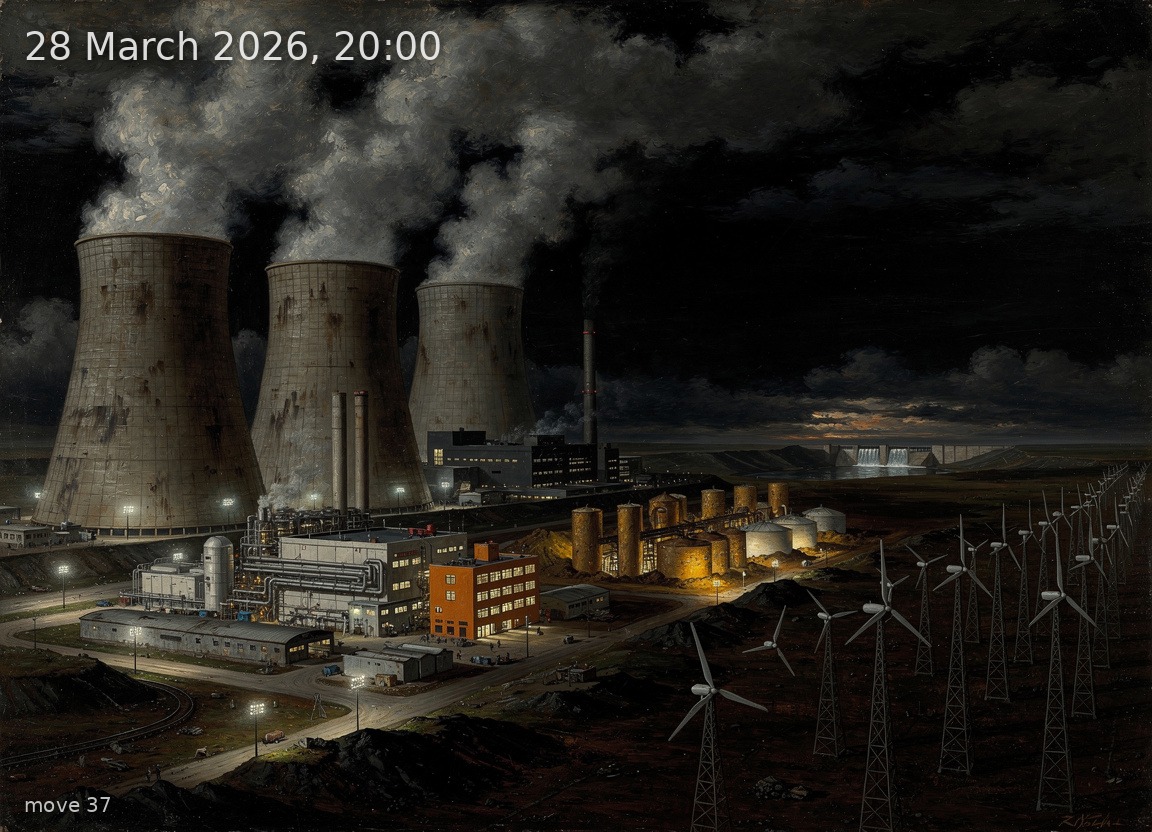
Brown coal and wind lead generation, but 13.2 GW net imports are needed to meet strong evening demand at 144 EUR/MWh.
Back
Generation mix
Wind onshore 23%
Wind offshore 7%
Biomass 12%
Hydro 3%
Natural gas 14%
Hard coal 11%
Brown coal 30%
45%
Renewable share
11.8 GW
Wind (on + offshore)
0.0 GW
Solar
39.0 GW
Total generation
-13.2 GW
Net import
144.0 €/MWh
Day-ahead price
2.7°C / 2 km/h
Temp / Wind speed
Open-Meteo, Kassel (51.3°N 9.5°E)
89.0% / 0.0 W/m²
Cloud cover / Radiation
398
gCO₂/kWh
Image prompt
Brown coal 11.7 GW dominates the left third of the scene as a massive lignite power station with four hyperbolic cooling towers emitting thick white-grey steam plumes into the night sky; wind onshore 9.0 GW and offshore 2.8 GW together span the right third as rows of three-blade turbines on lattice towers stretching across a flat darkened plain, blades turning very slowly in near-calm air; natural gas 5.3 GW appears centre-left as a compact CCGT facility with twin exhaust stacks and a single orange-lit control building; hard coal 4.4 GW sits behind the gas plant as a dark coal-fired station with a tall single chimney trailing thin smoke; biomass 4.6 GW is rendered centre-right as a cluster of illuminated wood-chip combustion units with short stacks and warm amber-lit storage silos; hydro 1.2 GW appears as a small concrete dam structure in the far background with a faint cascade of water catching artificial light. The time is 20:00, completely dark—a black sky with 89% cloud cover blocking all stars and moonlight, heavy overcast pressing down oppressively on the scene to reflect the high electricity price. Sodium-orange streetlights line an access road in the foreground, casting pools of amber on wet early-spring ground with sparse brown grass and patches of old snow at 2.7°C. Industrial floodlights illuminate the cooling towers and plant structures, their reflections shimmering faintly in puddles. No solar panels anywhere—no sunlight, no glow on the horizon, pure nighttime darkness. The atmosphere is heavy, damp, and oppressive with low clouds catching the orange industrial glow from below. Painted in the style of a highly detailed 19th-century German Romantic oil painting with rich impasto brushwork, deep chiaroscuro contrasts between industrial light and surrounding darkness, atmospheric depth achieved through layered mist and steam, meticulous engineering detail on every turbine nacelle, cooling tower, and exhaust stack. No text, no labels.