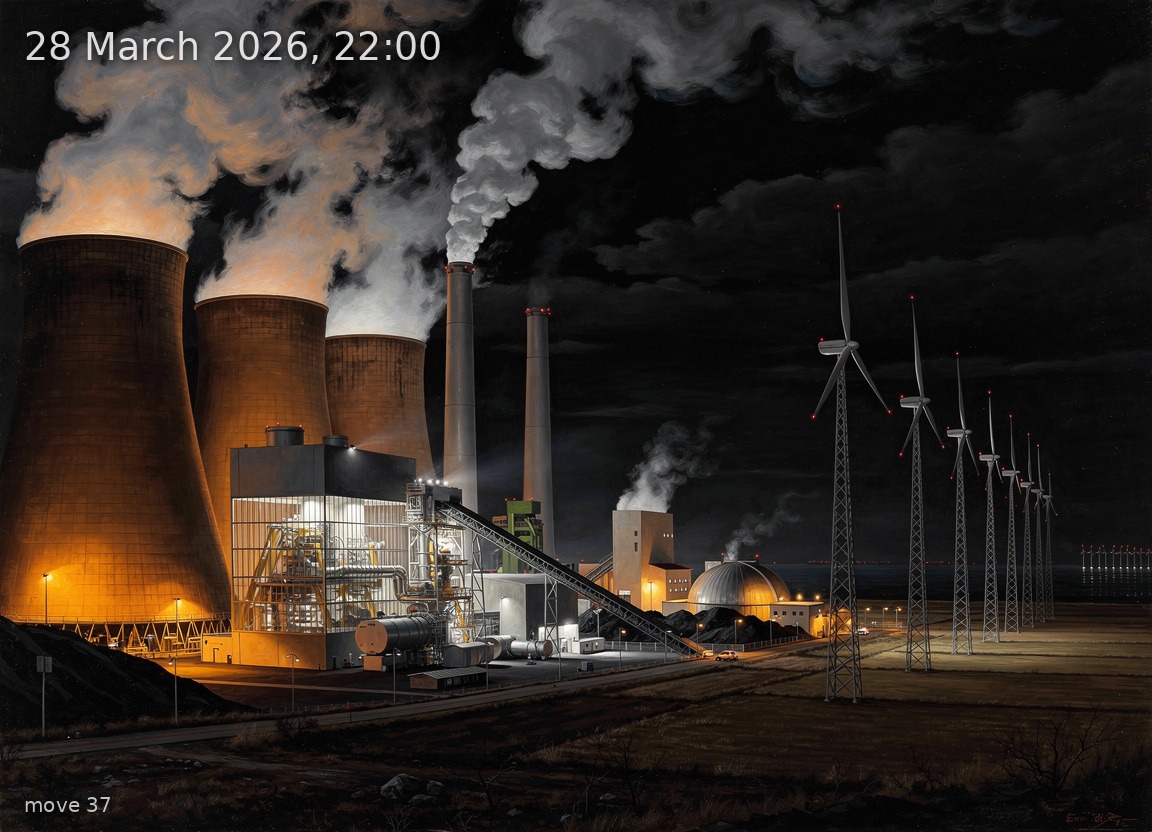
Brown coal and wind dominate generation as net imports of 5.6 GW cover late-evening heating demand at elevated prices.
Back
Generation mix
Wind onshore 25%
Wind offshore 7%
Biomass 11%
Hydro 3%
Natural gas 14%
Hard coal 12%
Brown coal 29%
46%
Renewable share
13.5 GW
Wind (on + offshore)
0.0 GW
Solar
42.2 GW
Total generation
-5.6 GW
Net import
125.3 €/MWh
Day-ahead price
2.1°C / 3 km/h
Temp / Wind speed
Open-Meteo, Kassel (51.3°N 9.5°E)
97.0% / 0.0 W/m²
Cloud cover / Radiation
390
gCO₂/kWh
Image prompt
Brown coal 12.0 GW dominates the left third of the scene as a massive lignite power complex with four hyperbolic cooling towers emitting thick white steam plumes into the black night sky, their concrete shells lit from below by sodium-orange industrial floodlights; wind onshore 10.7 GW fills the right third as a long row of tall three-blade turbines on lattice towers stretching into the dark distance across flat farmland, their red aviation warning lights blinking in slow rhythm, blades barely turning in the still air; wind offshore 2.8 GW appears as a faint cluster of turbines on a dark horizon line beyond a sliver of black sea at the far right; natural gas 5.9 GW occupies the centre-left as two compact CCGT plants with tall single exhaust stacks releasing thin grey plumes, their glass-walled turbine halls glowing warmly from within; hard coal 5.0 GW sits adjacent as a traditional coal plant with a single large smokestack and conveyor belts carrying dark fuel, lit by harsh white spotlights; biomass 4.6 GW appears as a modest wood-chip-fired CHP facility with a short rectangular stack and a steaming dome, nestled behind the coal plant; hydro 1.2 GW is represented by a small run-of-river weir with spillway foam visible in reflected lamplight at the bottom-right foreground. The sky is completely black and starless under 97% cloud cover, heavy and oppressive, with no moon or twilight visible—only the artificial orange and white lights of the industrial facilities illuminate the scene. The ground shows late-winter brown grass and bare deciduous trees with no leaves, frost glinting on metal surfaces, temperature near freezing. A sense of heavy atmospheric pressure pervades the composition. Style: highly detailed oil painting in the tradition of 19th-century German Romantic landscape painters such as Caspar David Friedrich crossed with industrial realism—rich impasto brushwork, deep chiaroscuro contrasts between orange industrial glow and the surrounding blackness, atmospheric depth with steam and haze softening distant structures, meticulous engineering detail on turbine nacelles, cooling tower ribbing, and CCGT exhaust assemblies. No text, no labels.