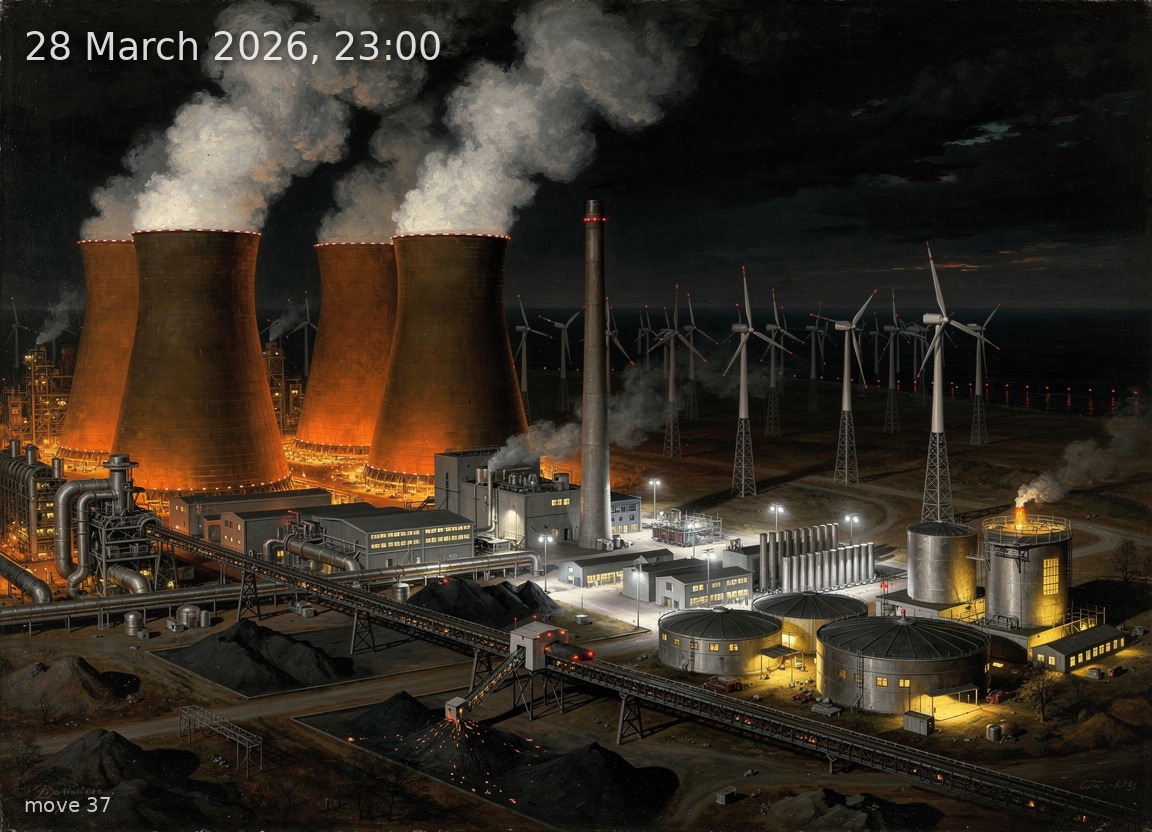
Brown coal and wind lead a tight late-night grid requiring net imports under overcast, near-freezing conditions.
Back
Generation mix
Wind onshore 26%
Wind offshore 7%
Biomass 11%
Hydro 3%
Natural gas 14%
Hard coal 12%
Brown coal 28%
47%
Renewable share
14.3 GW
Wind (on + offshore)
0.0 GW
Solar
43.0 GW
Total generation
-1.7 GW
Net import
119.6 €/MWh
Day-ahead price
1.6°C / 5 km/h
Temp / Wind speed
Open-Meteo, Kassel (51.3°N 9.5°E)
100.0% / 0.0 W/m²
Cloud cover / Radiation
384
gCO₂/kWh
Image prompt
Brown coal 12.0 GW dominates the left third of the scene as a massive lignite power complex with four hyperbolic cooling towers emitting thick white-grey steam plumes lit from below by sodium-orange industrial lighting; wind onshore 11.3 GW spans the centre-right as dozens of three-blade turbines on lattice and tubular towers, their red aviation warning lights blinking against a black sky, rotors turning at moderate speed; natural gas 5.9 GW appears as a cluster of compact CCGT plants with tall single exhaust stacks venting thin heat plumes, illuminated by harsh halogen floodlights; hard coal 5.0 GW sits adjacent to the lignite complex as a coal-fired station with a tall chimney and conveyor belts feeding stockpiles, orange sparks visible; wind offshore 3.0 GW is suggested on the far right horizon as a faint line of red blinking lights above an invisible sea; biomass 4.6 GW appears as a mid-ground industrial biogas facility with cylindrical digesters and a small smokestack glowing warmly; hydro 1.2 GW is a small dam structure in the lower foreground with water spilling under floodlight. The sky is entirely black with complete 100% cloud cover — no stars, no moon, no twilight glow whatsoever, a heavy oppressive overcast ceiling pressing down. The ground shows late-winter bare trees, patches of frost on dormant brown grass, temperature near freezing. The atmosphere feels heavy and tense, reflecting the high electricity price. Sodium streetlights cast amber pools along an access road. Painted in the style of a highly detailed 19th-century German Romantic oil painting — rich impasto brushwork, dramatic chiaroscuro between dark sky and industrial glow, atmospheric depth with mist and steam, meticulous engineering accuracy on every turbine nacelle, cooling tower, and exhaust stack. No text, no labels.