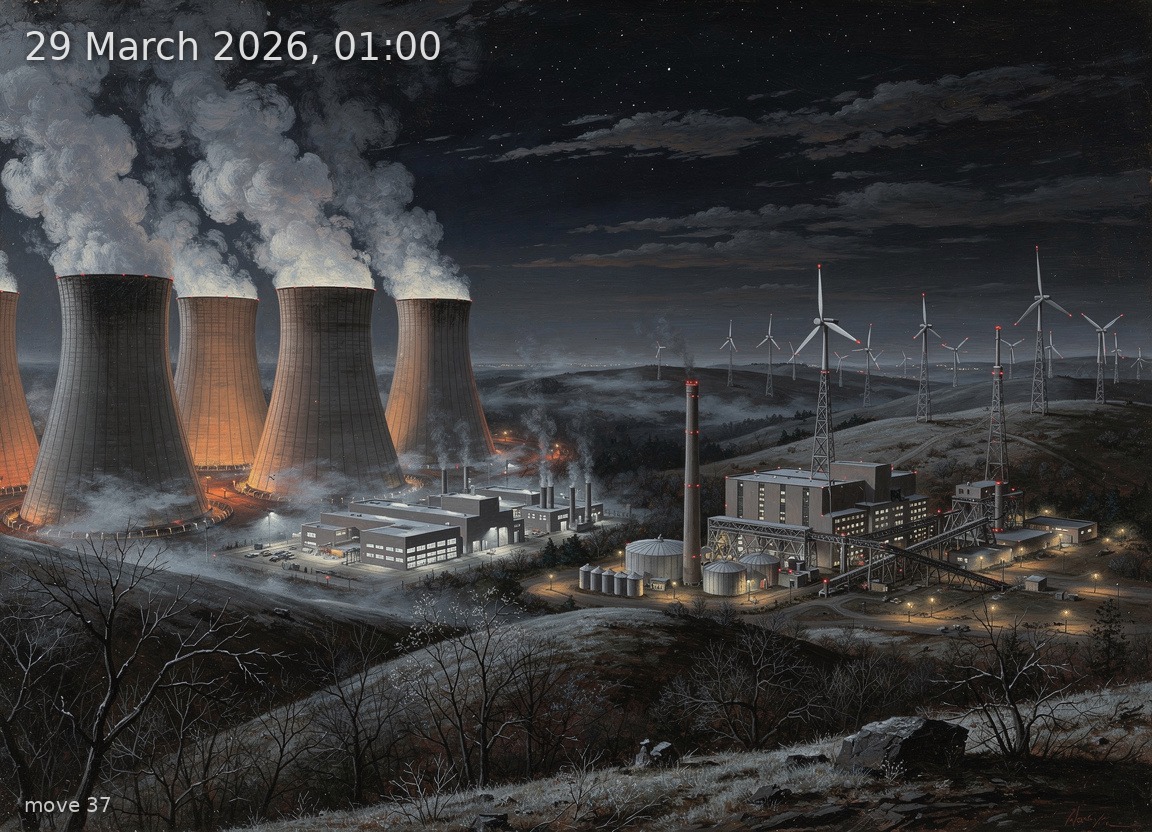
Brown coal and wind dominate a balanced nighttime grid, with elevated prices reflecting tight thermal dispatch.
Back
Generation mix
Wind onshore 27%
Wind offshore 6%
Biomass 11%
Hydro 3%
Natural gas 14%
Hard coal 12%
Brown coal 28%
46%
Renewable share
13.8 GW
Wind (on + offshore)
0.0 GW
Solar
42.3 GW
Total generation
+0.1 GW
Net export
107.7 €/MWh
Day-ahead price
1.7°C / 4 km/h
Temp / Wind speed
Open-Meteo, Kassel (51.3°N 9.5°E)
18.0% / 0.0 W/m²
Cloud cover / Radiation
387
gCO₂/kWh
Image prompt
Brown coal 11.9 GW dominates the left third of the scene as a vast complex of hyperbolic cooling towers with thick white steam plumes rising into the dark sky; wind onshore 11.3 GW spans the right third as dozens of three-blade turbines on lattice towers across rolling hills, their red aviation lights blinking in the darkness; natural gas 5.9 GW appears centre-left as compact CCGT units with tall single exhaust stacks emitting thin heat shimmer; hard coal 5.0 GW sits centre-right as a traditional power station with rectangular boiler houses, conveyors, and a tall chimney with a faint red glow; biomass 4.6 GW is rendered as a cluster of smaller industrial facilities with rounded silos and short stacks near the centre; wind offshore 2.5 GW is visible in the far-right distance as a line of turbines on the horizon above a dark sea; hydro 1.2 GW appears as a small dam and powerhouse nestled in a valley at far left. The time is 1:00 AM in late March—the sky is completely black with no twilight, no sky glow, a deep navy-black firmament speckled with faint stars visible through 18% scattered cloud wisps. Temperature is near freezing: bare deciduous trees, patches of frost on dormant grass, breath-visible cold atmosphere. Sodium-orange streetlights line a road threading between the facilities, casting warm pools of light. The elevated price manifests as a heavy, oppressive industrial atmosphere with dense steam hanging low. Painted in the style of a highly detailed 19th-century German Romantic oil painting—rich darks, dramatic chiaroscuro from artificial lighting, visible impasto brushwork, atmospheric depth receding into the dark distance—yet with meticulous engineering accuracy in every turbine nacelle, cooling tower curvature, and exhaust stack detail. No text, no labels.