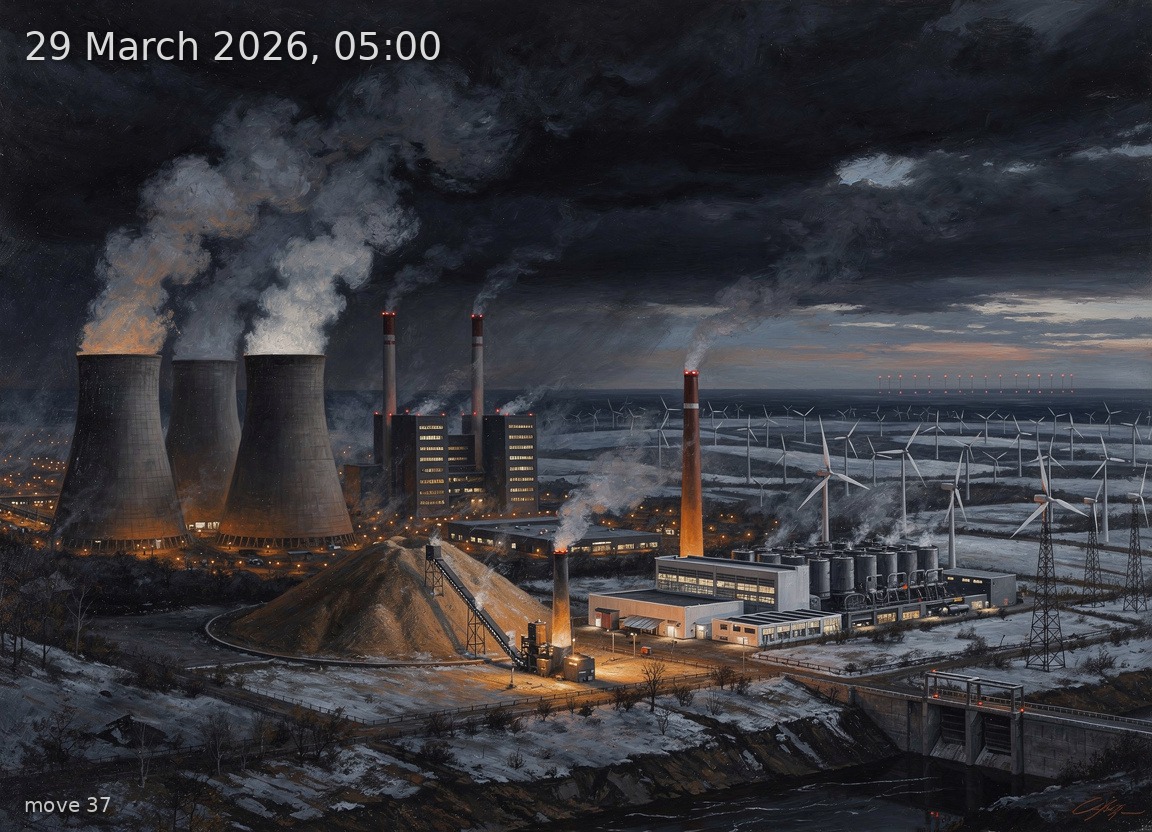
Pre-dawn cold drives 42.7 GW demand; wind and lignite dominate as Germany imports 5.4 GW.
Back
Generation mix
Wind onshore 28%
Wind offshore 7%
Biomass 11%
Hydro 3%
Natural gas 13%
Hard coal 13%
Brown coal 26%
48%
Renewable share
13.0 GW
Wind (on + offshore)
0.0 GW
Solar
37.3 GW
Total generation
-5.4 GW
Net import
104.6 €/MWh
Day-ahead price
-0.9°C / 6 km/h
Temp / Wind speed
Open-Meteo, Kassel (51.3°N 9.5°E)
95.0% / 0.0 W/m²
Cloud cover / Radiation
373
gCO₂/kWh
Image prompt
Brown coal 9.6 GW occupies the left third of the scene as a massive lignite power station with four hyperbolic cooling towers releasing thick white steam plumes into the black sky; hard coal 5.0 GW appears just right of centre as a pair of smaller coal plants with rectangular stacks and red aviation warning lights; natural gas 4.8 GW sits centre-right as compact CCGT units with slender single exhaust stacks glowing faintly orange from within; wind onshore 10.4 GW spans the right third and background as dozens of three-blade turbines on lattice and tubular towers, their nacelle lights blinking red in the darkness, rotors turning slowly; wind offshore 2.6 GW is suggested on the far-right horizon as a distant cluster of turbine warning lights over a dark flat plain implying the North Sea; biomass 4.0 GW appears as a mid-ground industrial facility with a wood-chip storage dome and a single illuminated smokestack; hydro 1.0 GW is a small dam structure in the lower-right foreground with water faintly reflecting sodium-yellow light. The sky is deep navy-black with 95% overcast — no stars visible, no twilight glow, only the faintest hint of pre-dawn grey-blue at the extreme eastern horizon. The temperature is below zero: frost coats the bare branches of dormant deciduous trees in the foreground, patches of old snow on frozen ground. The atmosphere is heavy, oppressive, dense with low cloud pressing down, reflecting the high electricity price. Sodium streetlights along a small road cast amber pools of light across frozen mud. Industrial smoke and steam merge into the low cloud base. Highly detailed oil painting in the tradition of 19th-century German Romantic landscape painters — rich, dark colour palette of deep blues, blacks, warm ambers, and cold whites; visible impasto brushwork; atmospheric depth with layers of mist and steam; meticulous engineering detail on every turbine nacelle, cooling tower contour, and exhaust stack. The scene evokes Caspar David Friedrich reimagining an industrial Ruhrgebiet dawn. No text, no labels.