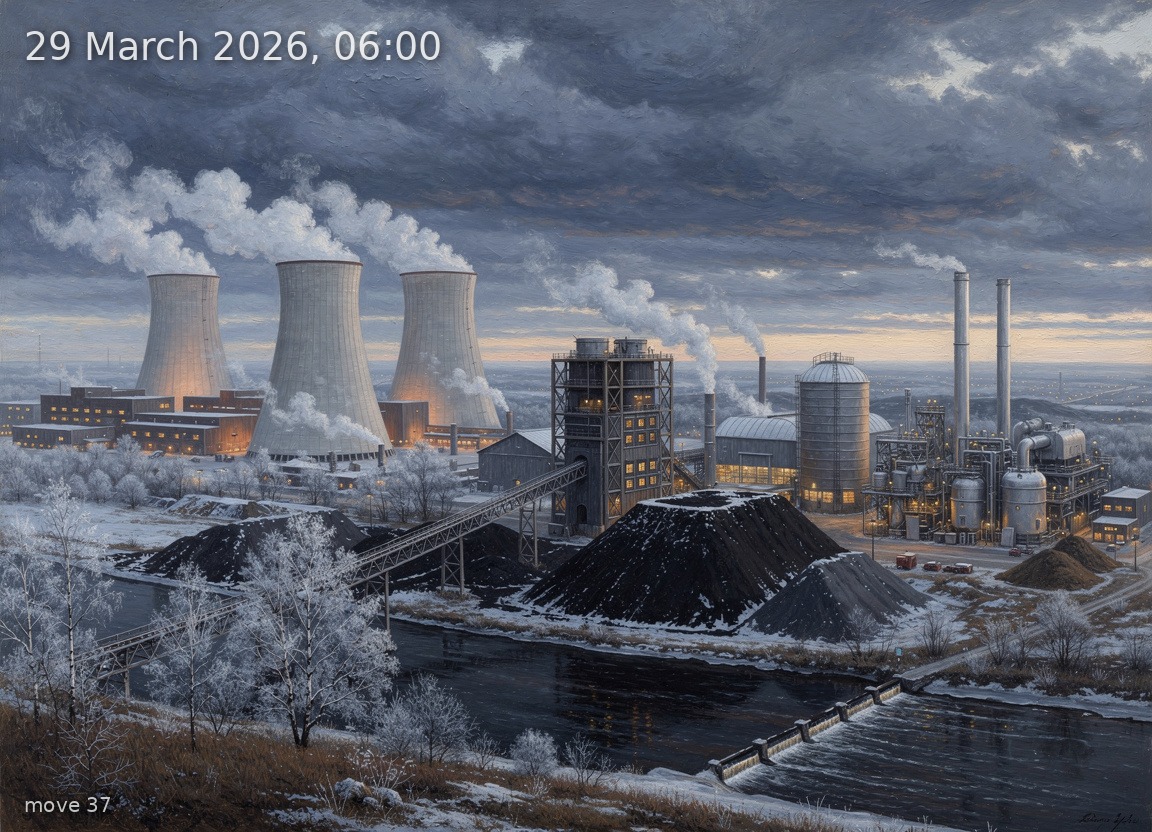
Wind and brown coal anchor a cold, dark pre-dawn grid facing 7.3 GW net imports at elevated prices.
Back
Generation mix
Wind onshore 27%
Wind offshore 7%
Solar 0%
Biomass 11%
Hydro 3%
Natural gas 13%
Hard coal 13%
Brown coal 26%
48%
Renewable share
12.8 GW
Wind (on + offshore)
0.0 GW
Solar
37.4 GW
Total generation
-7.3 GW
Net import
109.8 €/MWh
Day-ahead price
-0.8°C / 6 km/h
Temp / Wind speed
Open-Meteo, Kassel (51.3°N 9.5°E)
91.0% / 0.0 W/m²
Cloud cover / Radiation
372
gCO₂/kWh
Image prompt
Brown coal 9.6 GW dominates the left third of the scene as a massive lignite power station with four hyperbolic cooling towers emitting thick white steam plumes into the frozen air; hard coal 4.9 GW appears just right of centre as a pair of tall rectangular boiler houses with conveyor belts and a coal stockpile, smoke drifting from their chimneys; natural gas 4.8 GW sits as two compact CCGT units with slender exhaust stacks and heat-recovery modules near the centre-right; wind onshore 10.0 GW fills the right third and recedes into the distance as dozens of three-blade turbines on lattice and tubular towers turning slowly on ridgelines; wind offshore 2.8 GW is suggested by a row of distant turbines on the far-right horizon over a dark sea; biomass 4.1 GW appears as a medium-sized wood-chip-fired plant with a domed storage silo and a single stack near the coal complex; hydro 1.2 GW is a small run-of-river weir with a low concrete dam visible in the middle distance along a dark river. Time of day is early dawn at 06:00 in late March: the sky is deep blue-grey with the faintest pale luminescence along the eastern horizon, no direct sunlight, no visible sun disk; 91% cloud cover renders the sky a heavy, oppressive blanket of stratus clouds pressing down. Temperature is below zero: frost coats the bare deciduous trees and brown dormant grass, thin ice edges the river, breath-like condensation rises from every cooling tower and stack. No solar panels anywhere — zero solar generation. The atmosphere feels heavy and costly, the overcast sky weighing on the landscape. Wind turbine blades show slight motion blur. Sodium-orange lights glow from the industrial facilities and a small village in the valley. Highly detailed oil painting in the tradition of 19th-century German Romantic landscape painters — Caspar David Friedrich meets industrial realism — with rich, sombre colour palette of slate blues, ash greys, warm ambers from artificial light, visible textured brushwork, atmospheric depth and aerial perspective. Meticulous engineering detail on every turbine nacelle, cooling tower fluting, conveyor structure, and exhaust stack. No text, no labels.