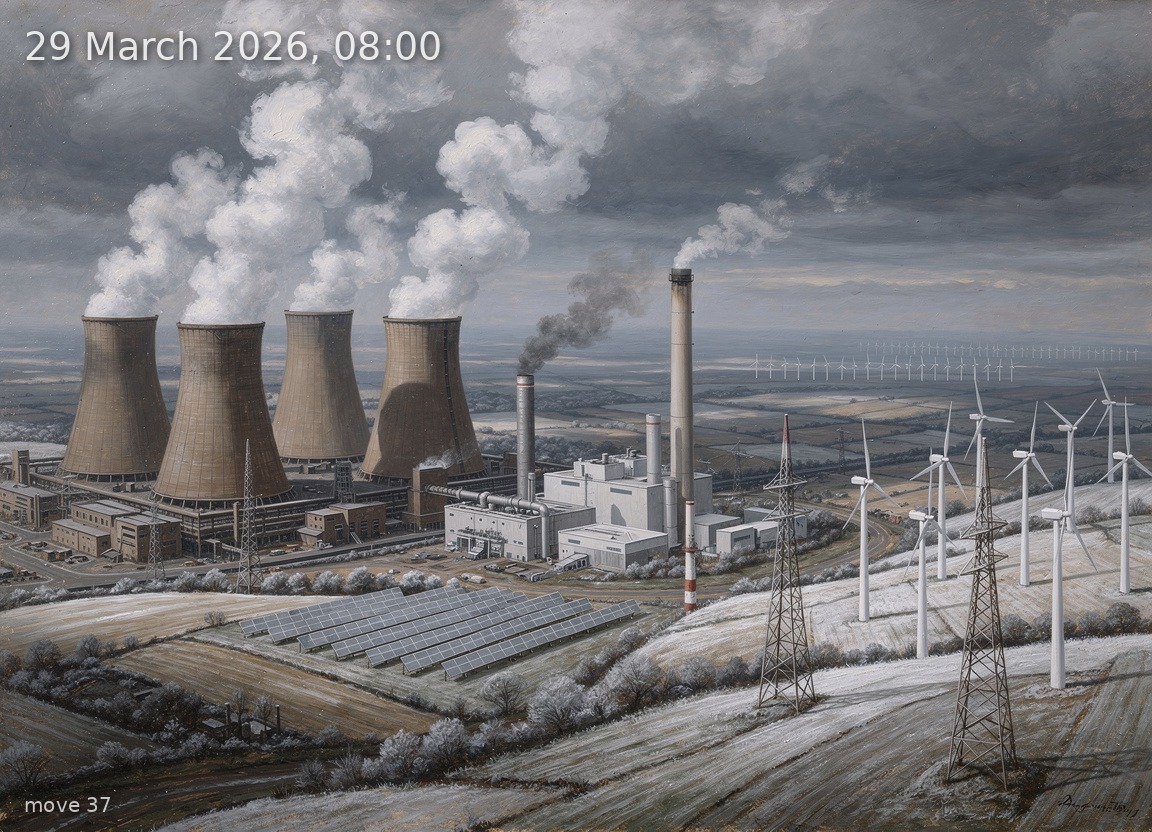
Cold overcast morning: wind and lignite dominate generation while 8 GW net imports cover the consumption gap.
Back
Generation mix
Wind onshore 19%
Wind offshore 7%
Solar 14%
Biomass 10%
Hydro 3%
Natural gas 12%
Hard coal 12%
Brown coal 23%
53%
Renewable share
10.7 GW
Wind (on + offshore)
5.9 GW
Solar
41.5 GW
Total generation
-8.2 GW
Net import
114.8 €/MWh
Day-ahead price
-0.4°C / 10 km/h
Temp / Wind speed
Open-Meteo, Kassel (51.3°N 9.5°E)
100.0% / 0.0 W/m²
Cloud cover / Radiation
336
gCO₂/kWh
Image prompt
Brown coal 9.4 GW occupies the left quarter as a massive lignite power station with four hyperbolic cooling towers belching thick white steam plumes into frigid air; hard coal 5.2 GW stands just right of center-left as a smaller coal plant with rectangular boiler houses and a single tall smokestack trailing grey exhaust; natural gas 4.8 GW appears center-right as a compact CCGT facility with sleek exhaust stacks and a modest vapor trail; wind onshore 7.9 GW spans the right third of the scene as two dozen three-blade turbines on lattice and tubular towers spread across gently rolling frost-covered farmland, blades turning slowly in light wind; wind offshore 2.8 GW is suggested by a distant line of turbines barely visible through haze on a far horizon; solar 5.9 GW appears as rows of aluminium-framed crystalline silicon panels on a hillside in the mid-ground, their surfaces dull grey reflecting no sunlight under the overcast; biomass 4.3 GW is a modest industrial plant with a woodchip silo and a single low chimney emitting thin white smoke, placed in the middle distance; hydro 1.1 GW is a small run-of-river weir with a concrete powerhouse visible along a river in the foreground valley. The time is 08:00 in late March: full daylight but entirely diffuse, the sky a uniform heavy blanket of 100% cloud cover in oppressive shades of pewter and slate grey, conveying high electricity prices and tight supply. Temperature is below freezing: bare deciduous trees with frost-rimmed branches, patches of ice on puddles, dormant brown grass with rime, breath-visible cold. The atmosphere is dense, heavy, claustrophobic—low ceiling of cloud pressing down on the industrial landscape. Rendered as a highly detailed oil painting in the tradition of 19th-century German Romantic landscape painters such as Caspar David Friedrich and Carl Blechen, with rich impasto brushwork, deep atmospheric perspective, meticulous engineering detail on every turbine nacelle, cooling tower, and panel frame, dramatic tonal contrasts between the dark earth and pale steam plumes, a palette of iron grey, cold blue, muted ochre, and chalk white. No text, no labels.