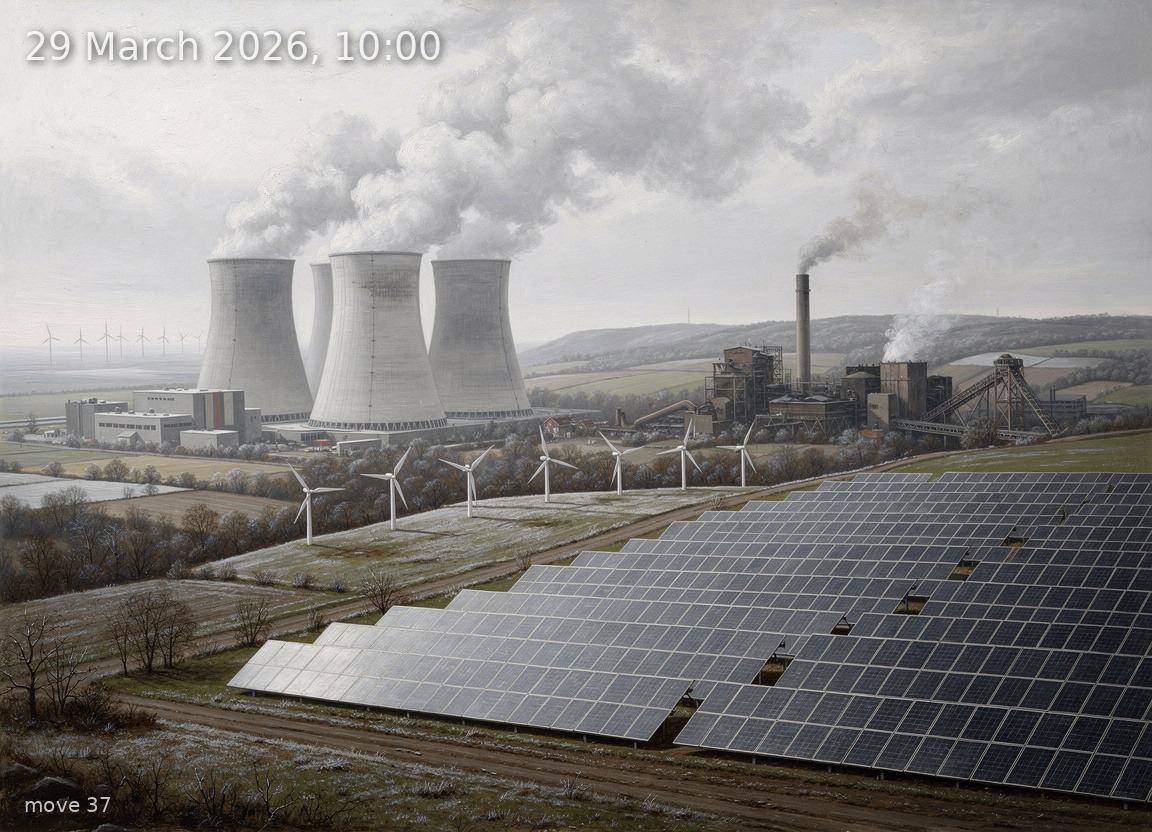
Solar leads at 19.6 GW under full overcast; brown coal at 9.2 GW and gas backstop a low-wind, import-dependent morning.
Back
Generation mix
Wind onshore 12%
Wind offshore 5%
Solar 37%
Biomass 9%
Hydro 2%
Natural gas 9%
Hard coal 9%
Brown coal 17%
64%
Renewable share
8.9 GW
Wind (on + offshore)
19.6 GW
Solar
53.0 GW
Total generation
-0.9 GW
Net import
74.8 €/MWh
Day-ahead price
2.1°C / 7 km/h
Temp / Wind speed
Open-Meteo, Kassel (51.3°N 9.5°E)
100.0% / 0.8 W/m²
Cloud cover / Radiation
256
gCO₂/kWh
Image prompt
Solar 19.6 GW dominates the right half of the scene as vast fields of aluminium-framed crystalline silicon PV panels stretching across flat farmland, their surfaces reflecting dull pewter light under total overcast; brown coal 9.2 GW occupies the left quarter as a massive lignite power station with four hyperbolic cooling towers emitting thick white-grey steam plumes merging into the cloud deck; wind onshore 6.2 GW appears as a row of seven three-blade turbines on low ridgelines in the centre-left middle distance, rotors turning very slowly in light air; wind offshore 2.7 GW suggested by distant turbines on a hazy horizon line at far left; natural gas 5.0 GW rendered as two compact CCGT units with slender single exhaust stacks and modest heat shimmer, positioned centre-left beside the coal plant; hard coal 4.8 GW shown as a gritty conventional power station with a single large smokestack and coal conveyor visible, adjacent to the lignite complex; biomass 4.5 GW depicted as a mid-sized wood-chip-fed plant with a rounded silo and low steam vent at centre-right edge; hydro 1.1 GW as a small run-of-river weir and powerhouse barely visible in a stream in the foreground. Full daylight at 10:00 AM but entirely diffuse — no shadows, no direct sun, a uniformly flat white-grey sky from horizon to zenith creating a heavy, oppressive atmosphere reflecting the 74.8 EUR/MWh price. Temperature 2°C: bare deciduous trees with no buds yet, frost lingering on north-facing grass, early spring brown-and-grey palette with patches of dull green. Light wind barely stirs branches. The landscape is central German lowland rolling into gentle hills. Highly detailed oil painting in the tradition of 19th-century German Romantic landscape painters — rich tonal depth, visible confident brushwork, atmospheric perspective with haze softening distant elements — yet with meticulous engineering accuracy on every turbine nacelle, every cooling tower's parabolic curve, every PV panel's cell grid. No text, no labels.