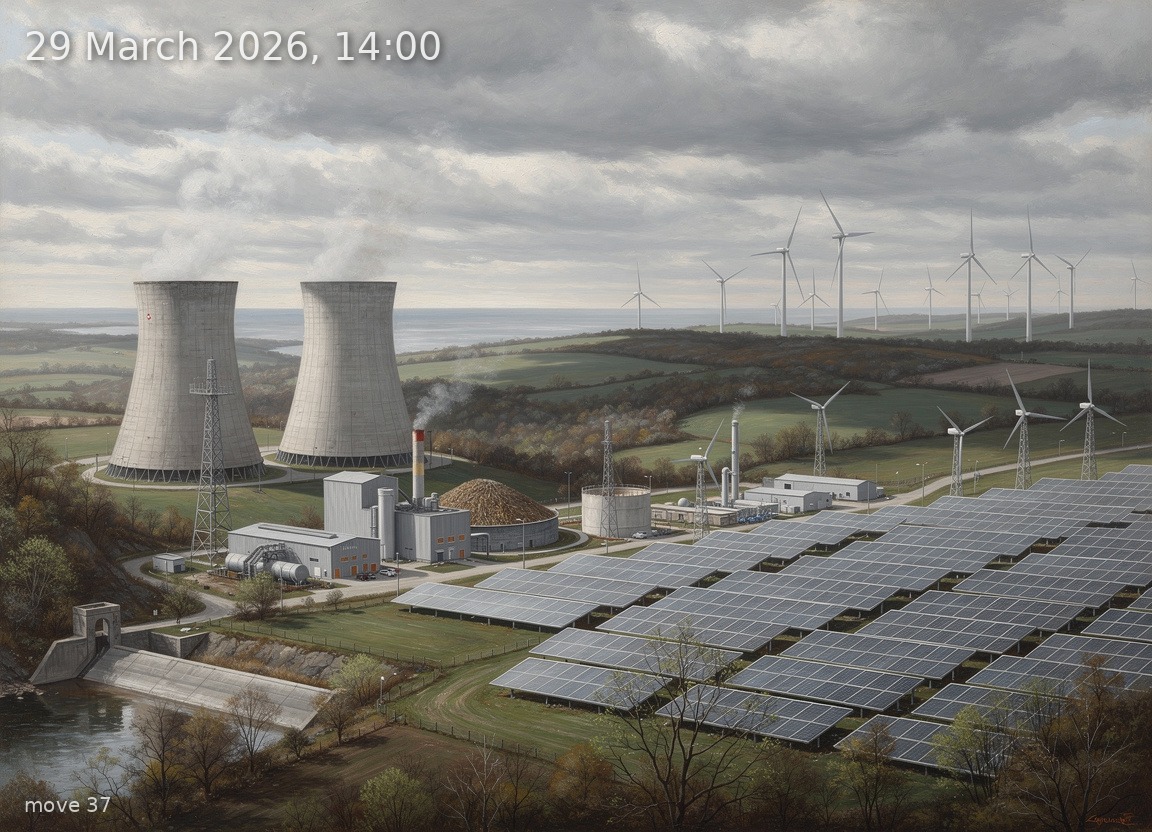
Solar at 31.7 GW and wind at 15.3 GW drive 9.2 GW net exports and a negative clearing price.
Back
Generation mix
Wind onshore 16%
Wind offshore 9%
Solar 52%
Biomass 7%
Hydro 2%
Natural gas 4%
Hard coal 3%
Brown coal 7%
86%
Renewable share
15.3 GW
Wind (on + offshore)
31.7 GW
Solar
60.6 GW
Total generation
+9.2 GW
Net export
-1.8 €/MWh
Day-ahead price
8.1°C / 10 km/h
Temp / Wind speed
Open-Meteo, Kassel (51.3°N 9.5°E)
91.0% / 173.0 W/m²
Cloud cover / Radiation
97
gCO₂/kWh
Image prompt
Solar 31.7 GW dominates the scene as an enormous expanse of crystalline silicon PV panels stretching across rolling fields covering more than half the canvas from centre to right; wind onshore 10.0 GW appears as dozens of three-blade turbines on lattice towers scattered across mid-ground hills; wind offshore 5.3 GW is visible as a cluster of tall turbines on the far horizon above a silver strip of sea; brown coal 4.4 GW occupies the left foreground as two massive hyperbolic cooling towers with thin, wispy steam plumes; biomass 4.2 GW sits beside them as a compact industrial facility with a wood-chip storage dome and a single exhaust stack; natural gas 2.2 GW appears as a small CCGT plant with a sleek exhaust stack and modest heat shimmer; hard coal 1.6 GW is a single smaller cooling tower partially behind the brown coal plant; hydro 1.1 GW is a modest dam and spillway nestled in a valley at the far left edge. Full afternoon daylight at 14:00 under a heavily overcast sky — thick grey-white stratus blanket with diffuse brightness, no visible sun disc, yet the landscape is well-lit with soft shadowless illumination. Temperature 8°C: early spring vegetation with pale green buds on bare deciduous trees, brown-grey fields, patches of fresh grass. Light breeze visible in gently swaying grass. The atmosphere is calm and open, reflecting the near-zero electricity price — no oppressive tones, just a quiet, expansive stillness. Highly detailed oil painting in the tradition of 19th-century German Romantic landscape painters — Caspar David Friedrich meets industrial modernity — rich muted colour palette of slate grey, sage green, and pewter, visible confident brushwork, atmospheric depth with soft aerial perspective fading toward the horizon, meticulous engineering accuracy on every turbine nacelle, aluminium PV frame, and cooling tower curve. No text, no labels.