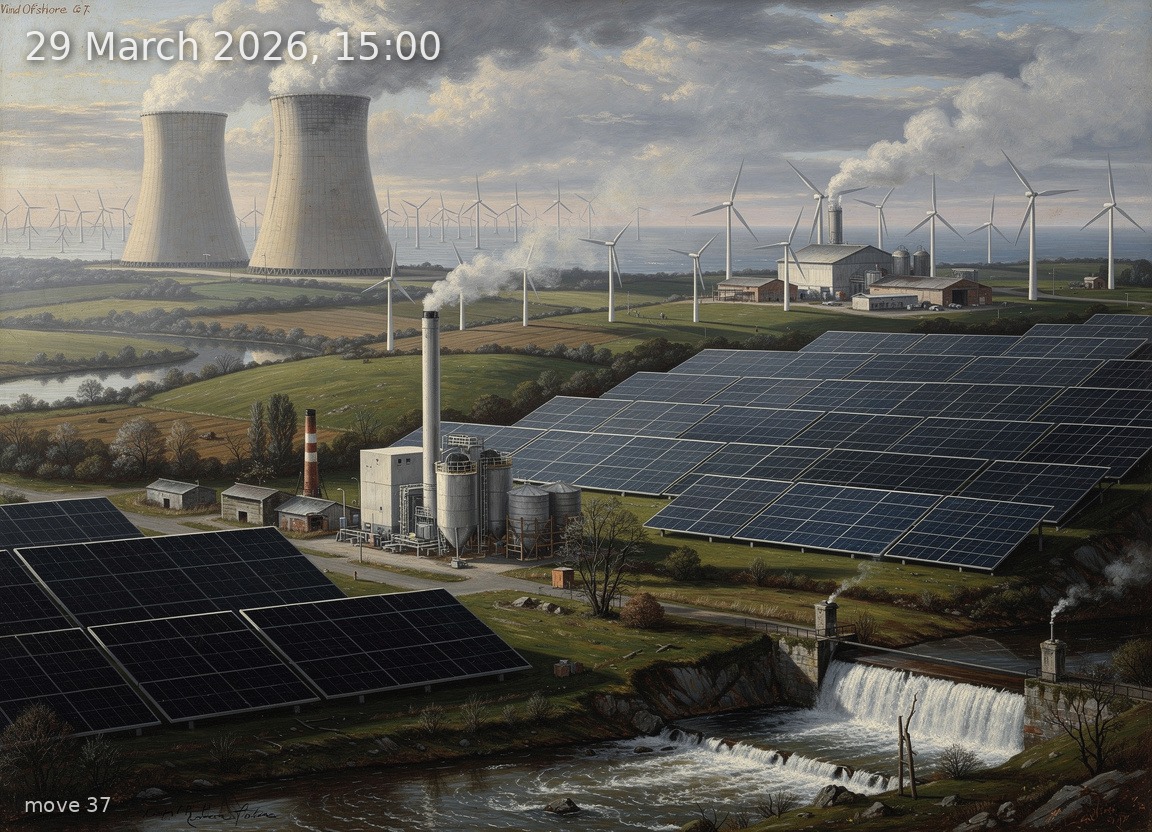
Solar at 29 GW and wind at 17.8 GW drive 8.5 GW net exports and a negative clearing price.
Back
Generation mix
Wind onshore 20%
Wind offshore 10%
Solar 49%
Biomass 7%
Hydro 2%
Natural gas 4%
Hard coal 2%
Brown coal 6%
88%
Renewable share
17.8 GW
Wind (on + offshore)
29.0 GW
Solar
59.3 GW
Total generation
+8.5 GW
Net export
-2.1 €/MWh
Day-ahead price
9.0°C / 9 km/h
Temp / Wind speed
Open-Meteo, Kassel (51.3°N 9.5°E)
67.0% / 229.8 W/m²
Cloud cover / Radiation
87
gCO₂/kWh
Image prompt
Solar 29.0 GW dominates the centre and right of the composition as vast expanses of aluminium-framed crystalline silicon photovoltaic arrays stretching across rolling farmland, catching diffused afternoon light through broken cloud; wind onshore 11.9 GW appears as dozens of three-blade turbines with white tubular towers scattered across gentle green hills in the middle distance; wind offshore 5.9 GW is visible as a dense row of larger turbines along a hazy North Sea horizon at the far left; biomass 4.1 GW is rendered as a cluster of modest industrial buildings with wood-chip silos and thin exhaust plumes in the left-centre; brown coal 3.7 GW occupies the far left background as two hyperbolic concrete cooling towers releasing soft white steam plumes; natural gas 2.1 GW appears as a compact combined-cycle gas turbine plant with a single tall exhaust stack and a smaller heat-recovery steam generator beside it; hard coal 1.5 GW is a single smaller smokestack facility partly obscured behind trees; hydro 1.2 GW is suggested by a small dam and spillway visible in a river valley at the lower right. The time is 15:00 in late March — full afternoon daylight, a sky with two-thirds cumulus cloud cover in greys and whites with generous patches of blue, the sun partially visible through a thinner cloud layer casting soft but directional light and muted shadows. Temperature is a cool 9°C: early spring vegetation, bare deciduous branches with the first hints of green buds, patches of bright green winter wheat in the fields. A light breeze at 9 km/h gently bends grass but turbine blades turn at moderate speed. The atmosphere is calm and expansive, reflecting the negative electricity price — an open, peaceful sky with no oppressive weight. Painted in the style of a highly detailed 19th-century German Romantic landscape oil painting — rich impasto brushwork, atmospheric aerial perspective fading to haze at the horizon, luminous cloud interiors, meticulous engineering detail on every turbine nacelle, every PV panel frame, every cooling tower's ribbed concrete surface, in the tradition of Caspar David Friedrich crossed with industrial realism. No text, no labels.