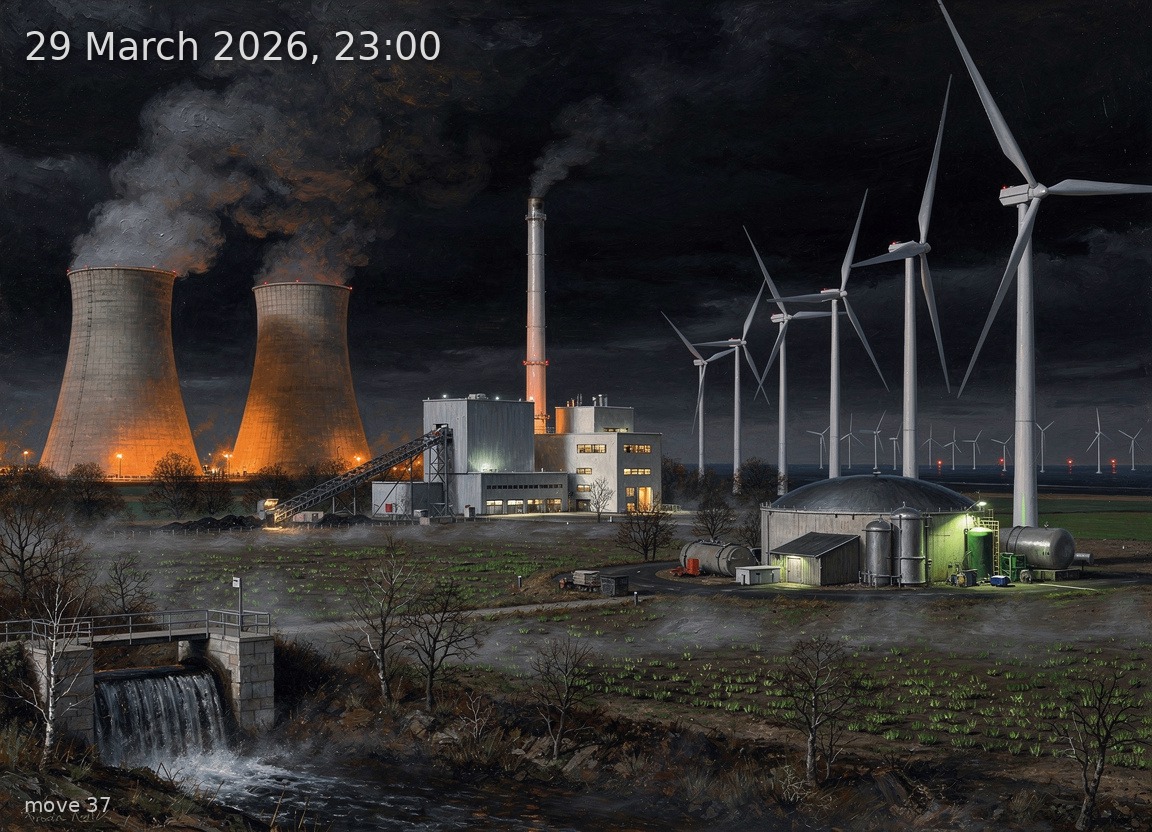
Strong overnight wind drives 39.3 GW and 11.5 GW net exports; thermal plants hold steady baseload under overcast skies.
Back
Generation mix
Wind onshore 56%
Wind offshore 9%
Biomass 8%
Hydro 2%
Natural gas 8%
Hard coal 7%
Brown coal 10%
75%
Renewable share
39.3 GW
Wind (on + offshore)
0.0 GW
Solar
60.2 GW
Total generation
+11.5 GW
Net export
25.6 €/MWh
Day-ahead price
4.5°C / 19 km/h
Temp / Wind speed
Open-Meteo, Kassel (51.3°N 9.5°E)
100.0% / 0.0 W/m²
Cloud cover / Radiation
174
gCO₂/kWh
Image prompt
Wind onshore 33.6 GW dominates the scene as vast ranks of three-blade turbines with white tubular towers and detailed nacelles stretching across the entire right half and background of the composition, their rotors visibly angled by strong winds. Wind offshore 5.7 GW appears as a distant cluster of taller turbines on the far-right horizon, lit by faint navigation beacons. Brown coal 6.2 GW occupies the left foreground as a pair of massive hyperbolic cooling towers with thick white-grey steam plumes billowing into the night, lit from below by orange sodium floodlights. Natural gas 4.8 GW sits centre-left as a compact CCGT facility with a tall single exhaust stack emitting a thin heat shimmer, its metal cladding gleaming under industrial lighting. Hard coal 4.1 GW appears just left of centre as a blocky power station with conveyor belts and a rectangular chimney, warmly lit from within. Biomass 4.6 GW is rendered as a mid-sized plant with a domed digester and short stack near the centre, its facility lights casting a greenish-yellow glow. Hydro 1.2 GW is a small concrete dam structure in the lower-left corner with water spilling faintly, floodlit. The sky is completely dark — deep navy-black, fully overcast with 100% cloud cover blocking all stars, no twilight whatsoever. The landscape is flat northern German farmland in early spring with bare-branched trees and patches of young green grass just emerging, the temperature near freezing suggested by a thin mist low along the ground. Sodium streetlights along a distant road cast amber pools. The atmosphere is calm and open, reflecting the low electricity price. Highly detailed oil painting in the tradition of 19th-century German Romantic landscape painters — Caspar David Friedrich meets industrial sublime — with rich dark colour palette, visible impasto brushwork, deep atmospheric perspective, and meticulous engineering accuracy on every turbine nacelle, cooling tower curve, and exhaust stack rivet. No text, no labels.