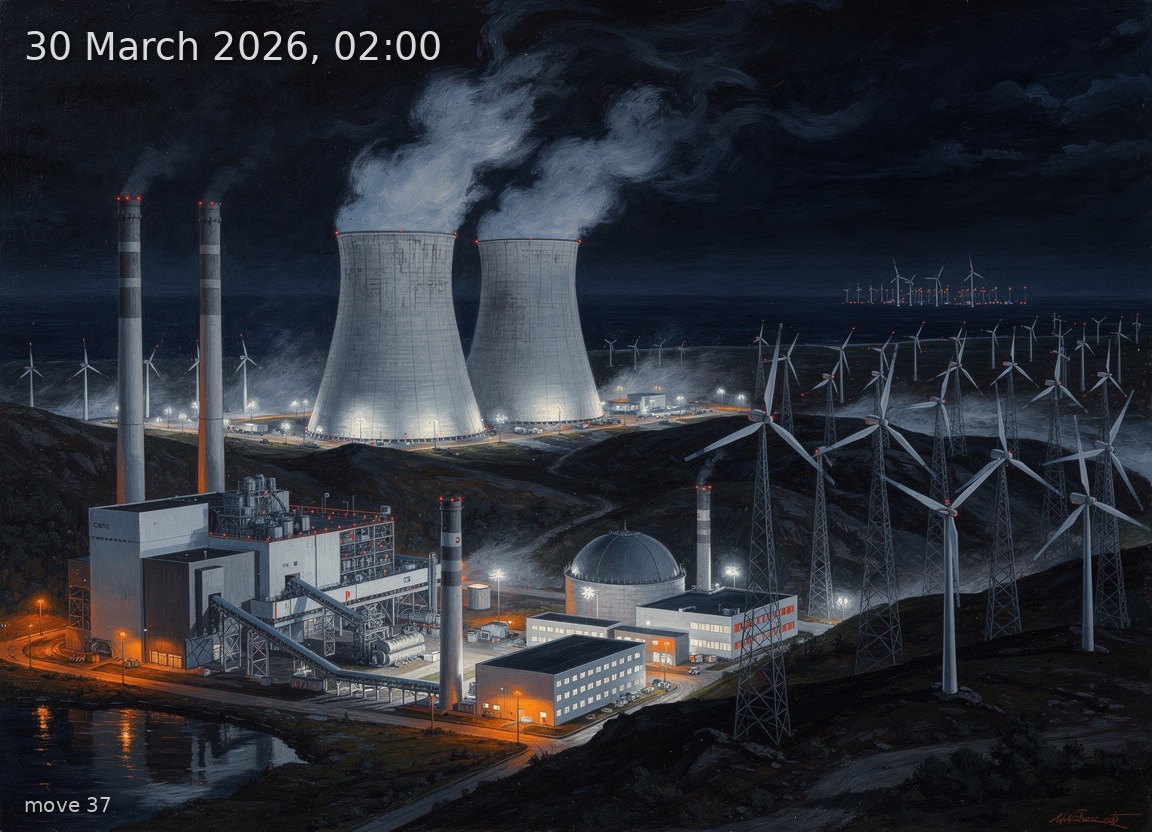
Massive onshore wind output of 36.9 GW drives 15.2 GW net exports and near-zero prices on a windy March night.
Back
Generation mix
Wind onshore 62%
Wind offshore 11%
Biomass 7%
Hydro 2%
Natural gas 5%
Hard coal 7%
Brown coal 7%
82%
Renewable share
43.3 GW
Wind (on + offshore)
0.0 GW
Solar
59.6 GW
Total generation
+15.2 GW
Net export
5.0 €/MWh
Day-ahead price
4.9°C / 34 km/h
Temp / Wind speed
Open-Meteo, Kassel (51.3°N 9.5°E)
100.0% / 0.0 W/m²
Cloud cover / Radiation
129
gCO₂/kWh
Records
#2
Storm Force
Image prompt
Wind onshore 36.9 GW dominates the entire right two-thirds of the scene as vast ranks of three-blade turbines on lattice and tubular towers stretching across rolling dark hills, rotors spinning vigorously in strong wind; wind offshore 6.4 GW appears as a distant cluster of larger turbines on the far-right horizon above a faintly visible sea line; hard coal 4.0 GW occupies the left foreground as a blocky power station with twin chimneys and conveyor gantries, lit by orange sodium lamps; brown coal 3.9 GW sits just behind it as a pair of hyperbolic cooling towers emitting thick white steam plumes rising into the black sky; natural gas 3.0 GW is a compact CCGT plant with a single tall exhaust stack and a lit control building to the left of center; biomass 4.3 GW appears as a medium-sized industrial facility with a wood-chip dome and a modest chimney with a warm amber glow, positioned center-left; hydro 1.2 GW is a small dam structure with spillway visible in the mid-ground valley between turbines and thermal plants. TIME: 02:00 at night — completely dark sky, deep black-navy with no twilight, no moon, heavy 100% cloud cover so no stars visible, only artificial light sources illuminate the scene — sodium streetlights cast orange pools, industrial facilities glow with working lights, cooling tower steam is lit from below by plant lighting. Temperature near 5°C: early spring, bare deciduous trees, patches of last frost on fields, dormant brown grass. Wind at 33.5 km/h visibly bends branches and drives turbine blades at high speed, steam from cooling towers shears sideways. Low electricity price atmosphere: calm, expansive openness despite the darkness, a sense of abundance and quiet surplus. Style: highly detailed oil painting in the tradition of 19th-century German Romantic landscape painters — rich deep blues, warm industrial oranges, visible confident brushwork, atmospheric depth with mist and steam layering the middle distance, meticulous engineering accuracy on turbine nacelles, three-blade rotors, aluminium cooling tower forms, CCGT exhaust geometry. The scene evokes Caspar David Friedrich's sense of sublime scale but applied to modern energy infrastructure. No text, no labels.