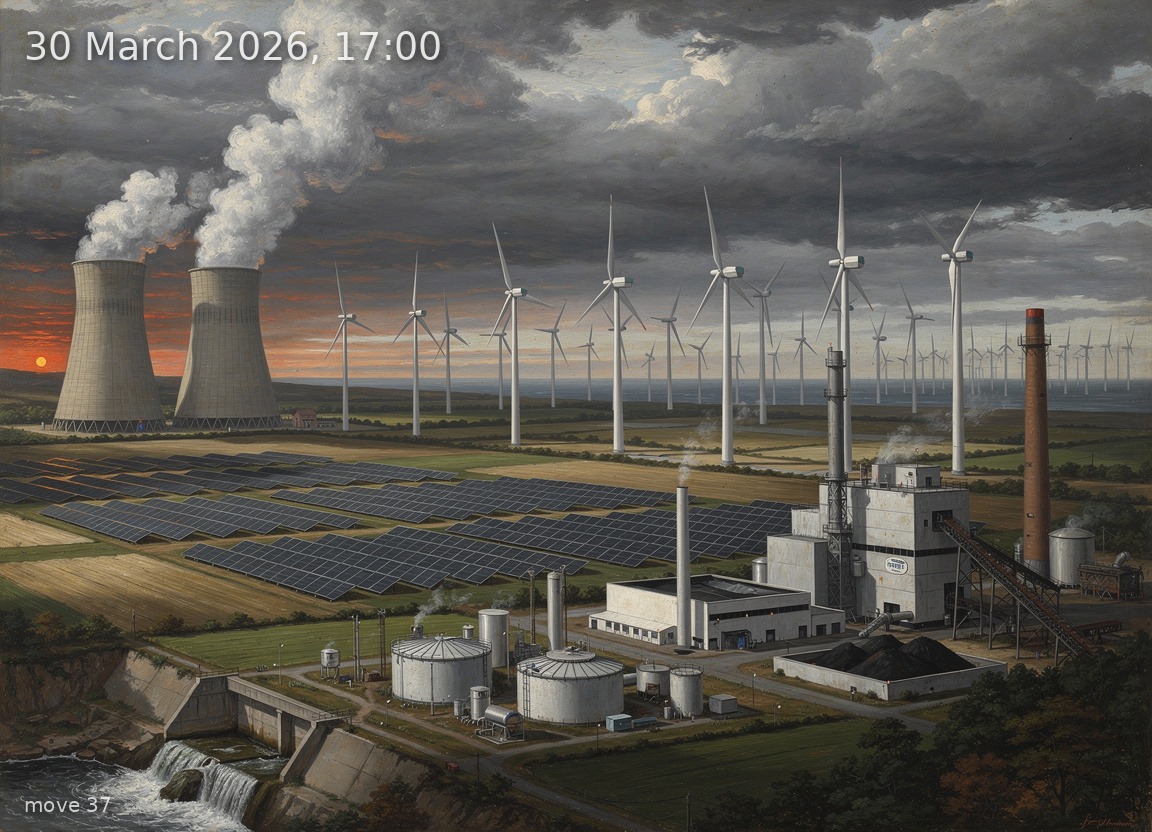
Strong onshore wind dominates at 25.2 GW while fading solar and thermal plants cover the 4.8 GW net import gap at dusk.
Back
Generation mix
Wind onshore 43%
Wind offshore 9%
Solar 20%
Biomass 7%
Hydro 2%
Natural gas 6%
Hard coal 6%
Brown coal 7%
82%
Renewable share
30.7 GW
Wind (on + offshore)
11.3 GW
Solar
58.0 GW
Total generation
-4.8 GW
Net import
77.5 €/MWh
Day-ahead price
7.6°C / 22 km/h
Temp / Wind speed
Open-Meteo, Kassel (51.3°N 9.5°E)
93.0% / 154.8 W/m²
Cloud cover / Radiation
128
gCO₂/kWh
Image prompt
Wind onshore 25.2 GW dominates the scene as vast ranks of three-blade turbines with white tubular towers and detailed nacelles stretching across rolling central German farmland, occupying nearly half the canvas from centre to right; wind offshore 5.5 GW appears as a distant row of taller turbines on a hazy grey-blue horizon line at far right; solar 11.3 GW is rendered as extensive fields of aluminium-framed crystalline silicon PV panels in the mid-ground left-of-centre, their surfaces reflecting only dim amber light; biomass 4.1 GW appears as a cluster of industrial biogas facilities with cylindrical digesters and small exhaust stacks in the lower-left foreground; brown coal 3.9 GW is depicted as two large hyperbolic concrete cooling towers with heavy white-grey steam plumes, positioned at the left edge; hard coal 3.6 GW sits adjacent as a block-shaped power station with tall chimneys and conveyor belts feeding dark fuel; natural gas 3.3 GW is a compact modern CCGT plant with a single slender exhaust stack and visible heat shimmer, placed between the coal plants and the biomass facility; hydro 1.2 GW is a small dam structure with spillway visible in a valley depression at the far left. The sky is 93% overcast with heavy stratiform clouds in slate grey, but a narrow band of deep orange-red dusk glow burns along the western horizon at lower left, the sun already below the treeline — the light is rapidly fading, casting long amber-brown shadows eastward across stubbled late-winter fields with sparse early green growth, temperature near 8°C suggested by bare deciduous trees and frost-tinged grass. Wind at 22 km/h animates the turbine blades with visible rotational blur and bends the dried grasses. The atmosphere feels heavy and oppressive, reflecting the elevated 77.5 EUR/MWh price — low clouds press down, the air is thick. Painted in the style of a highly detailed 19th-century German Romantic oil painting — rich impasto brushwork, luminous atmospheric depth recalling Caspar David Friedrich and Carl Blechen, but with meticulous engineering accuracy on every turbine nacelle, every cooling tower rib, every PV cell grid line. No text, no labels.