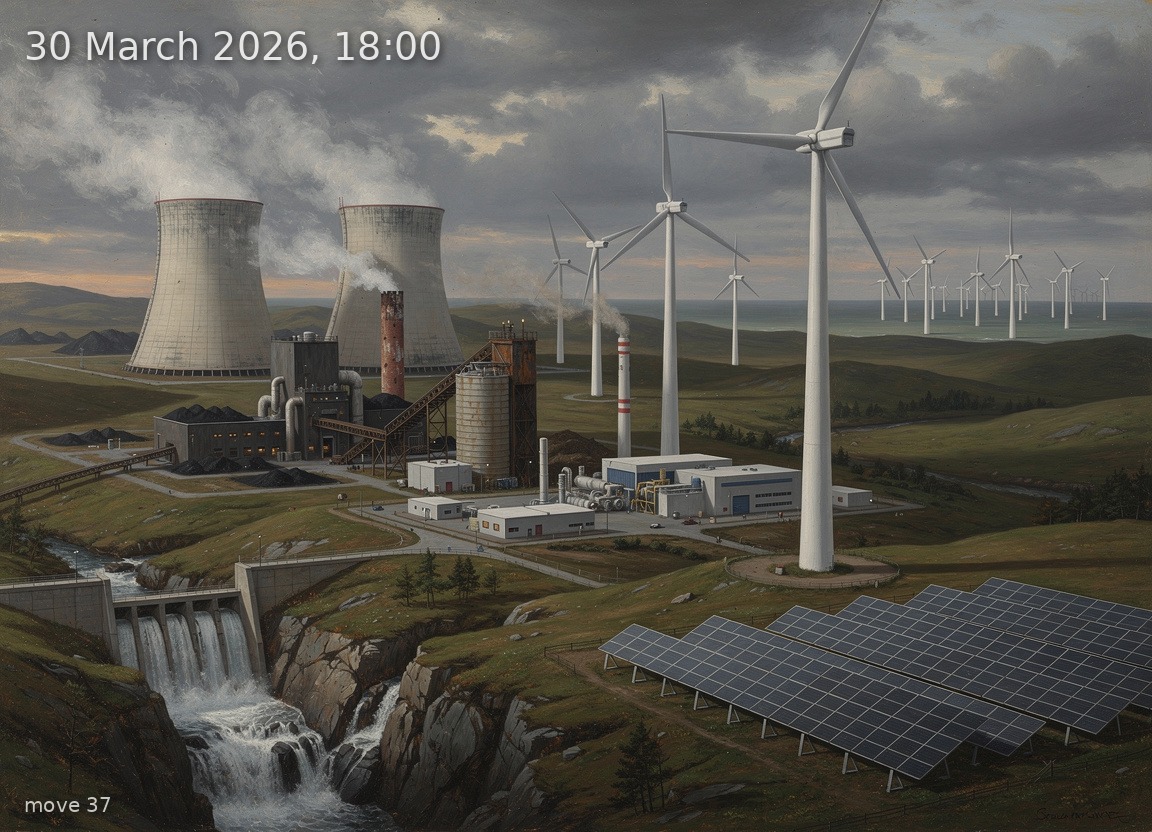
Strong onshore wind leads generation at 23.9 GW, but 13.4 GW net imports are needed to meet elevated evening demand.
Back
Generation mix
Wind onshore 47%
Wind offshore 12%
Solar 10%
Biomass 8%
Hydro 2%
Natural gas 6%
Hard coal 7%
Brown coal 8%
79%
Renewable share
29.7 GW
Wind (on + offshore)
4.8 GW
Solar
50.5 GW
Total generation
-13.4 GW
Net import
104.8 €/MWh
Day-ahead price
6.9°C / 20 km/h
Temp / Wind speed
Open-Meteo, Kassel (51.3°N 9.5°E)
92.0% / 94.5 W/m²
Cloud cover / Radiation
147
gCO₂/kWh
Image prompt
Wind onshore 23.9 GW dominates the right two-thirds of the scene as dozens of towering three-blade turbines with white tubular towers and detailed nacelles, rotors visibly turning in strong wind, stretching across rolling low hills into the distance; wind offshore 5.8 GW appears as a cluster of larger turbines barely visible on a far grey-green sea horizon at the right edge; solar 4.8 GW occupies a modest field of aluminium-framed crystalline silicon PV panels in the centre-right foreground, their surfaces dull under heavy overcast, catching only faint residual light; biomass 4.1 GW is rendered as a mid-ground industrial facility with a wood-chip silo and a single smoking stack to the left of centre; brown coal 3.9 GW appears as two large hyperbolic cooling towers on the far left, thick white steam plumes torn sideways by the wind; hard coal 3.6 GW sits adjacent as a dark coal-fired plant with conveyor belts and a tall brick chimney; natural gas 3.3 GW is a compact modern CCGT plant with a slender exhaust stack and visible heat shimmer, positioned between the coal plants and the biomass facility; hydro 1.2 GW is a small concrete dam with cascading water in the left foreground valley. The sky is dusk at 18:00 in late March — a narrow band of deep orange-red along the low western horizon rapidly giving way to heavy slate-grey and violet clouds covering 92 percent of the sky, the upper sky already darkening toward night; the atmosphere feels oppressive and weighty, reflecting the high electricity price; bare early-spring trees with just the first tiny buds line field edges, grass is pale green, temperature near 7°C gives a raw chill conveyed through muted cool tones; wind is evident in bent grasses, streaming cloud wisps, and sideways steam plumes. Rendered as a highly detailed oil painting in the tradition of 19th-century German Romantic landscape painters — rich impasto brushwork, dramatic atmospheric depth, luminous handling of the fading dusk light against industrial forms, meticulous engineering accuracy on every turbine nacelle, cooling tower, and PV module. No text, no labels.