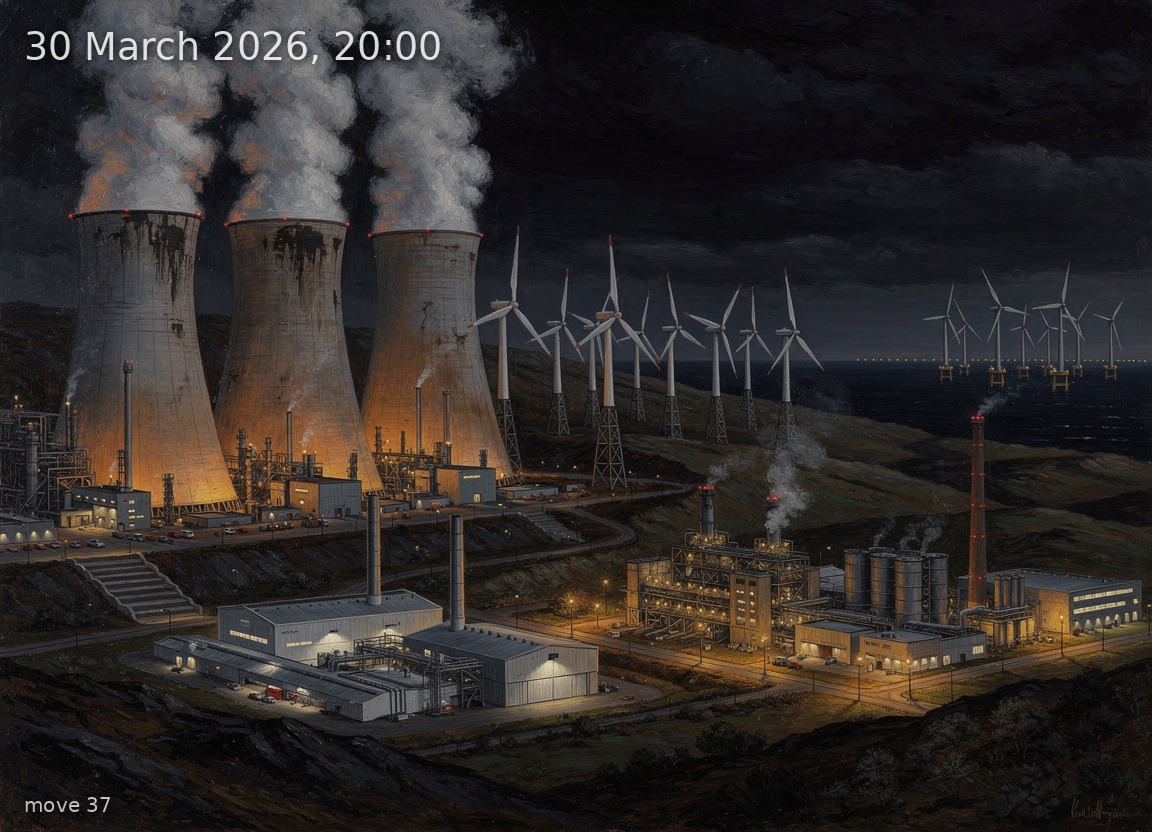
Strong wind (28 GW) leads generation but coal and gas (22.4 GW) and net imports (6.1 GW) cover evening peak demand.
Back
Generation mix
Wind onshore 39%
Wind offshore 11%
Solar 0%
Biomass 8%
Hydro 2%
Natural gas 14%
Hard coal 12%
Brown coal 14%
60%
Renewable share
28.1 GW
Wind (on + offshore)
0.0 GW
Solar
56.0 GW
Total generation
-6.1 GW
Net import
125.6 €/MWh
Day-ahead price
4.5°C / 16 km/h
Temp / Wind speed
Open-Meteo, Kassel (51.3°N 9.5°E)
100.0% / 0.0 W/m²
Cloud cover / Radiation
275
gCO₂/kWh
Image prompt
Wind onshore 22.0 GW dominates the right half of the scene as dozens of tall three-blade turbines on lattice and tubular towers stretching across rolling hills into the distance, rotors spinning briskly in moderate wind; wind offshore 6.0 GW appears as a cluster of larger turbines visible on a dark sea horizon at far right. Brown coal 8.1 GW occupies the left foreground as a massive lignite power station with four hyperbolic cooling towers emitting thick white steam plumes rising into the night sky, lit from below by orange sodium lamps. Hard coal 6.6 GW sits just right of the brown coal complex as a smaller station with rectangular cooling towers and a tall chimney stack, warmly lit by industrial floodlights. Natural gas 7.7 GW fills the centre-left as two sleek CCGT units with single tall exhaust stacks and low-profile turbine halls, their stainless-steel surfaces catching artificial light. Biomass 4.5 GW appears as a mid-ground wood-chip-fired plant with a modest stack and a dome-roofed fuel storage hall, steam wisping upward. Hydro 1.0 GW is a small concrete dam and penstock visible in the valley at centre-right, with a faint glow from the powerhouse windows. The time is 20:00 in late March — the sky is completely dark, deep black-navy, no twilight, no sky glow, full 100% cloud cover obscuring any stars. The atmosphere is heavy and oppressive, reflecting the high electricity price. Temperature is 4.5°C: early spring with bare deciduous trees, last patches of old snow on north-facing slopes, dormant brown grass. Sodium streetlights cast amber pools along a road in the valley. Lit windows of a small town glow warmly in the mid-ground. Style: highly detailed oil painting in the tradition of 19th-century German Romantic landscape painters — rich, deep colour palette dominated by blacks, deep blues, warm ambers and whites of steam; visible impasto brushwork; atmospheric depth with industrial haze; meticulous engineering detail on each turbine nacelle, cooling tower shell, exhaust stack, and dam structure. No text, no labels.