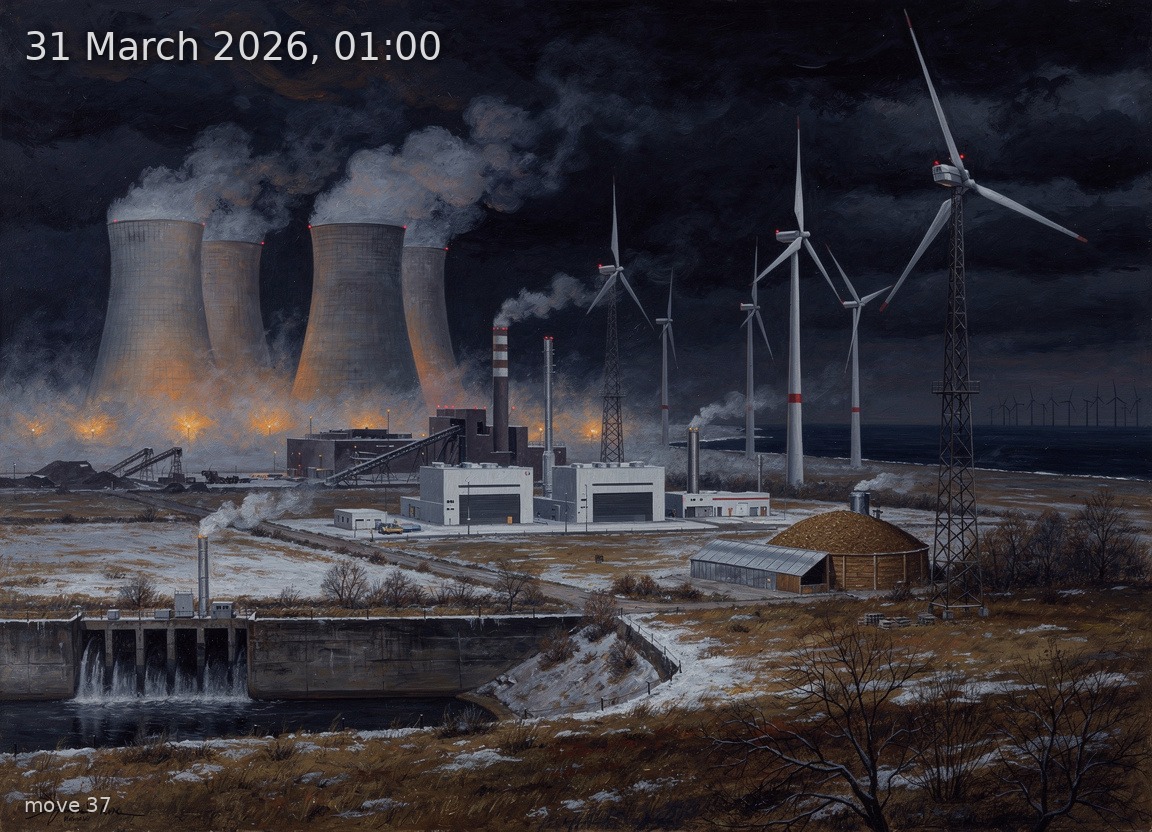
Strong overnight wind (25.6 GW) plus persistent coal and gas baseload push Germany into 6.6 GW net export at 1 AM.
Back
Generation mix
Wind onshore 36%
Wind offshore 11%
Biomass 8%
Hydro 2%
Natural gas 15%
Hard coal 12%
Brown coal 15%
57%
Renewable share
25.5 GW
Wind (on + offshore)
0.0 GW
Solar
54.0 GW
Total generation
+6.6 GW
Net export
102.7 €/MWh
Day-ahead price
2.1°C / 16 km/h
Temp / Wind speed
Open-Meteo, Kassel (51.3°N 9.5°E)
100.0% / 0.0 W/m²
Cloud cover / Radiation
291
gCO₂/kWh
Image prompt
Wind onshore 19.4 GW dominates the right two-thirds of the scene as dozens of tall three-blade turbines on lattice and tubular towers stretching across a flat north-German plain, rotors spinning briskly; wind offshore 6.2 GW appears as a distant row of larger turbines on the far-right horizon above a dark sea; brown coal 8.2 GW occupies the left foreground as a massive lignite power station with four hyperbolic cooling towers emitting thick white-grey steam plumes lit from below by orange sodium lamps; natural gas 8.3 GW sits centre-left as two compact CCGT plants with slim exhaust stacks and modest heat shimmer; hard coal 6.5 GW appears just behind the brown coal plant as a blocky power station with conveyor belts and a tall chimney; biomass 4.4 GW is rendered as a mid-ground industrial facility with a woodchip storage dome and a single steaming stack; hydro 1.0 GW is a small dam and penstock visible in the far centre-left valley. Time is 1:00 AM — the sky is entirely black with no twilight whatsoever, heavy 100% cloud cover erasing all stars, deep navy-to-black atmosphere pressing down oppressively to reflect the high 102.7 EUR/MWh price. The only light sources are orange-yellow sodium streetlights lining a road in the foreground, the glowing windows of control buildings, red aviation warning lights blinking on turbine nacelles, and the warm industrial glow from furnace buildings and plant interiors. Temperature is near freezing: bare winter-brown grass, patches of frost on the ground, leafless trees along field edges. The wind is visible in the motion of grass and slight lean of distant saplings. Highly detailed oil painting in the tradition of 19th-century German Romantic landscape painters — rich, deep colour palette of indigo, burnt sienna, and ochre; visible impasto brushwork; atmospheric depth with fog hugging the ground near the cooling towers; meticulous engineering detail on every turbine nacelle, three-blade rotor, aluminium-framed structure, and industrial stack. The mood is brooding, powerful, industrially sublime. No text, no labels.