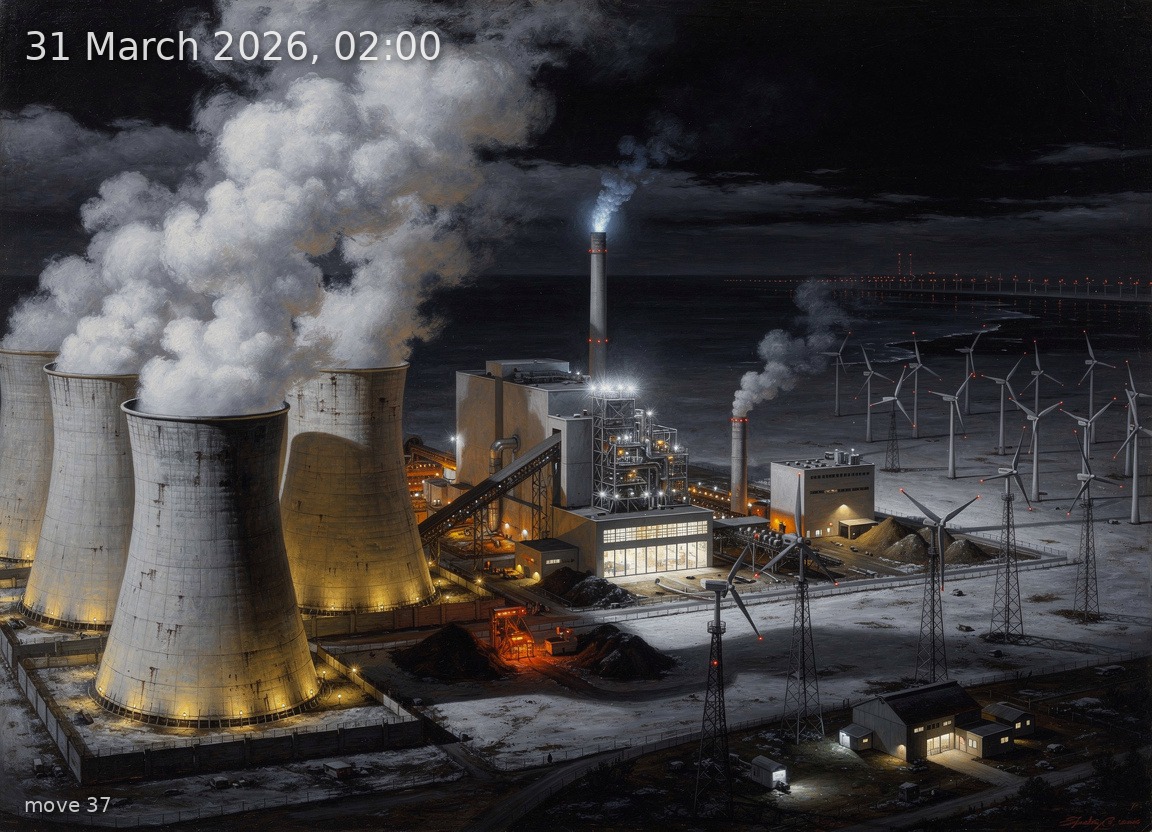
Wind dominates at 25.4 GW alongside 20.3 GW of thermal generation, driving 4.1 GW net exports at elevated overnight prices.
Back
Generation mix
Wind onshore 38%
Wind offshore 12%
Biomass 8%
Hydro 2%
Natural gas 11%
Hard coal 12%
Brown coal 17%
60%
Renewable share
25.4 GW
Wind (on + offshore)
0.0 GW
Solar
50.8 GW
Total generation
+4.1 GW
Net export
101.3 €/MWh
Day-ahead price
3.0°C / 8 km/h
Temp / Wind speed
Open-Meteo, Kassel (51.3°N 9.5°E)
71.0% / 0.0 W/m²
Cloud cover / Radiation
283
gCO₂/kWh
Image prompt
Brown coal 8.8 GW occupies the left quarter of the scene as a cluster of massive hyperbolic cooling towers with thick white steam plumes rising into the black sky, their concrete forms illuminated by amber sodium lights at their base; hard coal 5.9 GW appears just right of centre-left as a large power station with conveyor belts and a tall chimney stack lit by orange industrial floodlights; natural gas 5.6 GW sits at centre as a compact CCGT plant with a single tall exhaust stack and a faint blue-white gas flare, pipes and turbine hall glowing under halogen work lights; wind onshore 19.2 GW spans the entire right half and background as dozens of three-blade turbines on lattice and tubular towers, their aviation warning lights blinking red against the pitch-black sky, rotors visibly turning in moderate wind; wind offshore 6.2 GW is suggested in the far-right distance as a line of turbines standing in dark water on the horizon, red nacelle lights reflecting faintly; biomass 4.1 GW appears as a modest wood-chip-fired plant with a short smokestack and a steaming exhaust near centre-right; hydro 1.1 GW is a small run-of-river station at the lower right foreground, water rushing through illuminated sluice gates. The time is 2 AM — the sky is completely black with no twilight or sky glow, a heavy 71% overcast hiding all stars, giving a dense oppressive ceiling above the industrial landscape. Temperature is 3°C: bare deciduous trees with no leaves, patches of lingering frost on the ground, early spring but still wintry. The elevated electricity price is conveyed through a heavy, brooding atmosphere — thick low clouds press down on the scene, trapping the amber and white industrial light in a hazy, almost suffocating luminous fog between earth and sky. Style: highly detailed oil painting in the tradition of 19th-century German Romantic landscape painters such as Caspar David Friedrich and Carl Blechen, but depicting an industrial energy landscape — rich deep blues, blacks, warm ambers and cool whites, visible confident brushwork, atmospheric depth with layers of mist and steam, meticulous engineering detail on every turbine nacelle, cooling tower, and smokestack. No text, no labels.