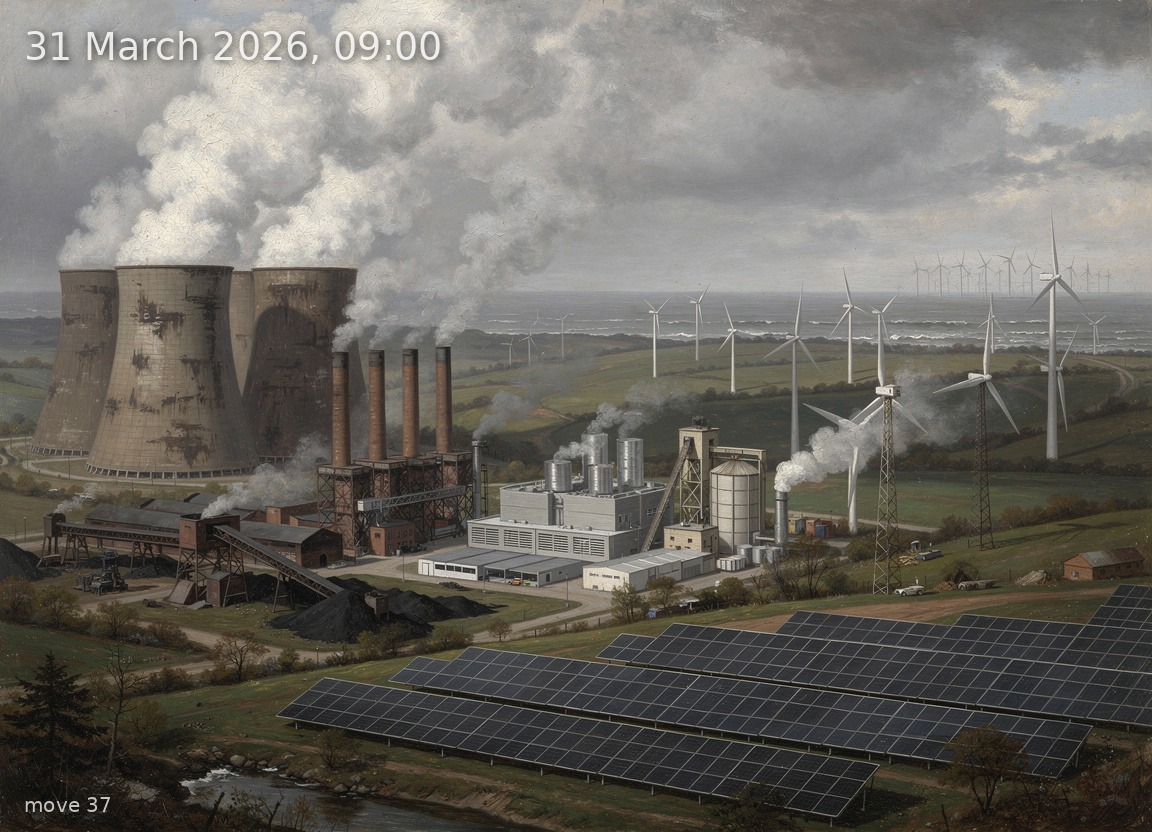
Wind leads at 22.8 GW with strong thermal backup as overcast skies limit solar and tight supply lifts prices.
Back
Generation mix
Wind onshore 27%
Wind offshore 8%
Solar 18%
Biomass 7%
Hydro 2%
Natural gas 13%
Hard coal 10%
Brown coal 15%
62%
Renewable share
22.8 GW
Wind (on + offshore)
11.9 GW
Solar
64.9 GW
Total generation
-0.8 GW
Net import
135.6 €/MWh
Day-ahead price
4.2°C / 16 km/h
Temp / Wind speed
Open-Meteo, Kassel (51.3°N 9.5°E)
80.0% / 27.8 W/m²
Cloud cover / Radiation
262
gCO₂/kWh
Image prompt
Brown coal 9.8 GW occupies the far left as a cluster of massive hyperbolic cooling towers with thick white steam plumes rising into the overcast sky; hard coal 6.6 GW appears just left of centre as a row of tall chimneys and conveyor-belt fed boiler houses with thinner grey smoke; natural gas 8.2 GW fills the centre-left as compact CCGT power blocks with paired exhaust stacks and visible heat shimmer; wind onshore 17.3 GW dominates the right half of the composition as dozens of three-blade turbines on lattice and tubular towers stretching across rolling hills, blades visibly turning in moderate wind; wind offshore 5.5 GW is visible on the far-right horizon as a line of turbines standing in a grey sea; solar 11.9 GW appears as large fields of aluminium-framed crystalline silicon panels in the mid-ground foreground, reflecting only diffuse grey light under heavy clouds; biomass 4.4 GW is rendered as a medium-sized industrial plant with a wood-chip silo and single stack emitting pale vapour, nestled between the coal plant and wind turbines; hydro 1.1 GW appears as a small concrete run-of-river dam with a narrow waterfall in the lower-left corner. The sky is 80% overcast with a thick, oppressive blanket of stratocumulus clouds in grey and pewter tones, allowing only occasional wan patches of pale daylight—no direct sunshine, no blue sky. The lighting is flat, diffuse daytime at 09:00 in late March, casting soft shadows. The landscape is early-spring central German terrain: bare deciduous trees just hinting at bud-break, brown-green dormant grass, patches of last frost. The atmosphere feels heavy and pressured, reflecting the high electricity price—a brooding, leaden quality to the air. Style: highly detailed oil painting in the tradition of 19th-century German Romantic landscape painters such as Caspar David Friedrich and Carl Blechen, with rich tonal depth, visible impasto brushwork, atmospheric perspective fading into misty distance, meticulous engineering detail on every turbine nacelle, cooling tower, PV panel frame, and smokestack. No text, no labels, no people prominent—only the vast industrial-natural panorama.