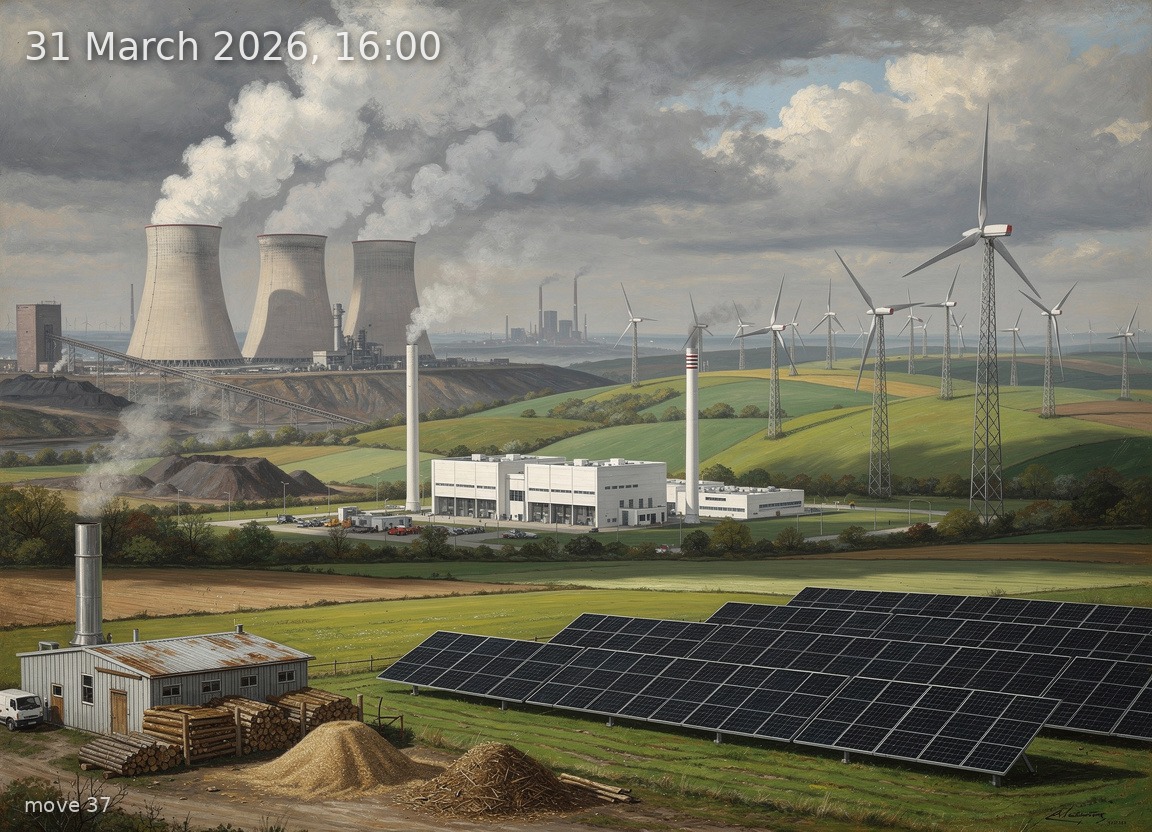
Wind and solar drive 75% renewables at 68.6 GW total, creating 8.4 GW net exports despite persistent thermal generation.
Back
Generation mix
Wind onshore 33%
Wind offshore 5%
Solar 29%
Biomass 6%
Hydro 2%
Natural gas 7%
Hard coal 7%
Brown coal 11%
75%
Renewable share
26.2 GW
Wind (on + offshore)
20.0 GW
Solar
68.6 GW
Total generation
+8.4 GW
Net export
82.2 €/MWh
Day-ahead price
10.2°C / 20 km/h
Temp / Wind speed
Open-Meteo, Kassel (51.3°N 9.5°E)
98.0% / 303.2 W/m²
Cloud cover / Radiation
176
gCO₂/kWh
Image prompt
Wind onshore 22.7 GW dominates the right half and background as vast rows of modern three-blade turbines on lattice towers stretching across rolling green hills, rotors spinning briskly in strong wind. Solar 20.0 GW fills the center-right foreground as expansive fields of aluminium-framed crystalline silicon PV panels on flat farmland, angled south, catching diffuse light through heavy clouds with occasional bright patches. Brown coal 7.3 GW occupies the left background as a cluster of massive hyperbolic cooling towers emitting thick white steam plumes that merge with the overcast sky, flanked by conveyor belts and lignite stockpiles. Natural gas 5.0 GW appears center-left as two compact CCGT power plants with tall single exhaust stacks releasing thin heat shimmer. Hard coal 4.8 GW sits behind the gas plants as a traditional coal station with rectangular boiler houses, coal bunkers, and a pair of tall chimneys trailing grey smoke. Biomass 4.1 GW is rendered as a modest wood-chip-fired plant with a squat stack and timber storage yard in the left foreground. Wind offshore 3.5 GW is visible on the distant horizon as a line of turbines emerging from haze. Hydro 1.1 GW appears as a small concrete run-of-river weir with spillway on a river cutting through the lower foreground. The sky is 98% overcast — a heavy, oppressive blanket of grey stratocumulus pressing low, but with one dramatic rift near the horizon letting pale golden late-afternoon daylight stream through at a low angle, illuminating the solar panels and casting long shadows from the turbine towers. The atmosphere feels weighty and congested, reflecting the high electricity price. Vegetation is early spring: fresh pale-green buds on deciduous trees, bright green grass, some bare branches remaining. Temperature around 10°C — figures in the scene wear light jackets. The wind visibly bends grass and streaks the cooling tower plumes sideways. Style: highly detailed oil painting in the tradition of 19th-century German Romantic landscape painters such as Caspar David Friedrich and Carl Blechen — rich, layered colour with deep earth tones and luminous cloud edges, visible confident brushwork, atmospheric perspective with hazy industrial distance, meticulous engineering detail on every turbine nacelle, every PV cell grid, every cooling tower's parabolic curve. The composition feels monumental and contemplative, a masterwork depicting Germany's transitional energy landscape. No text, no labels.