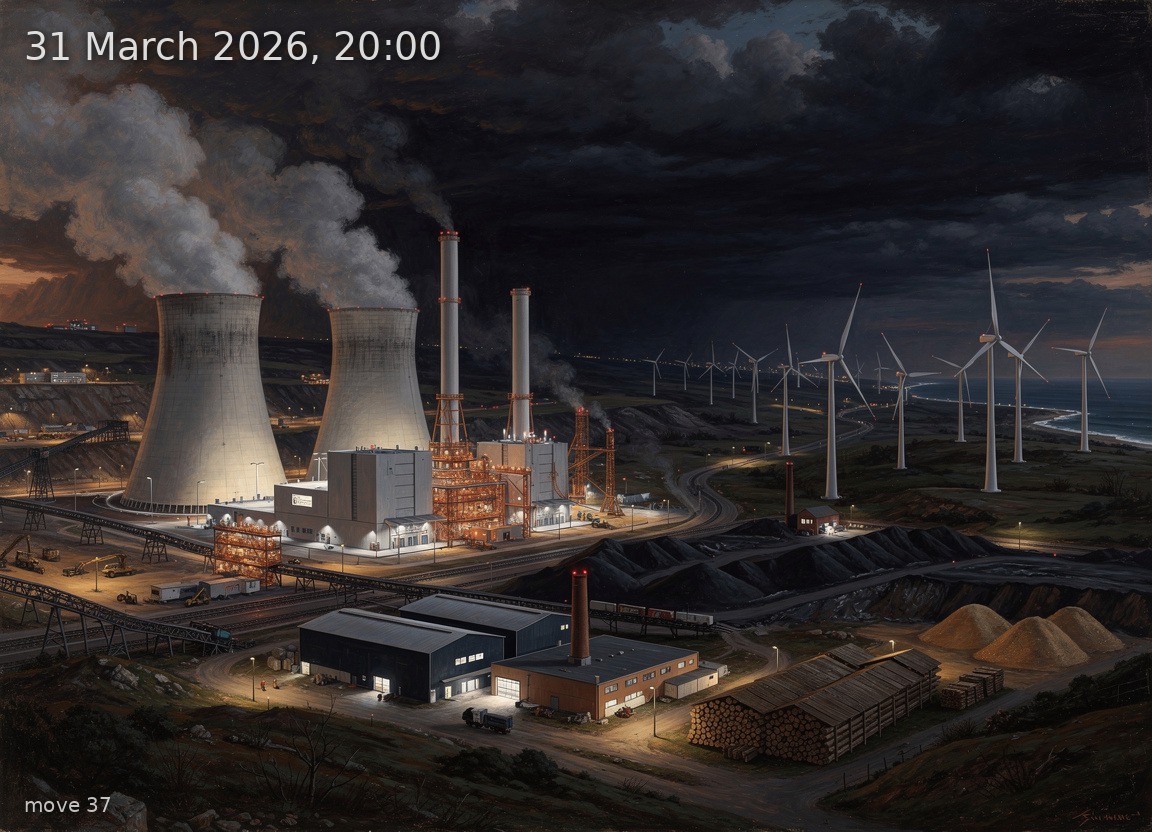
Wind, brown coal, gas, and hard coal anchor generation as net imports of 11.5 GW cover evening peak demand.
Back
Generation mix
Wind onshore 28%
Wind offshore 5%
Solar 0%
Biomass 9%
Hydro 2%
Natural gas 20%
Hard coal 14%
Brown coal 22%
44%
Renewable share
16.1 GW
Wind (on + offshore)
0.0 GW
Solar
49.2 GW
Total generation
-11.5 GW
Net import
176.0 €/MWh
Day-ahead price
6.8°C / 14 km/h
Temp / Wind speed
Open-Meteo, Kassel (51.3°N 9.5°E)
90.0% / 2.5 W/m²
Cloud cover / Radiation
381
gCO₂/kWh
Image prompt
Wind onshore 13.8 GW and offshore 2.3 GW together span the right third of the scene as dozens of three-blade wind turbines with white tubular towers and nacelles, rotors turning steadily in moderate wind, arranged across dark rolling hills and a distant sliver of North Sea coast. Brown coal 10.7 GW dominates the left quarter as a cluster of massive hyperbolic cooling towers emitting thick white-grey steam plumes, flanked by lignite conveyor belts and open-pit silhouettes. Natural gas 9.9 GW fills the centre-left as three compact CCGT power stations with tall single exhaust stacks venting thin heat shimmer, orange sodium lights illuminating their steel structures. Hard coal 6.8 GW appears as a pair of large conventional boiler houses with prominent chimneys and coal stockpiles beside rail sidings, positioned between the gas plants and cooling towers. Biomass 4.6 GW is rendered as a modest wood-chip-fired plant with a short smokestack and timber storage yard at the far centre. Hydro 1.1 GW appears as a small concrete dam with spillway in a valley at the distant right edge. Time is 20:00 in late March—the sky is fully dark, deep navy-black, no twilight glow, no sunset remnant, heavy 90% cloud cover obscuring all stars. The atmosphere is oppressive and heavy, reflecting the high electricity price: low-hanging clouds press down, tinged faintly orange-brown by reflected industrial light. Temperature is a cool 6.8°C; bare early-spring trees with only the faintest bud hints, brown dormant grass, patches of lingering frost. No solar panels visible anywhere—zero solar generation. Sodium-yellow and white industrial lighting casts pools of warm light across the facilities, steam plumes glow from below, and the turbine warning lights blink red atop each nacelle. Transmission pylons with high-voltage lines thread across the middle ground connecting all sources. Style: highly detailed oil painting in the tradition of 19th-century German Romantic landscape painting—Caspar David Friedrich meets industrial sublime—rich layered colour, visible confident brushwork, atmospheric depth with sfumato in the steam and clouds, meticulous engineering accuracy in every turbine blade, cooling tower curve, and exhaust stack rivet. No text, no labels.