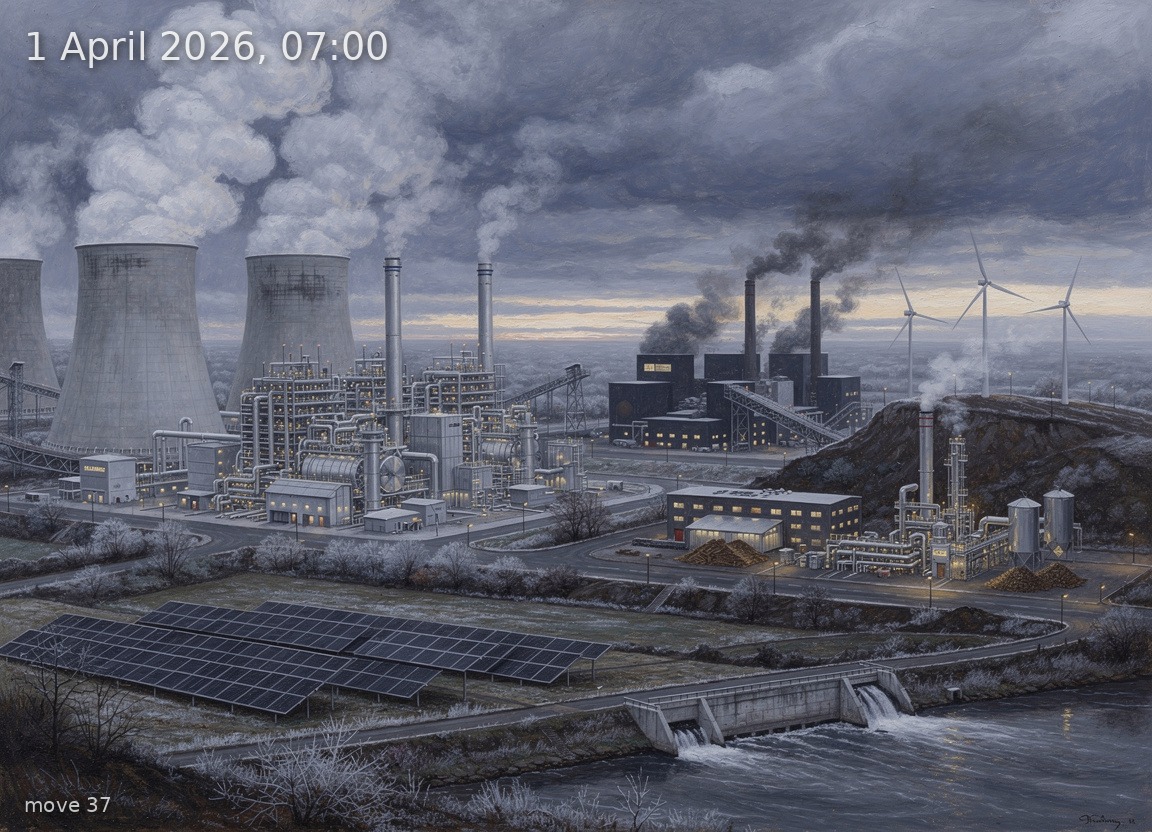
Gas, brown coal, and hard coal dominate domestic supply as low wind, overcast skies, and heavy imports define the morning.
Back
Generation mix
Wind onshore 4%
Wind offshore 0%
Solar 4%
Biomass 11%
Hydro 3%
Natural gas 34%
Hard coal 17%
Brown coal 26%
23%
Renewable share
1.6 GW
Wind (on + offshore)
1.6 GW
Solar
37.3 GW
Total generation
-23.2 GW
Net import
226.9 €/MWh
Day-ahead price
3.1°C / 6 km/h
Temp / Wind speed
Open-Meteo, Kassel (51.3°N 9.5°E)
89.0% / 0.0 W/m²
Cloud cover / Radiation
508
gCO₂/kWh
Image prompt
Natural gas 12.7 GW dominates the centre-left of the scene as a cluster of large combined-cycle gas turbine plants with tall single exhaust stacks emitting pale plumes; brown coal 9.8 GW occupies the left quarter as massive hyperbolic cooling towers with thick white steam columns rising into the grey sky; hard coal 6.2 GW appears centre-right as a row of conventional coal-fired power stations with rectangular boiler houses and tall chimneys trailing dark-tinged smoke; biomass 4.1 GW is rendered in the mid-ground right as smaller industrial CHP facilities with wood-chip storage silos and modest stacks; wind onshore 1.6 GW appears as a handful of distant three-blade turbines on a ridge, rotors barely turning in negligible wind; solar 1.6 GW is represented by a small field of aluminium-framed crystalline silicon panels in the foreground, their surfaces dull and unreflective under thick cloud; hydro 1.2 GW is a concrete run-of-river weir with turbine house visible along a grey river in the lower foreground; wind offshore 0.1 GW is a single barely visible turbine silhouette on the far horizon. Time is 07:00 dawn in early April: the sky is deep blue-grey with the faintest pale band of pre-dawn light along the eastern horizon, no direct sunlight, 89% cloud cover forming a heavy unbroken overcast ceiling that feels oppressive and weighty — reflecting the extreme 226.9 EUR/MWh price. Temperature is 3°C: bare deciduous trees, frost on grass, early spring with no leaves yet, patches of lingering ice at puddle edges. The air is still, almost no breeze. Overhead high-voltage transmission lines on steel lattice pylons stretch toward the horizon, symbolising the massive import flows. Painted as a highly detailed oil painting in the tradition of 19th-century German Romantic landscape art — rich, sombre colour palette of slate greys, muted ochres, and deep indigos, visible textured brushwork, atmospheric depth with industrial haze softening distant structures, meticulous engineering detail on every plant and turbine, dramatic chiaroscuro from artificial sodium-orange facility lighting against the pre-dawn gloom. No text, no labels.