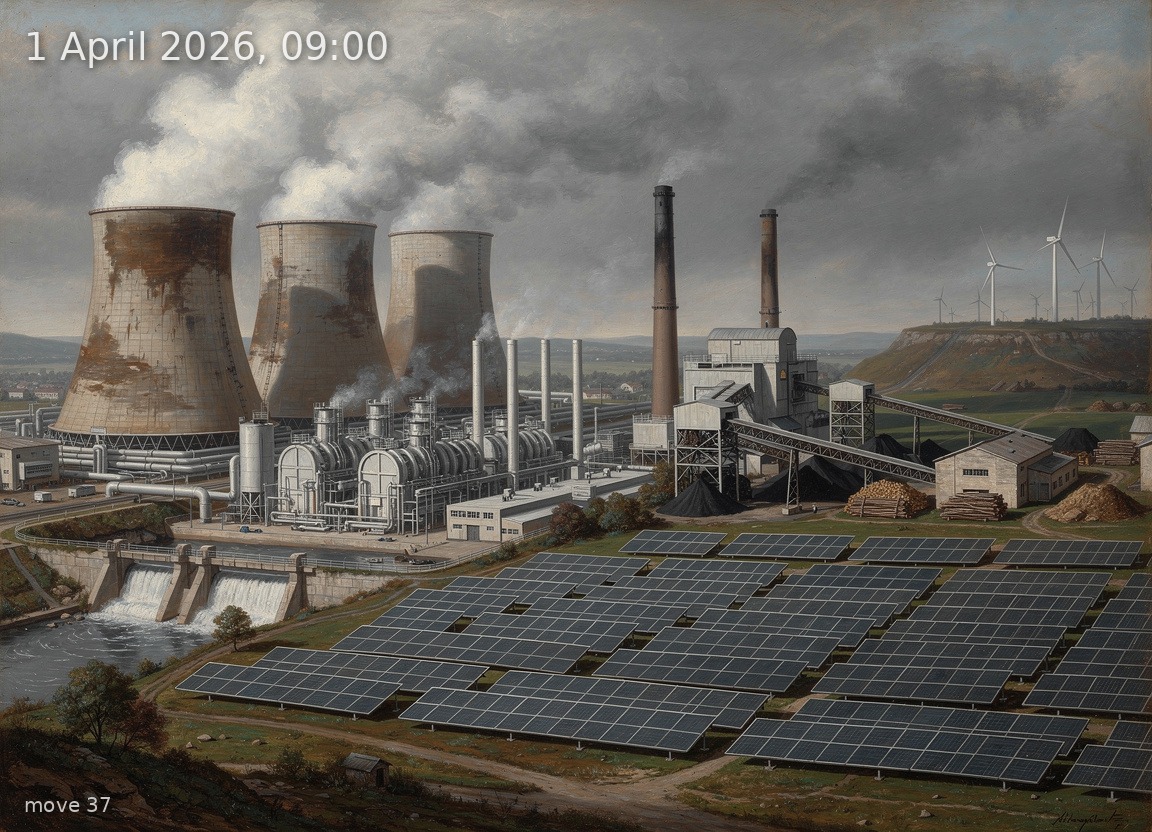
Gas, brown coal, and hard coal dominate as overcast skies and calm winds suppress renewables, driving high prices and large net imports.
Back
Generation mix
Wind onshore 2%
Wind offshore 0%
Solar 30%
Biomass 8%
Hydro 2%
Natural gas 25%
Hard coal 13%
Brown coal 20%
42%
Renewable share
1.2 GW
Wind (on + offshore)
15.2 GW
Solar
51.3 GW
Total generation
-13.6 GW
Net import
171.5 €/MWh
Day-ahead price
4.0°C / 4 km/h
Temp / Wind speed
Open-Meteo, Kassel (51.3°N 9.5°E)
100.0% / 5.0 W/m²
Cloud cover / Radiation
380
gCO₂/kWh
Image prompt
Brown coal 10.1 GW occupies the left quarter as a massive lignite power station with four hyperbolic cooling towers trailing thick white-grey steam plumes into the overcast sky; natural gas 12.8 GW fills the centre-left as a sprawling CCGT complex with tall slender exhaust stacks venting shimmering heat haze; hard coal 6.6 GW appears centre-right as a traditional coal plant with twin chimneys and conveyor belts feeding dark fuel; solar 15.2 GW stretches across the right third as vast fields of aluminium-framed crystalline silicon PV panels on flat farmland, their surfaces dull and muted under the heavy cloud layer reflecting no glint of sun; biomass 4.3 GW appears as a wood-chip-fed industrial facility with a modest stack and timber piles in the mid-ground behind the solar field; wind onshore 1.1 GW is represented by a small cluster of three-blade turbines on a distant ridge, their rotors barely turning in the still air; hydro 1.1 GW shows as a small concrete run-of-river weir beside a grey stream in the far background valley. The sky is entirely overcast at 100 % cloud cover — a flat, heavy, oppressive pewter-grey ceiling with no break of blue or sunlight, pressing down on the landscape. Time is 09:00 in early April: full diffuse daylight but no shadows, flat illumination. Temperature is 4 °C: bare deciduous trees with only the faintest hint of budding, brown-green dormant grass, patches of frost lingering in shaded hollows. The air is still, no motion in vegetation or smoke, emphasising the calm of 4.5 km/h wind. The atmosphere feels heavy and expensive — thick haze between the industrial structures, a brooding weight to the clouds suggesting the 171.5 EUR/MWh price tension. High-voltage transmission pylons march across the middle distance connecting the stations, with cables sagging under implied load. Painted in the style of a highly detailed 19th-century German Romantic oil painting — rich impasto brushwork, atmospheric aerial perspective with receding grey-blue tones, meticulous engineering detail on every turbine nacelle, cooling tower, and PV module frame, yet imbued with the emotional grandeur of Caspar David Friedrich's industrial sublime. No text, no labels, no people.