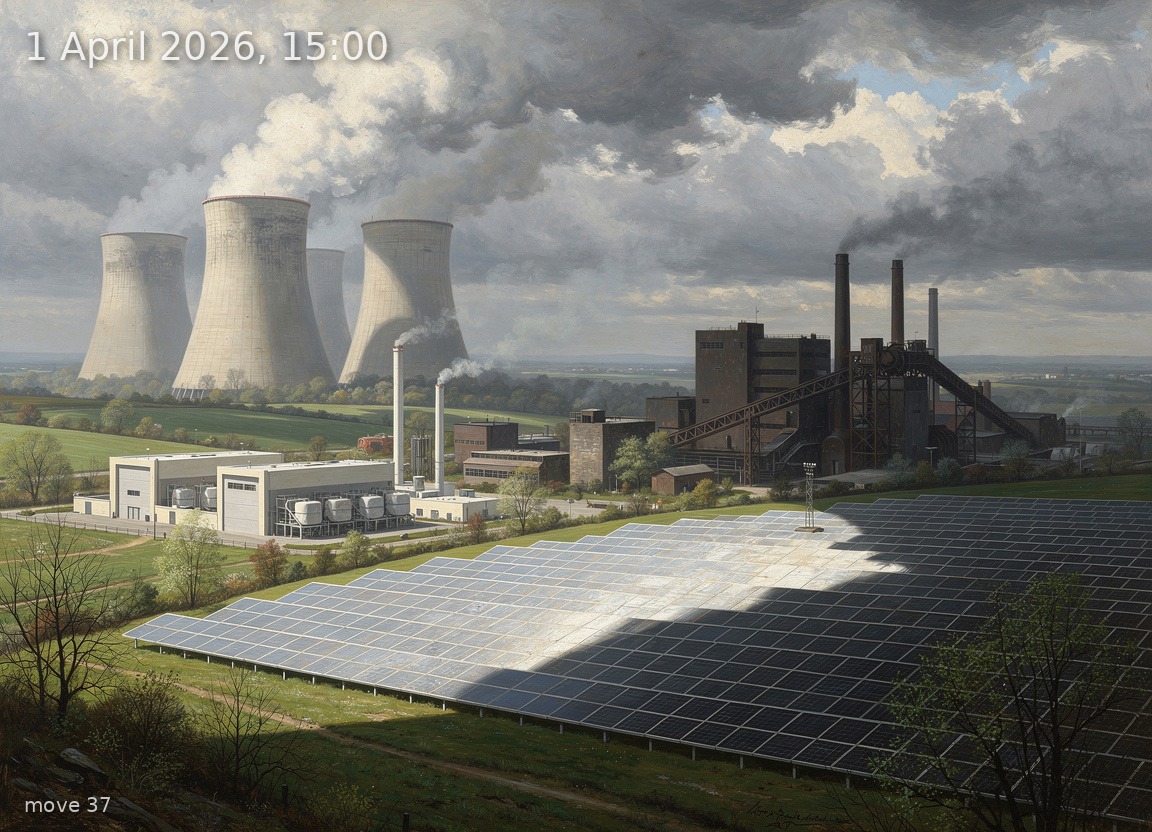
Solar at 34.3 GW leads generation under broken cloud, with 18 GW of fossil thermal filling the gap left by near-absent wind.
Back
Generation mix
Wind onshore 2%
Wind offshore 2%
Solar 57%
Biomass 7%
Hydro 2%
Natural gas 8%
Hard coal 9%
Brown coal 13%
70%
Renewable share
2.6 GW
Wind (on + offshore)
34.3 GW
Solar
60.2 GW
Total generation
-0.2 GW
Net import
93.8 €/MWh
Day-ahead price
10.3°C / 6 km/h
Temp / Wind speed
Open-Meteo, Kassel (51.3°N 9.5°E)
91.0% / 307.0 W/m²
Cloud cover / Radiation
213
gCO₂/kWh
Image prompt
Solar 34.3 GW dominates the scene as a vast expanse of crystalline silicon PV panels stretching across gently rolling central German farmland, covering more than half the canvas from centre to right, their aluminium frames catching diffuse silvery light filtering through broken overcast. Brown coal 8.0 GW occupies the left background as a cluster of massive hyperbolic cooling towers emitting thick white-grey steam plumes that merge into the heavy cloud layer. Hard coal 5.2 GW appears as a dark industrial complex with tall rectangular stacks and conveyor gantries just to the right of the lignite plant. Natural gas 4.8 GW is rendered as a pair of compact CCGT units with slender exhaust stacks and thin heat shimmer, positioned in the mid-left between coal and solar. Biomass 4.0 GW appears as a mid-sized wood-clad power station with a modest chimney and stacked timber nearby, set among trees at the left edge. Wind onshore 1.4 GW is a small group of three-blade turbines on a distant ridge, their rotors barely turning in the light 5.9 km/h breeze. Wind offshore 1.2 GW is suggested by a faint line of turbines on a hazy horizon far right. Hydro 1.3 GW appears as a small concrete dam with spillway in a forested valley in the far background. The sky is 91% overcast — a heavy grey-white ceiling of stratocumulus — but a large ragged break in the clouds allows a shaft of direct afternoon sunlight (15:00 full daylight, sun in the southwest) to pour through, brilliantly illuminating the solar field while leaving the coal plants in shadow. Temperature is a cool early spring 10°C: bare branches on some trees, fresh green buds on others, patchy new grass. The atmosphere feels heavy and oppressive, reflecting the 93.8 EUR/MWh price — the air dense, the cloud ceiling pressing down, steam and haze blurring the horizon. Style: highly detailed oil painting in the tradition of 19th-century German Romantic landscape painters — Caspar David Friedrich's atmospheric grandeur combined with Adolph Menzel's industrial precision. Rich layered colour, visible confident brushwork, deep atmospheric perspective. Each technology rendered with meticulous engineering accuracy: turbine nacelles, lattice towers, PV cell grid patterns, cooling tower parabolic profiles, CCGT heat-recovery units. No text, no labels, no people in foreground.