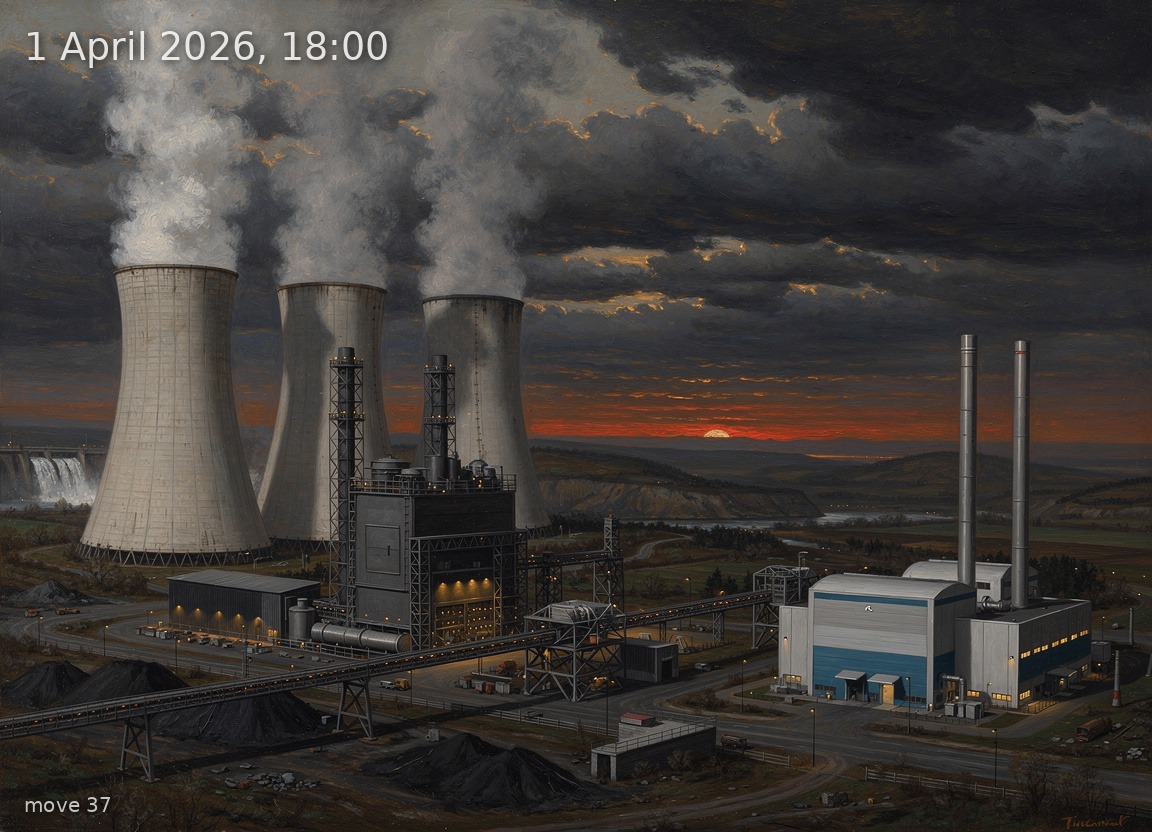
Coal dominates domestic generation at 15.3 GW as fading solar and negligible wind drive heavy net imports of ~27.9 GW.
Back
Generation mix
Wind onshore 4%
Wind offshore 3%
Solar 23%
Biomass 12%
Hydro 3%
Natural gas 10%
Hard coal 21%
Brown coal 24%
45%
Renewable share
2.5 GW
Wind (on + offshore)
7.7 GW
Solar
34.0 GW
Total generation
-27.9 GW
Net import
152.1 €/MWh
Day-ahead price
9.5°C / 4 km/h
Temp / Wind speed
Open-Meteo, Kassel (51.3°N 9.5°E)
50.0% / 176.2 W/m²
Cloud cover / Radiation
405
gCO₂/kWh
Image prompt
Brown coal 8.3 GW dominates the left third of the scene as a cluster of massive hyperbolic cooling towers with thick white-grey steam plumes rising into a heavy, oppressive sky; hard coal 7.0 GW occupies the left-centre as a sprawling power station with conveyor belts, tall chimneys, and dark smoke trails; natural gas 3.5 GW appears centre-right as two compact CCGT units with slender exhaust stacks emitting thin heat shimmer; solar 7.7 GW fills the right-centre foreground as extensive rows of aluminium-framed crystalline silicon PV panels catching the last orange-red light of dusk; biomass 4.0 GW is rendered as a wood-fired CHP plant with a modest chimney and stacked timber in the mid-ground; wind onshore 1.4 GW shows as a few three-blade turbines on low hills in the far right background with rotors barely turning; wind offshore 1.1 GW is suggested by distant turbines on a hazy horizon line at far right; hydro 1.0 GW appears as a small dam and spillway in a valley at far left background. Time of day is dusk at 18:00 in early April: the lower horizon glows deep orange-red with the last remnants of sunset, the sky above transitions rapidly to dark blue-grey, and the upper sky is already near-dark. Fifty percent cloud cover creates broken altocumulus layers half-lit in amber and half in deep slate. The atmosphere is heavy and oppressive, reflecting the extreme price conditions — a brooding, weighted sky pressing down on the industrial landscape. Temperature is a cool 9.5°C in early spring: bare deciduous trees with only the faintest buds, pale dormant grass, patches of last frost on shadowed ground. Wind is nearly still — no visible motion in vegetation or turbine blades. The landscape is a wide German lowland panorama stretching to distant hills. Transmission pylons with high-voltage lines recede into the murky distance, symbolizing the massive import flows. Style: highly detailed oil painting in the tradition of 19th-century German Romantic landscape painters — rich, sombre colour palette of amber, slate, umber, and charcoal, visible impasto brushwork, dramatic chiaroscuro, atmospheric depth with sfumato in the distance — yet every piece of energy infrastructure is rendered with meticulous engineering accuracy: turbine nacelles, lattice towers, cooling tower parabolic profiles, conveyor gantries, PV panel grid patterns. The painting evokes Caspar David Friedrich's sublime dread transposed onto a modern industrial evening. No text, no labels.