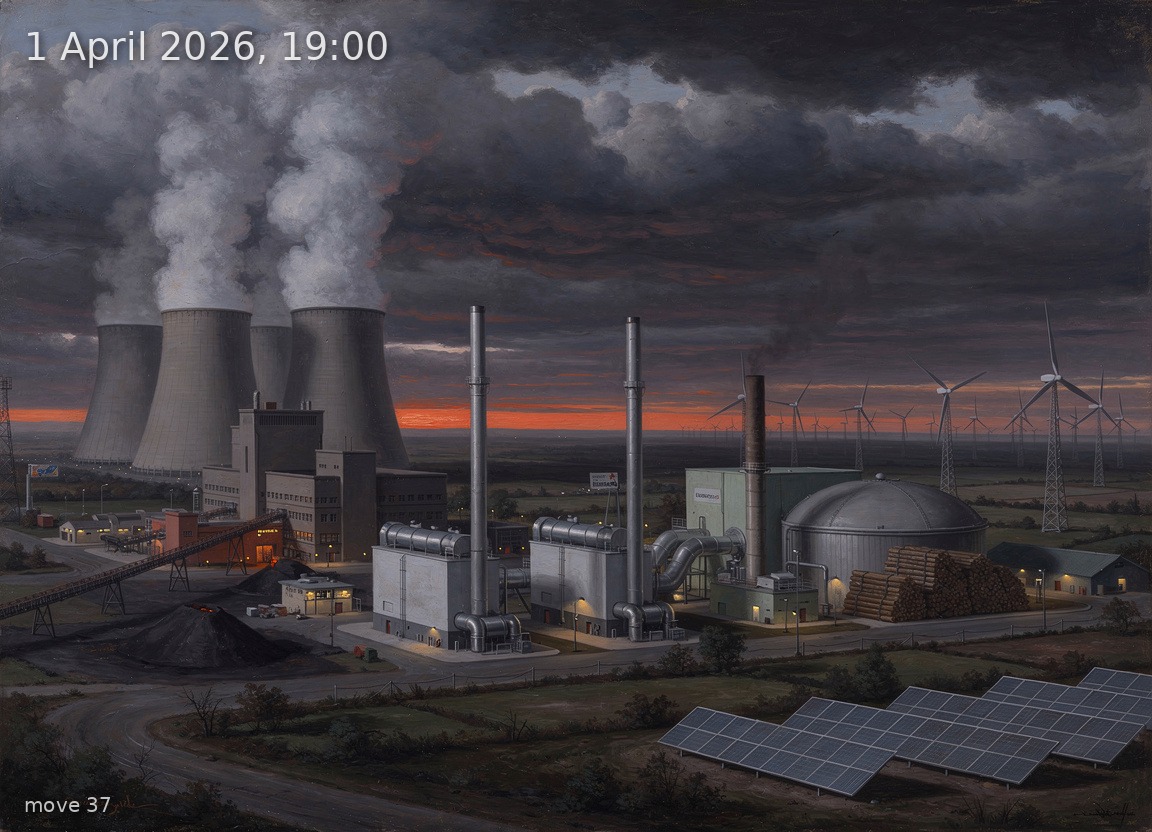
Brown coal, hard coal, and gas dominate domestic supply while massive net imports cover the 33 GW generation shortfall at dusk.
Back
Generation mix
Wind onshore 6%
Wind offshore 4%
Solar 4%
Biomass 14%
Hydro 4%
Natural gas 18%
Hard coal 19%
Brown coal 30%
32%
Renewable share
2.9 GW
Wind (on + offshore)
1.2 GW
Solar
28.7 GW
Total generation
-33.2 GW
Net import
188.7 €/MWh
Day-ahead price
8.9°C / 4 km/h
Temp / Wind speed
Open-Meteo, Kassel (51.3°N 9.5°E)
76.0% / 47.5 W/m²
Cloud cover / Radiation
481
gCO₂/kWh
Records
#3
Import Peak
Image prompt
Brown coal 8.6 GW dominates the left third of the scene as a cluster of massive hyperbolic cooling towers with thick white-grey steam plumes rising into the dusk sky; hard coal 5.6 GW occupies the centre-left as a coal-fired power station with tall square stacks and conveyor belts feeding dark fuel into glowing furnaces; natural gas 5.3 GW fills the centre as two compact CCGT units with slender single exhaust stacks emitting thin heat shimmer; biomass 4.0 GW appears centre-right as a wood-chip-fed industrial plant with a modest smokestack and stacked timber logs; wind onshore 1.8 GW and wind offshore 1.1 GW are visible in the right background as a sparse line of three-blade turbines on lattice towers, their rotors barely turning in the still air; solar 1.2 GW appears as a small field of aluminium-framed crystalline silicon panels in the right foreground, reflecting almost no light; hydro 1.1 GW is depicted as a modest dam with a thin water cascade at the far right edge. Time is 19:00 in early April: the sky shows a rapidly fading dusk with a narrow band of deep orange-red glow along the lower horizon, transitioning upward through purple-grey to near-darkness at the zenith. Clouds cover 76% of the sky in heavy, oppressive stratiform layers that press down on the landscape, amplifying the sense of expensive, strained supply. The air is cool at 9°C; bare-branched early-spring trees with the faintest buds dot the foreground, and damp grass glistens faintly. Sodium streetlights along a distant road cast amber pools of light. The atmosphere is heavy, brooding, thick — reflecting the extreme price. Rendered as a highly detailed oil painting in the tradition of 19th-century German Romantic landscape painters such as Caspar David Friedrich and Carl Blechen, with rich chiaroscuro, visible impasto brushwork, atmospheric depth and haze, meticulous engineering detail on every turbine nacelle, cooling tower, and exhaust stack. No text, no labels.