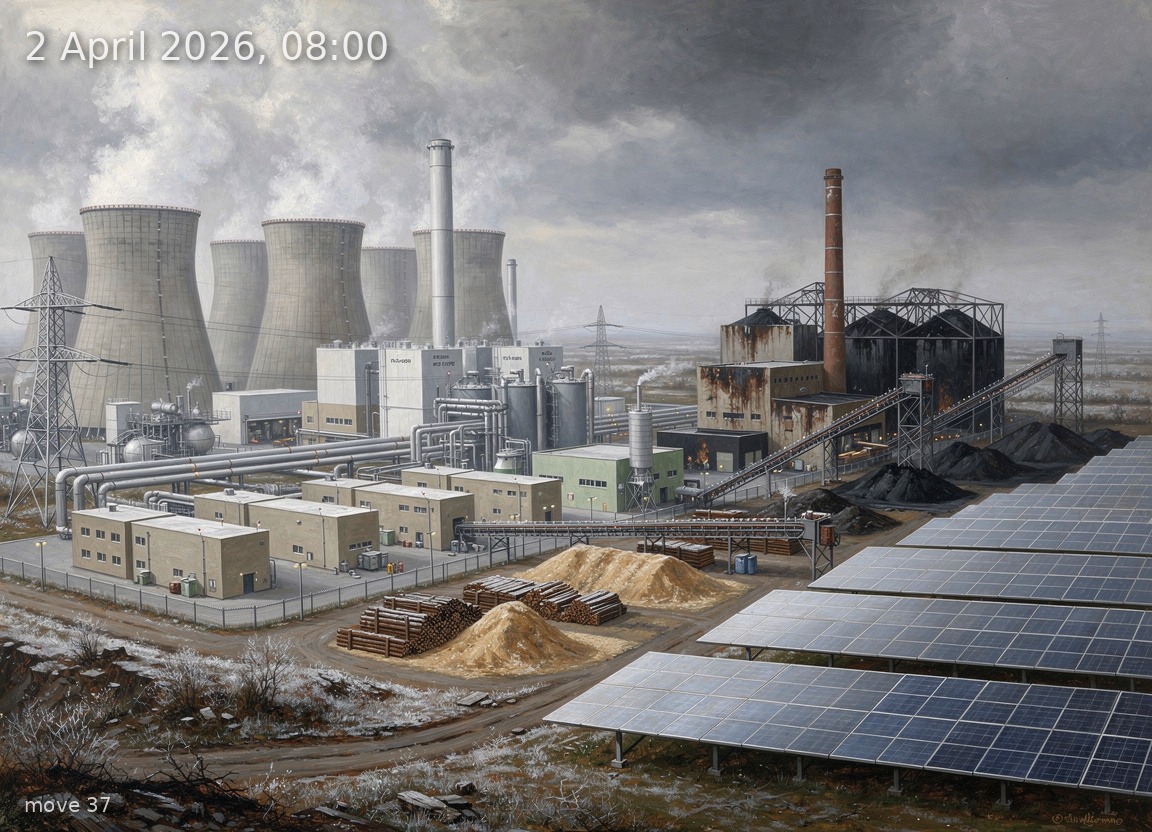
Cold snap drives 66.4 GW demand; brown coal, gas, and hard coal dominate as cloud cover limits solar and wind stays modest.
Back
Generation mix
Wind onshore 10%
Wind offshore 6%
Solar 23%
Biomass 8%
Hydro 2%
Natural gas 19%
Hard coal 12%
Brown coal 20%
49%
Renewable share
8.6 GW
Wind (on + offshore)
12.5 GW
Solar
53.7 GW
Total generation
-12.7 GW
Net import
157.7 €/MWh
Day-ahead price
-2.0°C / 5 km/h
Temp / Wind speed
Open-Meteo, Kassel (51.3°N 9.5°E)
77.0% / 5.8 W/m²
Cloud cover / Radiation
344
gCO₂/kWh
Records
#2
Ice Hour
Image prompt
Brown coal 10.6 GW dominates the left quarter of the scene as a cluster of massive hyperbolic cooling towers releasing thick white-grey steam plumes into the overcast sky; natural gas 10.3 GW fills the centre-left as a row of compact CCGT power blocks with tall single exhaust stacks venting shimmering heat haze; hard coal 6.3 GW appears centre-right as a dark industrial complex with conveyor belts, coal bunkers, and a tall chimney with a faint plume; solar 12.5 GW spans the right third as extensive fields of aluminium-framed crystalline silicon PV panels on frost-whitened ground, their surfaces reflecting only dull grey light under the heavy overcast; wind onshore 5.6 GW stands as a line of three-blade turbines on distant low hills behind the solar field, blades turning slowly in the light breeze; wind offshore 3.1 GW appears as a cluster of turbines barely visible on a grey North Sea horizon glimpsed through a gap between the coal plants; biomass 4.3 GW is rendered as a mid-sized wood-chip power station with a modest smokestack and timber storage yard nestled between the gas plant and the coal complex; hydro 1.0 GW is a small run-of-river weir with a turbine house at the far right edge beside a half-frozen stream. Time of day is 08:00 in early April: full daylight but deeply overcast at 77% cloud cover, flat diffuse illumination with no visible sun, sky a uniform heavy silver-grey pressing down oppressively to reflect the 157.7 EUR/MWh price. Temperature is −2 °C: frost coats every metal surface, grass is white with rime, bare deciduous trees with only the faintest suggestion of early buds stand along field margins, breath-like vapour rises from workers near a substation. The atmosphere is weighty, dense, and cold, with muted earth tones. Style: highly detailed oil painting in the tradition of 19th-century German Romantic landscape painters such as Caspar David Friedrich and Carl Blechen—rich layered colour, visible confident brushwork, atmospheric aerial perspective receding into misty industrial haze, meticulous engineering accuracy on every turbine nacelle, lattice tower, cooling tower paraboloid, PV panel frame, and exhaust stack. The composition conveys the monumental scale of industrial energy infrastructure under a brooding northern European sky. No text, no labels, no people in foreground.